
MUMBAI: Schools surveyed across 10 states – Maharashtra, Uttar Pradesh, Karnataka, Telangana, Assam, Bihar, Chhattisgarh, Punjab, Odisha and Mizoram – report acute teacher shortages in fundamental subjects such as mathematics and science (35%), English (31%), and in regional languages (30%). Moreover, it was found that only 51% of mathematics teachers studied the subject at under-graduate level, highlighting credential mismatches.
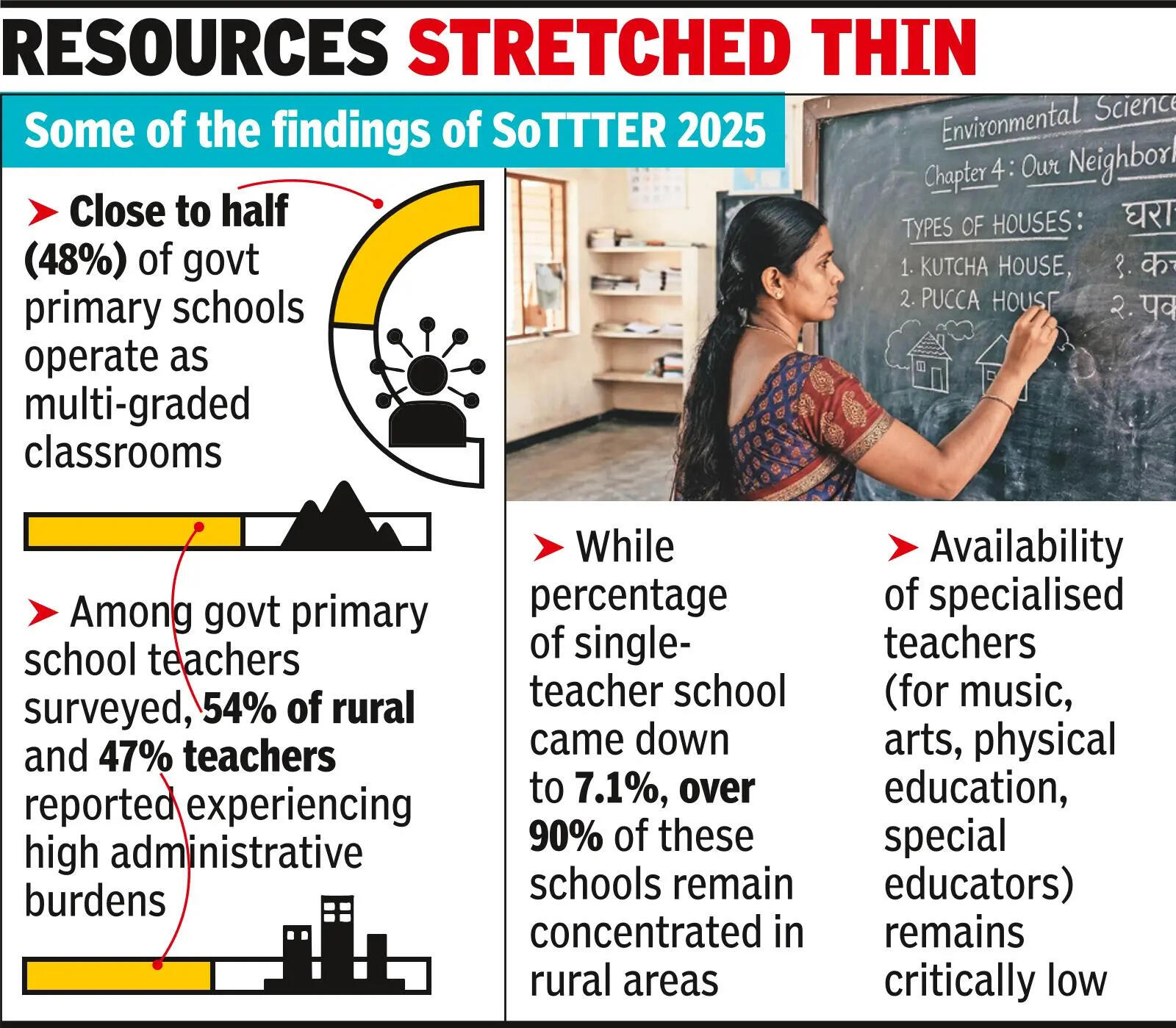
Resources stretched thin
Govt schools face recruitment delays and staff shortages (33% reported staffing challenges), but little retention difficulty. Private schools, on the other hand, recruit faster but face higher teacher attrition (as reported by 14%), especially in rural areas (18%).These are some of the findings from the executive summary of the biennial report on the ‘State of Teachers, Teaching and Teacher Education for India’ (SoTTTER) 2025 by TISS Centre of Excellence in Teacher Education (CETE) released on Teachers’ Day. The SoTTTER 2025 focuses on three landmark policies that reached key implementation milestones in 2025 – 15 years of the Right To Education Act (2009), 10 years of the Rights of People with Disabilities Act (2016), and five years of the National Education Policy (2020).Comparing the data from the SoTTTER 2023, the report highlighted a critical aspect of the student enrollment falling sharply by 1.55 crore in five years – from 26.5 crores in 2021-22 to 23.2 crores in 2024-25. At the same time, the teaching workforce grew by six lakh, thereby improving the average student-teacher ratio. The report also highlighted ‘an accelerated privatisation and feminisation of the teaching force’. Women now make up 54% of the teaching workforce, up from 51% in the previous report. However, a clear urban-rural gap remains – women comprise 67% of urban teachers, while rural schools remain male-dominated, with women accounting for only 47%.The summary of SoTTTER 2025 also underscores a worrying rise in multi-grade classrooms in govt schools, where a single teacher instructs students from multiple grades. In 2025, nearly half of govt primary schools operated as multi-grade classrooms, up from 38% recorded in 2023.The report, which reviewed the structural and pedagogical shifts in the Indian teaching workforce, will be officially released in Oct this year, in collaboration with the Language and Learning Foundation.Prof Padma M Sarangapani, former chairperson of CETE, currently Dean of IMSE, Mahindra University, and principal investigator of the study, noted that while many aspiring teachers are genuinely motivated to enter the profession, the lack of job security and employment opportunities acts as a disincentive. Nearly half of the teachers surveyed also felt that the profession is misunderstood and that their work is not sufficiently valued or appreciated. “Another major concern is the delayed recruitment process, which can sometimes take seven to eight years. With no guarantee of securing a job, this uncertainty can significantly demotivate young aspirants,” she said. The report also gives recommendations for resolving the persistent teacher shortages.Apart from the national datasets from the U-DISE+ 2024-25 and Periodic Labour Force Survey 2024-25, the report used primary data from the field survey covering 499 schools in the 10 states. Some of the positive developments include improved working conditions for teachers, reduction in single-teacher schools, and increase in the numbers of teachers with greater local connect.