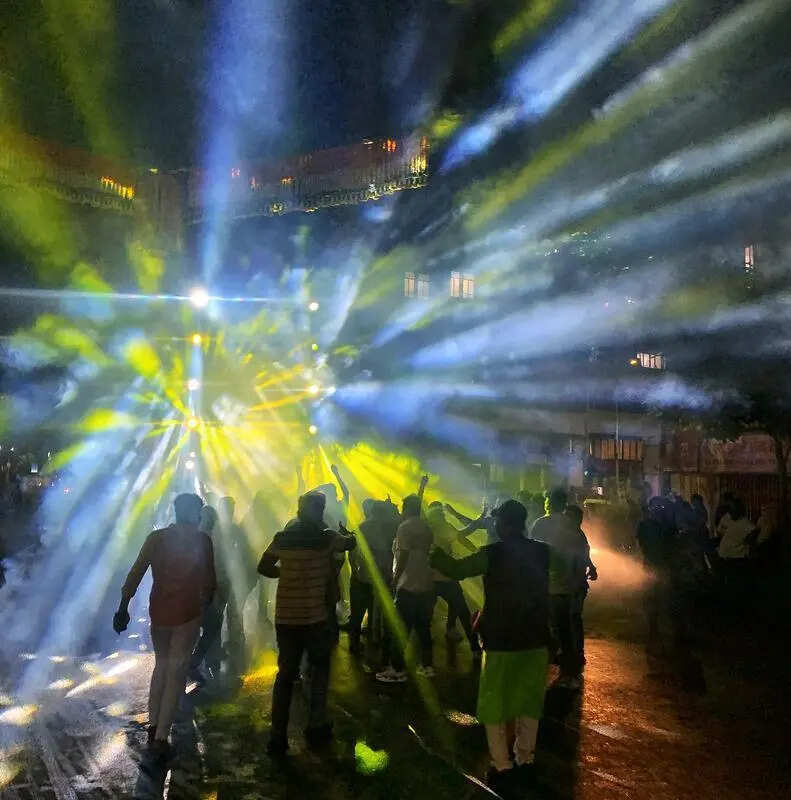
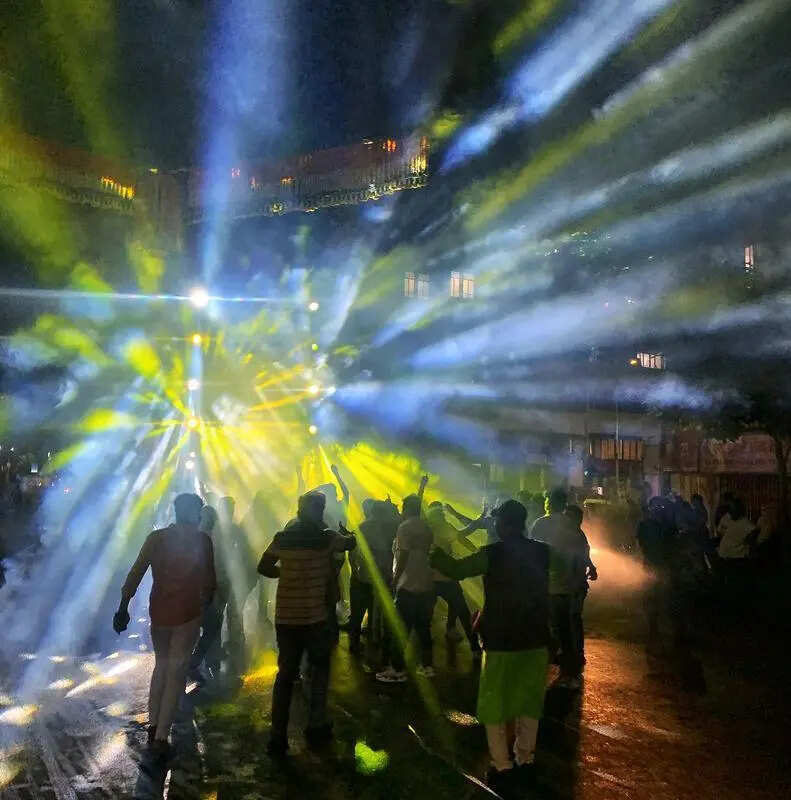
Pune: A wave of protests in recent weeks against the use of blaring speaker sound systems and DJs during festive celebrations may slowly be manifesting some change, much to the relief of many city residents.With politicians changing their tune about loudspeaker-led revelry in the face of fierce citizen opposition, police have this year announced stricter curbs on speaker use, decibel levels and timings ahead of Ganeshotsav, which is celebrated with much enthusiasm in the city. But Puneites also pointed out that this is not an isolated issue. Residents of areas like Boat Club Road, Koregaon Park, Bopodi, Aundh, Peths, Salisbury Park and others have for long been complaining against the health and safety impact of auditory and visual pollution caused by speaker stacks and laser lights. Many said that while things get worse during festivals, the problem lasts all year round. In fact, Pune city police have dealt with over 15,000 complaints related to noise pollution since Jan this year alone, as per official data revealed to TOI. Roda Mehta, a long-time resident of Boat Club Road and coordinator for area residents, said that deafening noise comes from all directions. “We get blaring music in the day and often well into the night beyond 10pm, not just from nearby pandals but also across the river near Yerawada, around 1km away as the crow flies. Although the locations are far, the sound feels like it is thumping next to us. On procession nights, it is impossible to bear. Decibel levels are rising each year. Even with windows shut on my first-floor house, we touched 120dB on a sound testing device last year. It is not just a festival-related issue but unfortunately occurs on random nights, too,” she said. “Firecrackers add to the chaos. Every midnight for the last few months, firecrackers are burst somewhere in Sangamwadi for at least five minutes, well within our earshot. We even started a pan-city signature campaign against noise pollution addressed to the police commissioner and other departments concerned,” Mehta added. Elsewhere, hundreds gathered on Aug 30 at Goodluck Chowk on FC Road to protest the use of speaker systems and DJs during festivals like Dahi Handi and Ganeshotsav. Citizens of all ages and from all walks of life wielded posters on health hazards and said they have also sent mass emails to local police stations. Deccan resident and fitness trainer Sharad Kelkar said commuting during festivals is too stressful, not just because of traffic or crowding, but more due to the deafening assault on one’s senses. “Over the years, people have lost eyesight because of laser lights, or high decibel levels have permanently affected hearing. There have even been deaths. Yet, some insist on such celebrations during festivals. The impact is dreadful, no matter how healthy one might be. Authorities should put an end to it,” Kelkar said. Not far from Deccan, residents of Peth areas said they have the short end of the stick. In the narrow bylanes of old city areas, mandals have not only take over carriageways, but their speaker systems make buildings shudder. Anti-noise crusader and Narayan Peth resident Vidyanand Bapat (37), who has been in the news for his fearless campaign, said that decibel limits during festivals have become a big pain point for core-city denizens in the last half decade. “Celebrations have been enjoyed for over a century without ear-splitting speakers. In Peth areas, noise gets unbearable because of how close everything already is. When pandals come up on narrow roads, traffic is also affected. During the pandemic, there were no loud celebrations and it worked just fine,” pointed out Bapat, an IT professional. For two months, he sent repeated communications to authorities, including corporators, the PMC chief, CM, police commissioner and others, reiterating the need to ban use of DJs and loud music systems during festivals. “The frustration has been building up. Every year, authorities and mandals make promises, but come festival time everything goes for a toss. Rules are in place, but on-ground implementation is absent. Temporary solutions have always been the administration’s approach. But what the city needs is to address the issue at its root. The use of loud music systems or laser beams is just a show of money and power. It should be banned,” added Bapat, who hails from Ratnagiri and has been living in Pune for the last eight years. Other neighbourhoods with buildings in close proximity, like Model Colony, face woes similar to Peth areas. Model Colony Parisar Sudharna Samiti president Vikramsinh Mohite said that barring the Gajanana Ganeshutsav Mandal in their area, all others seem to be in competition over who can be the loudest. “Last year, we had a meeting at a high-rise building in a flat on the seventh floor during Ganeshotsav, and the music was so loud that we could barely hear each other even with closed windows. The building was not even close to any pandals. I had to get new windows installed at a cost of Rs5.5 lakh to keep some of the sound out,” Mohite said. “The larger problem is that this is not just a festive trend anymore. There is always some occasion to be feted. No event organisers, nor the corporators who support them, realise how it affects residents,” he added. In some other areas, the problem is concentrated on particular days of some festivals. Meenal Patel, a mohalla committee member for the BT Kawade Road area, said that last year, the first nine days of Ganeshotsav were not noise-filled for them. “However, on the last day of immersions (visarjan), mandals were overcompensating. Our buildings and windows were vibrating and stepping out for a small errand or a walk was unimaginable,” she said, adding, “On a positive note, awareness has been rising and the last four years have been slightly better than before. But on certain days, there is no control — and the police also become unresponsive at such junctures.” The mohalla committee here has also collected signatures and submitted a letter to the Mundhwa police. They are raising awareness and encouraging residents to participate mindfully in celebrations. What are police doing? Every year during festival time, residents repeatedly complain on the 112 helpline to register their annoyance against loud noise. However, police and residents said that the noise stops when personnel reach the location, then increases soon after they leave. “Yerawada police station, for example, is sympathetic to celebrations with loud noise. They sometimes try to reason with residents that it’s festival time and the noise will go away in a couple of days. If the police themselves don’t act as per the law, what can one expect from the common person? Is it fair to expect citizens battling illnesses, or studying or working to be hassled this way? One person’s entertainment cannot and should not interfere with others’ peace of mind,” Mehta said. “We understand that the police are understaffed and often doing their best. But a stricter mandate needs to filter down from higher authorities and political heads, who only seem to be encouraging noisy revelry,” she alleged. On the flipside, residents said the Bharati Vidyapeeth police help raise awareness on the effects of noise pollution. Area resident Vickrant Siingh said, “For the last four years or so, the situation in this neighbourhood has deteriorated hugely when it comes to noise pollution. Pandals have increased on a 200m stretch and residents, especially senior citizens, are harassed by loud music. We have submitted letters to the police and now plan to hold a protest rally, to be joined by students, senior citizens and retired army personnel. We are also trying to set up a meeting of all stakeholders to come to a common consensus. The police are supporting us,” said the business owner. Police POV We have received close to 15,000 noise pollution complaints since Jan this year. Each time, police go to the spot to check decibel levels. The music system is immediately seized, and an official complaint is registered if violation of rules is found. In some places, the volume is reduced once police near the place, but we are usually able to detect what is really happening, especially if repeated complaints pour in about the same location. We have also completely banned the use of plasma and pressure mid sound systems, besides the existing ban on laser use — Amitesh Kumar | Commissioner of police, Pune Medical Expert During festival season, we definitely see a additional number of patients that are exhibiting symptoms of decreased hearing. In some cases it is temporary, which is good, but in some it is not reversible and can cause permanent damage. What citizens need to understand is that short bursts of high-intensity sounds are as damaging as constant exposure to loud sounds over time. So, even for commuters just passing by speakers and not necessarily living in the same area, the high decibel sounds can be very detrimental — Dr Seemab Shaikh | Head of ENT department at Inamdar Multispeciality Hospital What Political Representatives Say Police have taken the forefront to find a midpoint on how many speakers can be used for festive celebrations. Four base and four top seems to be this midpoint, and everyone should accept it. It will create sound that is somewhat acceptable to all. We need to celebrate in a big way and consider increasing participation, while taking care of the enthusiasm of mandals who want to use speakers. The festival has come a long way, and this is a part of its changing nature. The administration will take a call based on what is good for everyone. Once it has been decided, no one should do anything that goes against it or break the law — Ganesh Bidkar | Leader of house, PMC We are completely against the use of blaring music systems and DJs that result in noise pollution during festivals. Ganeshotsav is a wonderful festival that Pune has gifted to the country and DJs or speaker systems were never a part of it. However, under the guise of celebration and with political patronage, the deafening blare of DJ systems has now become the norm. This is bringing disrepute to the occasion. A festival is meant to bring joy to all; yet, by subjecting the elderly, babies, intellectually challenged children, and voiceless animals to distressing noise, are we perhaps tarnishing our own culture? — Prashant Jagtap | City president, Congress Pune (East) Plea for state-wide regulations at NGT We were able to obtain a National Green Tribunal (NGT) order in 2024, wherein the green court for the first time regulated use of speakers during Ganapati celebrations. In Nov 2025, we filed a case in NGT to get even stricter regulations applied to any public use of speakers in the whole of Maharashtra across all events. In its first hearing, the NGT judge asked us to suggest a policy that will help apply the strict regulations across the state, which we have drafted and submitted. In June this year, NGT sought replies from state authorities. At the last hearing, state authorities have requested some time to respond to the policy we submitted. The next hearing is scheduled for Sept 10 — Maitreya Ghorpade | Environment lawyer