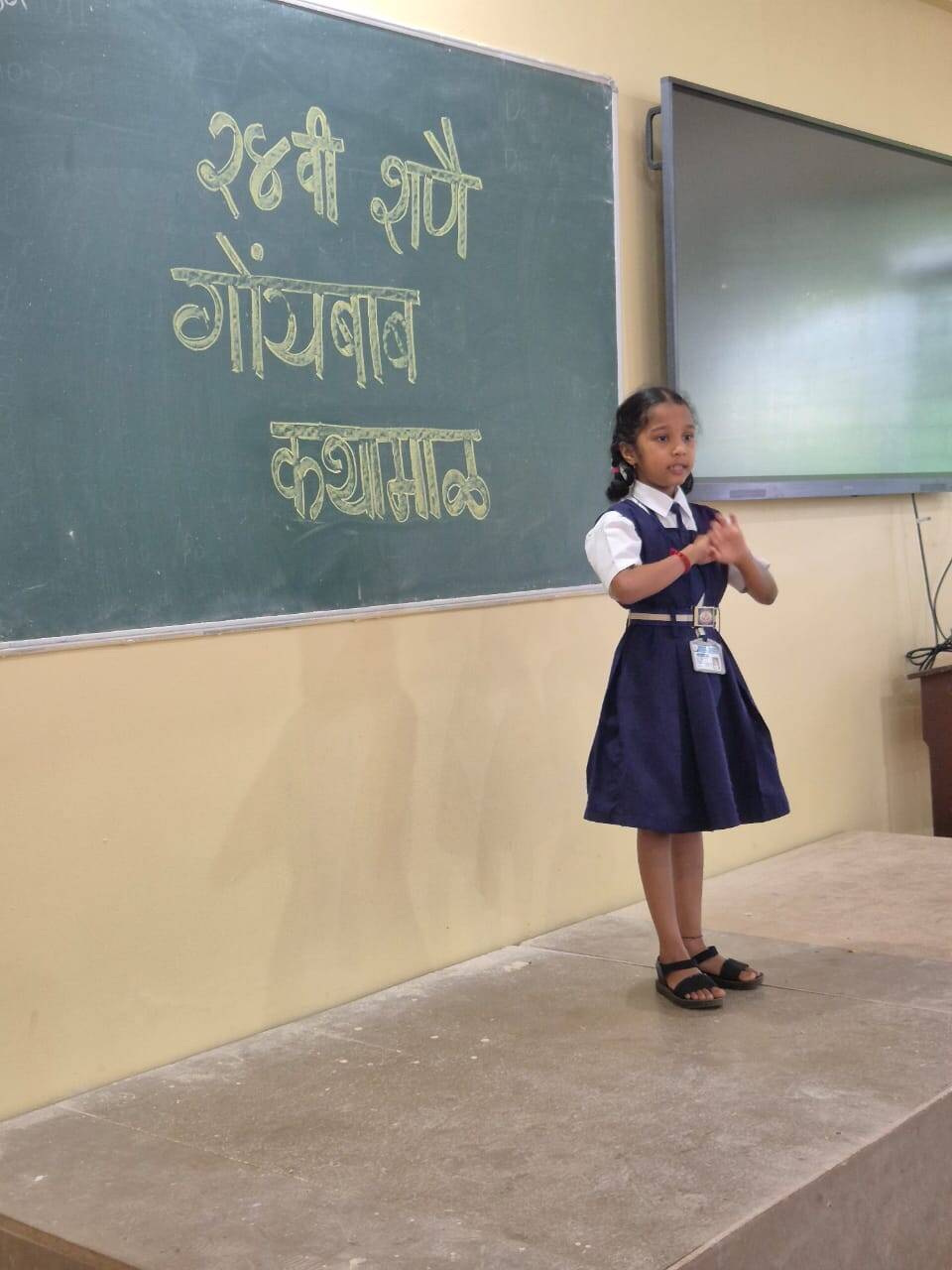
Margao: Twenty-five years ago, a group of Konkani language activists sat down to solve a problem that had quietly troubled them for years — an entire generation educated in English, Marathi and Portuguese, yet unable to find its voice in its own mother tongue. What emerged from those brainstorming sessions was a storytelling competition for schoolchildren. Today, the Shennoi Goembab Katha Mala has turned out to be the most eagerly awaited highlights of the academic calendar, one that education circles are increasingly citing as a model for mother-tongue learning.Organised by the Konkani Bhasha Mandal and named after Vaman Raghunath Varde Valaulikar — revered as Shennoi Goembab, father of the modern Konkani movement — the competition began in 2001-02 to mark his 125th birth anniversary. It has been held without a break every year since, growing from a handful of taluka-level events into a state-wide exercise spanning 20 centres, roughly 180 judges and over a hundred volunteers and organisers, all coordinated to run simultaneously on a single day.Jnanpith awardee Damodar Mauzo, who was Mandal president when the idea took shape, recalls it as a collective decision born out of necessity. “Our only objective then was to propagate Konkani to the grassroots,” he says, recalling how students who froze mid-sentence in English or Marathi storytelling contests never suffered the same fate in Konkani — because in their own tongue, a forgotten word could always be swapped for another without breaking the flow of thought.That, Mauzo believes, is the silent driver behind the competition’s success. To choose a single story to narrate, a child typically reads through ten or twelve tales before shortlisting four or five — often with parents pitching in. “Their sensitivities, which were until then lying dormant, get activated,” he says, comparing the effect to his own childhood encounter with the works of Marathi writer Sane Guruji, which he says reshaped his worldview toward empathy and compassion. At a time when he feels literature has ceded ground to sociology and politics in shaping young minds, storytelling remains, in his words, the surest way to stir human sentiment and produce leaders brimming with compassion.The competition’s format has evolved considerably since its makeshift early years. What once took the Mandal five to six months to conduct taluka by taluka now unfolds across 20 centres in a single day, with district and state finals following within the week. Even the pandemic could not break its run — the Mandal shifted the 2020-21 edition online rather than skip a year.Anant Agni, who has watched the competition from every vantage point – organiser, judge, school headmaster and parent – sees it as “a meaningful initiative that complements the objectives of the National Education Policy by promoting skill development through several dialects of Konkani, the mother tongue, which gives the participants the confidence to express themselves naturally.” That confidence, Mandal members say, has travelled with them in the professions and careers they find themselves in. Agni says several alumni of the Katha Mala have gone on to become entrepreneurs, orators and professionals across fields, many crediting their early years narrating stories in Konkani for the ease with which they now command a room — in any language. Ivon D’Souza from Velim, now a medical student, traces his own screen career back to those early years on the Katha Mala stage. He went on to play a role in director Laxman Shetgaokar’s film “Baga Beach”, followed by a couple of other film projects. “I owe the honing of my skills to KBM’s storytelling competition,” he says.What began as a modest effort to get children speaking Konkani has, a quarter-century on, become a template for how, in Mauzo’s words, “a language movement can double as a leadership incubator.”