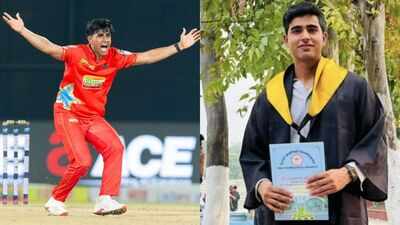
NEW DELHI: Anshuman Hooda bursts into laughter when asked to choose between his office laptop and his cricket ball. “My cricket ball is my best friend,” he tells TimesofIndia.com.His elder brother, Vikram Hooda, says their mother, Prem Lata Singh, a primary class teacher at a Municipal Corporation of Delhi (MCD) school, is happy to see Anshuman pursue cricket, especially now that he has a stable job. “Earlier, they used to say that he needed a job. Now that he has one and is doing well, she is happy,” Vikram says of their parents.Anshuman had a breakout 2026 Delhi Premier League (DPL) season — emerging as the Purple Cap winner with 22 scalps — which played a crucial role in South Delhi Superstarz’s title triumph.But there was a time when Hooda thought cricket had run its course. Two attempts at the Under-23 trials had gone by without success. There was no age-group cricket on his résumé, no traditional pathway through Delhi’s junior system and no obvious route into first-class cricket. He had an engineering degree from Delhi Technological University (DTU) and a job at EY. The sensible thing, he thought, was to move on.“I tried for Under-23 for two years, but I couldn’t make it. I thought it would be very difficult because I hadn’t played any professional cricket or age-group cricket. It would have been very difficult to directly get selected for the Ranji Trophy or first-class cricket,” Anshuman recollects.
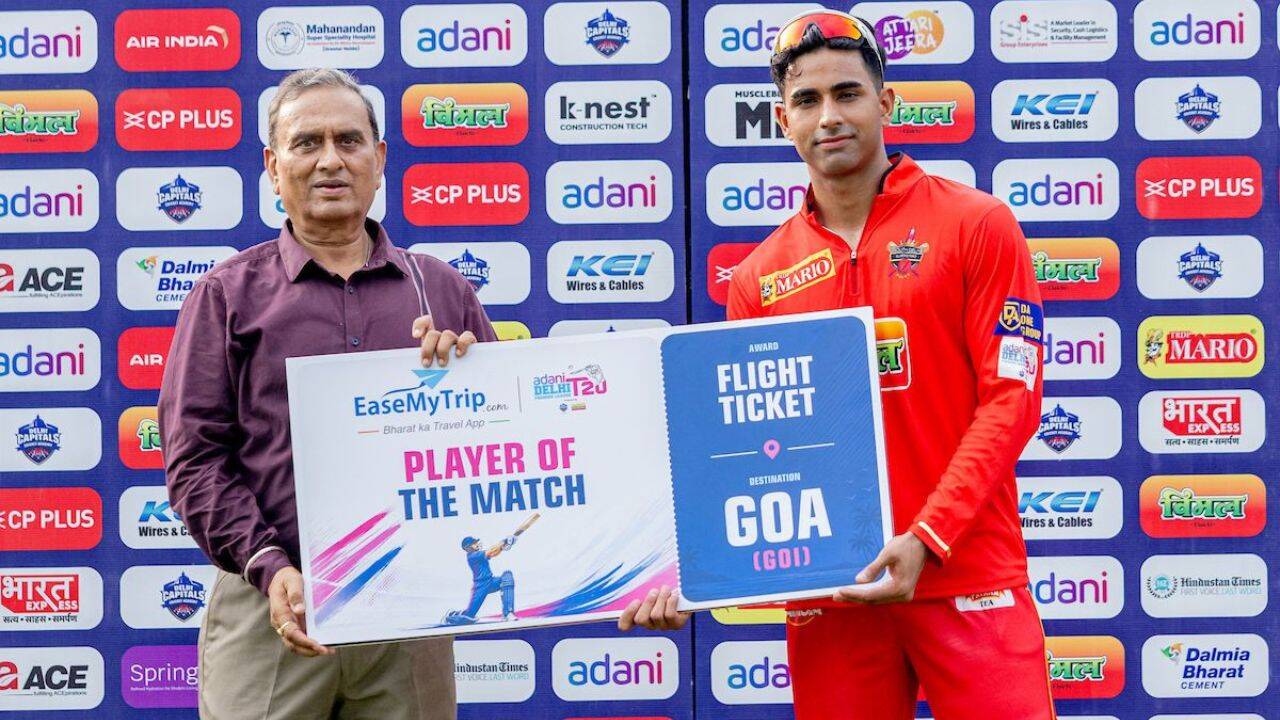
Anshuman Hooda receives the player of the match award from DDCA secretary Ashok Sharma. (Special Arrangement)
“So at that time, I thought I should quit cricket and pursue my career in engineering or something.”But just when he thought of walking away from the game, his coach Harish Dagar, who runs a cricket academy named Delhi Cricket Hub in Delhi’s Paschim Vihar, and trains youngsters at DTU, stepped up.“It was in 2023. He had just graduated. He had got the job through campus placement and was ready to move on with his life. I pleaded with him to give it one more year. I asked him to come to my academy four days a week for a year, and if nothing would pan out, I would let him pursue his corporate job,” reminisces Dagar.
I have seen some substantial progress in my cricket in recent months and in this tournament. So in the coming times, I might shift my whole focus to cricket and give it my all.
Anshuman Hooda
Then came the Delhi Premier League (DPL). And with it came a completely different possibility. For a young man who had arrived late to leather-ball cricket, DPL became the stage on which his raw pace, athleticism and appetite for fast bowling could finally be seen. The numbers followed. The attention followed, and now Anshuman is finally ready to become a full-time cricketer.“I have seen some substantial progress in my cricket in recent months and in this tournament. So in the coming times, I might shift my whole focus to cricket and give it my all,” he says.
The boy who skated before he bowled
Anshuman is 25 and, in cricketing terminology, he can be called a late bloomer. But the most unusual thing about Anshuman’s story is perhaps where it began. Not with a cricket academy. Not with a junior tournament. Not with a childhood obsession with bowling. With roller skates.
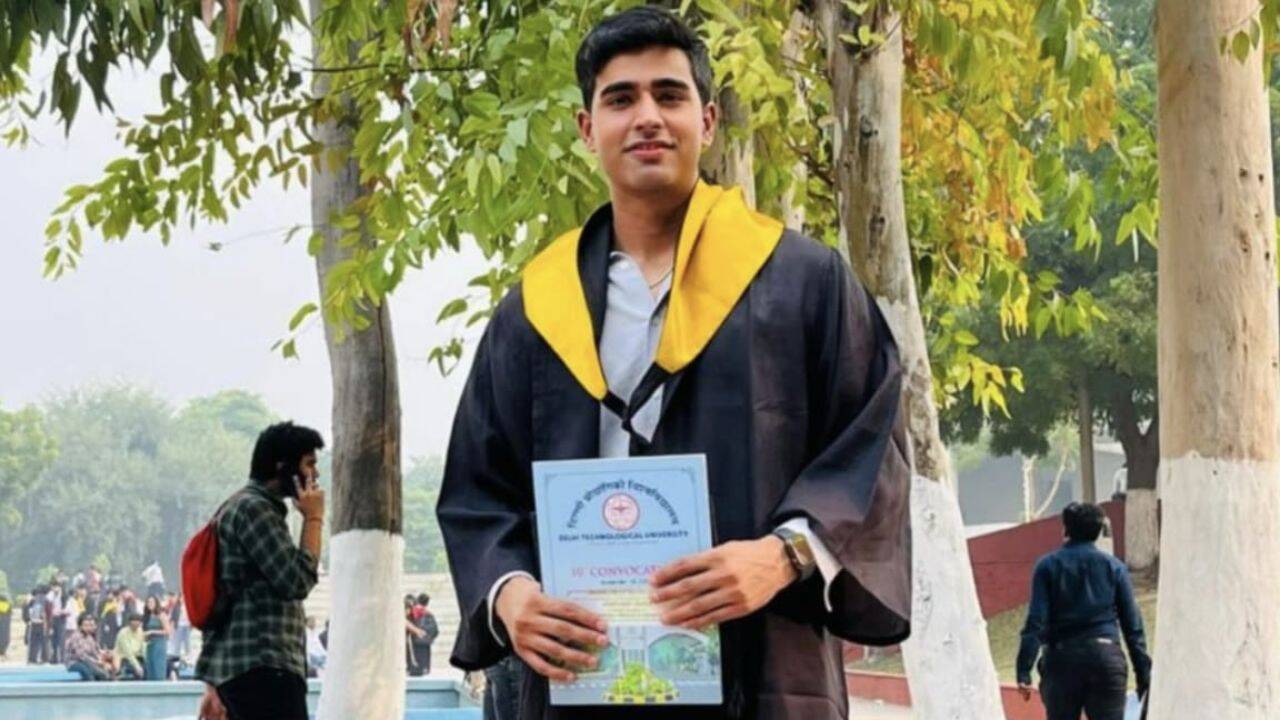
Anshuman Hooda has graduated from DTU with a degree in Production and Industrial Engineering in 2023. (Special Arrangement)
Growing up, Anshuman was a national-level roller skater. Cricket existed around him, but it was not initially the sport that defined him. His elder brother Vikram had played cricket, and there was, as Anshuman puts it, a familiar sibling dynamic. His brother took science. He took science. His brother studied engineering. He studied engineering. But when it came to cricket, Anshuman’s journey took its own route.It was only when he reached college that the game began to take hold.“I just started playing in college, and that’s when I got into leather-ball cricket professionally, playing for the college team and all. That’s when I fell in love with bowling fast, getting wickets and the aggression that comes with it. I just loved bowling fast.”
I worked on his mind 80-85 per cent. I made him mentally strong. I told him never to think that he was tired or burdened. Once I worked on his mindset and the roadmap was clear in front of him, he knew what he had to do.
Harish Dagar | Anshuman Hooda’s coach
When cricket had to fit around a career
That love became the starting point of something neither his résumé nor his previous sporting journey could have predicted.Harish Dagar first noticed Anshuman in 2019 while they were at university. What caught his eye was not a polished fast bowler. It was the physical package.Fitness. Arm speed. Natural movement.Anshuman was playing tennis-ball cricket when Dagar asked him to try medium pace. The first attempts were raw and erratic, but there was enough pace and athletic ability for the coach to believe there was something worth developing.
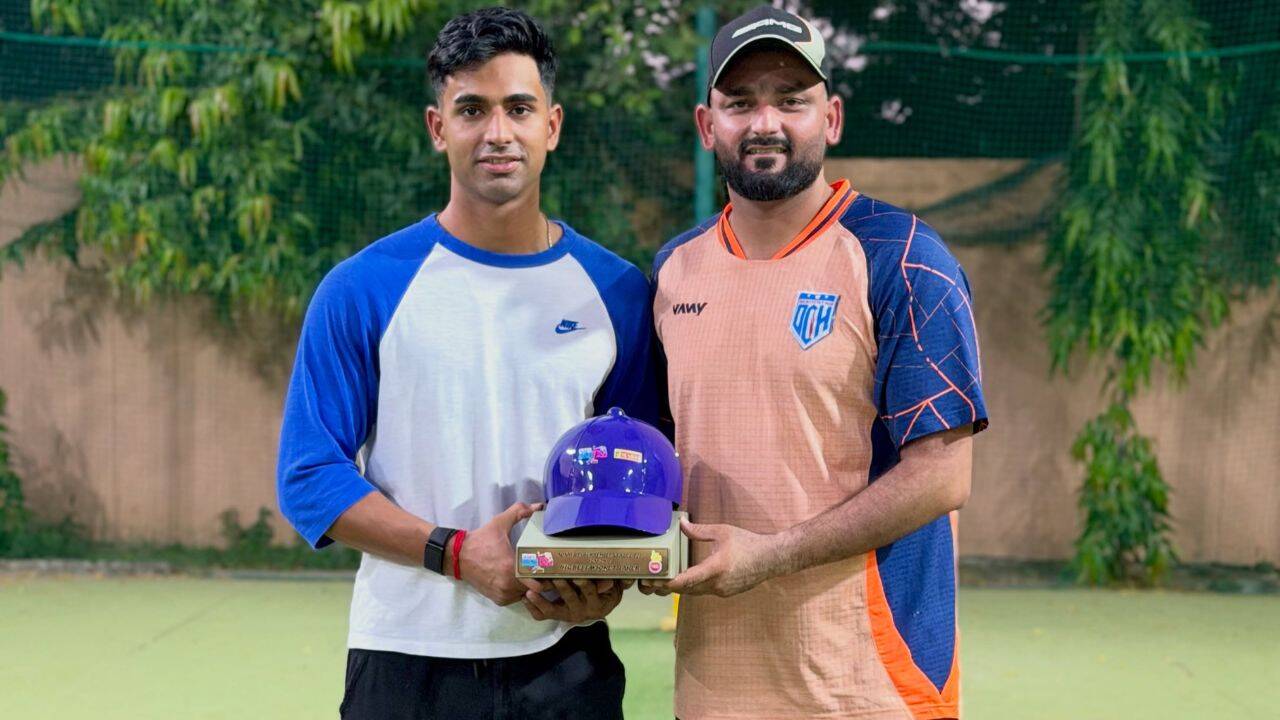
Anshuman Hooda with his coach Harish Dagar (Special Arrangement)
“His body alignment was natural. His strength was natural, and his pace was natural. But he didn’t have enough strength in his body initially. That’s why I told him that if you don’t maintain your fitness along with your natural pace, you will face problems,” says Dagar.“He was also busy with his job. He couldn’t always take proper sessions. He would come at night, then have to go to the gym and take practice sessions. It was very hectic.“I worked on his mind 80-85 per cent. I made him mentally strong. I told him never to think that he was tired or burdened.“Once I worked on his mindset and the roadmap was clear in front of him, he knew what he had to do. At one point he had to focus on fitness, at another he had to do his job, and then he had to come to me for his sessions.”
Fast bowling is not a very comfortable activity for the body. You accelerate, then your whole body has to absorb the impact before you bowl. It definitely takes a toll on the body.
Anshuman Hooda
Anshuman graduated from DTU with a degree in Production and Industrial Engineering and joined a multinational company in 2023. He worked from home, which helped him juggle the demands of employment and an increasingly serious cricket career. But balancing the two was never going to be easy.Fast bowling is an unforgiving craft. It demands strength, recovery, repetition and hours of training. Dagar’s approach was to build Anshuman patiently, focusing not merely on speed but on the physical and mental foundations that could allow him to bowl fast consistently.Anshuman also had to understand his own body. He had dealt with niggles and the physical toll that comes with repeatedly accelerating, landing and transferring his entire body weight through a bowling action.“Fast bowling is not a very comfortable activity for the body. You accelerate, then your whole body has to absorb the impact before you bowl. It definitely takes a toll on the body,” he says.
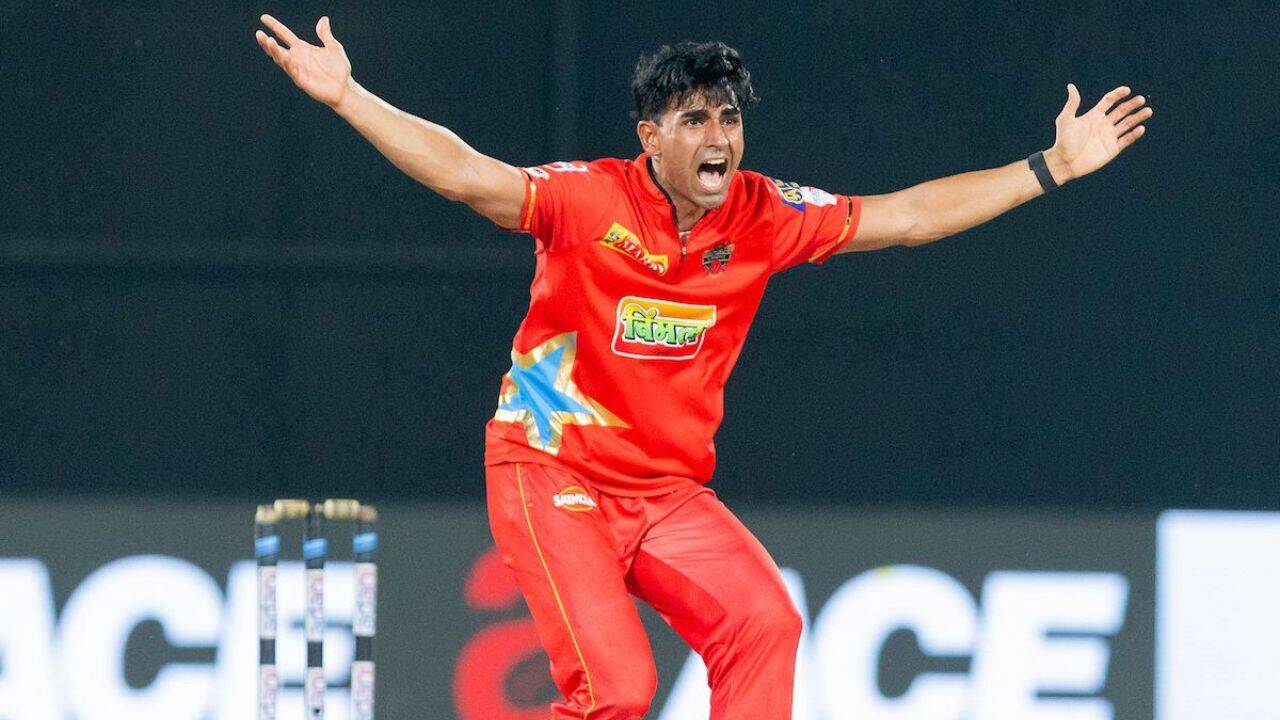
Anshuman Hooda appeals for a wicket during the Delhi Premier League. (Special Arrangement)
But there was no great mystery behind his motivation. He adds: “It was just the love for the sport and the love for bowling fast that kept me motivated and helped me come back stronger every time.”That attitude has been central to his development.
The making of a fast bowler
Dagar describes the next stage of the process in more professional terms: periodisation, rest, strength work, workload scheduling, diet, physiotherapy and technical skills. Anshuman had to develop a stock ball and variations such as the leg-cutter and off-cutter while ensuring that his body could cope with the demands of pace.
Shikhar Dhawan himself, the team owner, surprised me. He came and we had a little conversation. He gave me some very good tips and a direction to work towards from here.
Anshuman Hooda
The objective was never simply to produce a fast delivery. It was to produce a fast bowler. The first real crack in the wall came through the DPL.In 2024, he got his opportunity with South Delhi, initially finding chances hard to come by. Then came a spell that changed perceptions. The next season brought more opportunities, including a five-wicket haul, and soon IPL franchises were looking at him as a net bowler and trial candidate.The journey from someone contemplating quitting cricket to someone attracting franchise attention had happened remarkably quickly. For Anshuman, the attention became tangible when Shikhar Dhawan, the owner of his DPL team, spoke to him after his performances.“Shikhar Dhawan himself, the team owner, surprised me. He came and we had a little conversation. He gave me some very good tips and a direction to work towards from here,” he says.
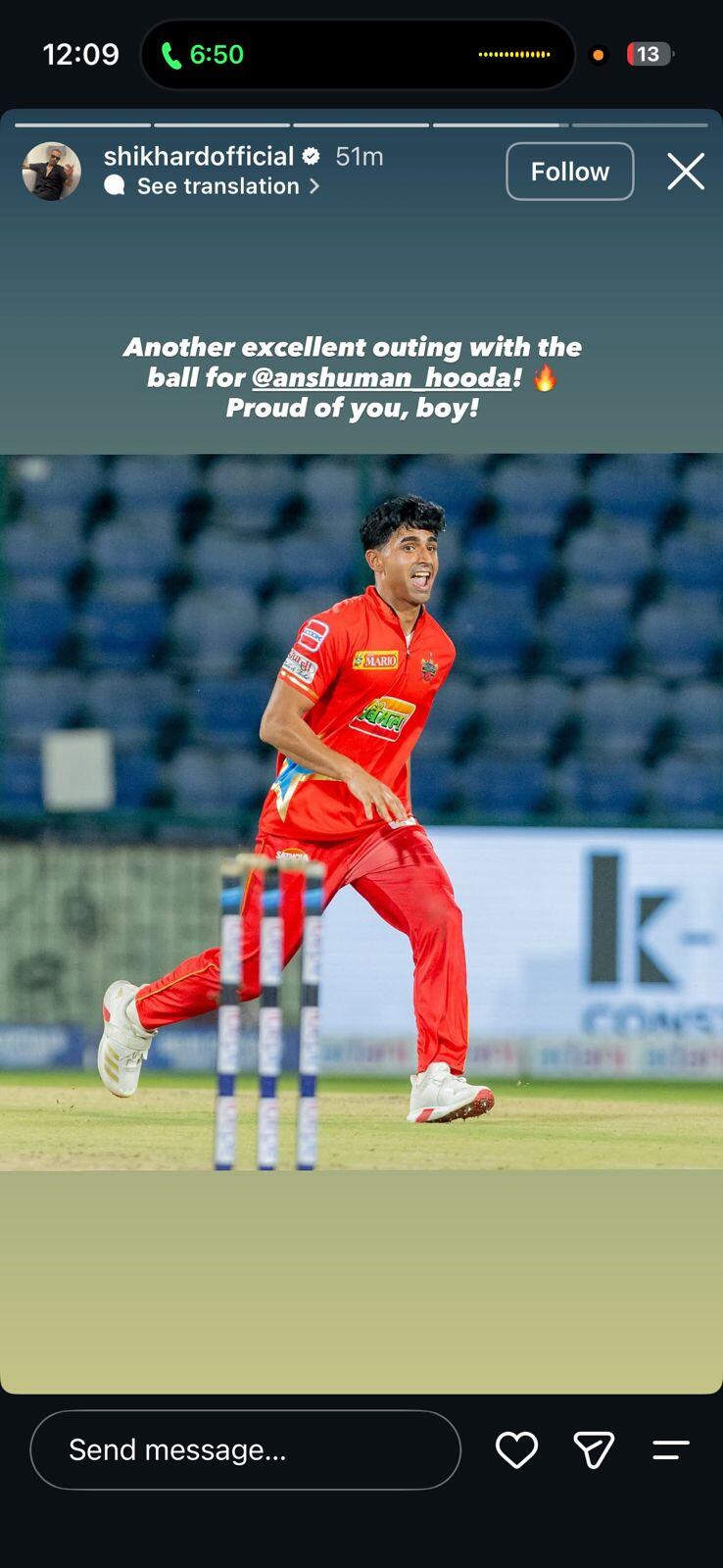
Shikhar Dhawan showered praise on Anshuman Hooda in one of his Instagram stories. (Screengrab)
It was a moment of validation. For someone who had spent years outside the conventional cricket pathway, being noticed by an established name carried significance beyond a conversation.
Speed is not enough
At 140 kmph, Anshuman possesses the one commodity that can change a fast bowler’s career quickly: pace. Coach Dagar believes there is more to come. Anshuman is not shy about wanting it.“Definitely, speed is what I want. If I can, I will definitely look to bowl even faster and build the strength and skills to do that, while making sure there is no compromise on accuracy and line,” said Anshuman.That final clause is important. Pace can attract attention. Accuracy keeps a fast bowler in a team. For Anshuman, the next challenge is therefore not simply touching a bigger number on the speed gun. It is learning how to sustain high pace across long spells, particularly in red-ball cricket.He is already thinking about it. “These are the things we prepare for. Who bowls in a four-day or five-day game and bowls long spells with the same effort? That is what I am preparing for. If I get an opportunity, I will definitely do that.”Anshuman’s ambition is clear. First, Delhi. Then first-class cricket. Then, eventually, IPL and India.“The eventual goal is to play and win matches for the country. That is my ultimate goal,” he says.
Job or cricket
There is, however, one more conversation happening in Anshuman’s life. The conversation between security and possibility. An engineering degree and a job at a good company offer a predictable future. And he has got a promotion before the start of the DPL season as well. Cricket offers something very different: uncertainty, competition and the possibility of a career that can disappear as quickly as it arrives.
Currently, I have joined back. But as I have seen some substantial progress in my cricket in recent months and in this tournament, I might, in the coming times, shift my whole focus to cricket and give it my all.
Anshuman Hooda
For now, Anshuman has returned to work. But his cricket has progressed to the point where continuing to divide himself between the two may no longer be possible.“Currently, I have joined back. But as I have seen some substantial progress in my cricket in recent months and in this tournament, I might, in the coming times, shift my whole focus to cricket and give it my all.”
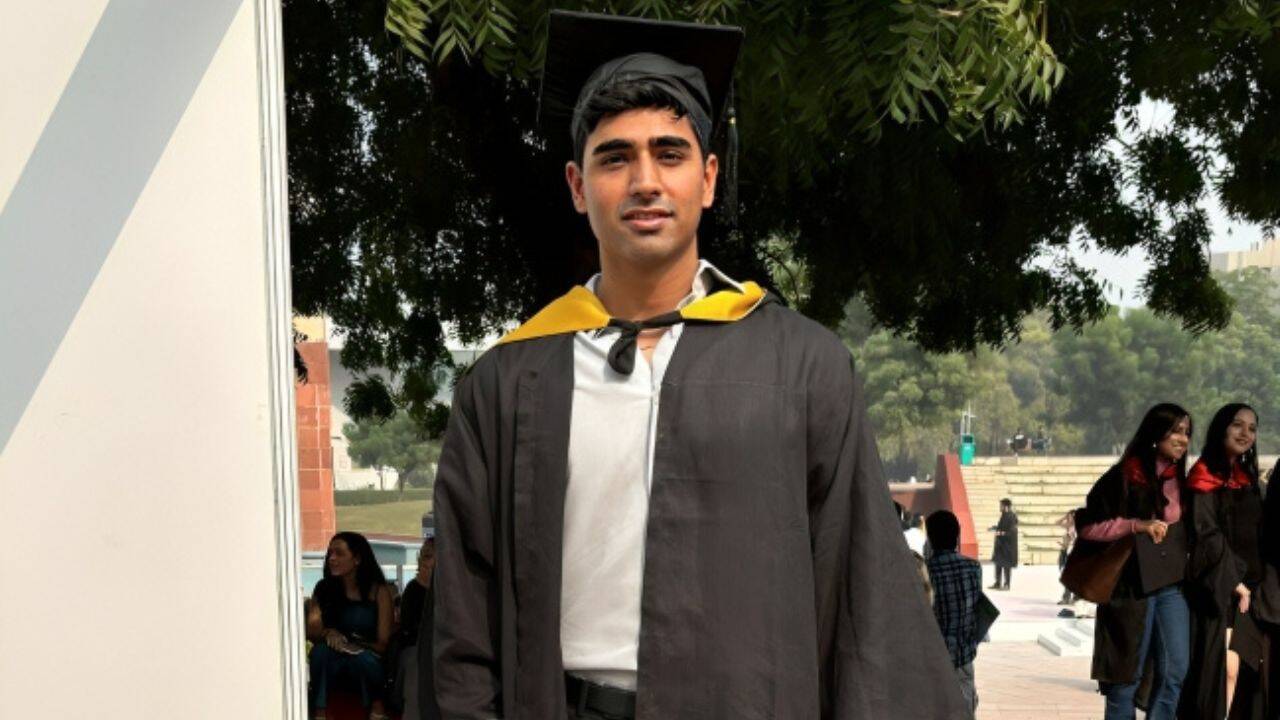
Anshuman Hooda during his convocation at DTU. (Special Arrangement)
It is a significant sentence from someone who once thought about quitting the sport altogether. There is also a quiet irony in the fact that the engineer who learned to manage competing demands may soon have to choose one.Anshuman knows where he wants to go.“I will give it my all. Let’s see what happens ahead.”