
NEW DELHI: Delhi government has set up a debt repayment fund, named Consolidated Sinking Fund, to gradually build a reserve for repaying its existing debt and other financial liabilities with the objective of creating a long-term financial cushion for debt repayment.Apart from helping govt meet future obligations in a more predictable and financially disciplined manner, this will also ensure it has resources available when its existing loans and other financial obligations are due, and does not have to arrange a large amount in one go from its annual budget, which potentially hampers capital and other projects.LG TS Sandhu has approved the constitution and administration of the fund, which will start operating from the financial year 2026-27, and cannot be used for any purpose other than repayment of govt’s outstanding liabilities.Govt will contribute to the fund over the years and invest the money in securities, allowing it to earn interest until it is needed to repay debt.
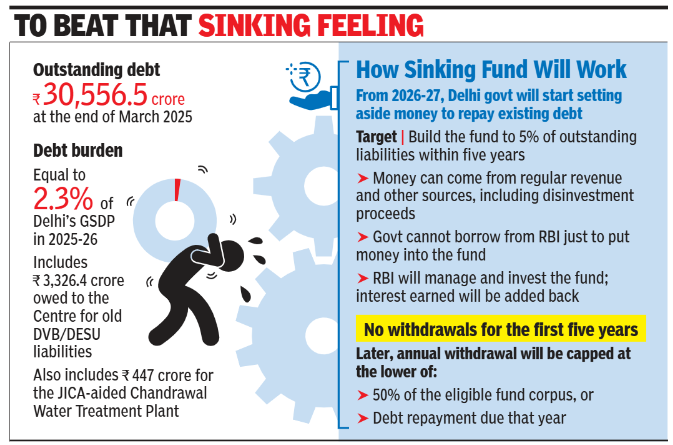
To beat that sinking feeling
At the end of March 2025, Delhi’s outstanding debt stood at Rs 30,556 crore, equivalent to 2.3% of its Gross State Domestic Product (GSDP) in 2025-26, according to Economic Survey 2025-26.This included a Rs 3,326-crore loan from Centre for meeting outstanding liabilities of DVB/DESU, the city’s former electricity utilities, and Rs 447 crore for Chandrawal Water Treatment Plant project, aided by Japan International Cooperation Agency.According to the notification regarding setting up of the sinking fund, it will be an amortisation fund for redemption of the outstanding liabilities of the govt commencing from 2026-27.Simply put, from this financial year, Delhi government will start using the fund as a dedicated reserve to gradually repay the money it already owes.Under the scheme, government will make efforts to build the fund’s corpus to 5% of its outstanding liabilities within five years.It can make contributions any number of times a year using its regular revenue or other sources, including disinvestment proceeds.However, it cannot borrow from Reserve Bank of India, specifically to make contributions to the fund.The central banking institution will manage the fund, with the money invested in securities and the interest earned added to the fund.The corpus will effectively remain locked for the first five years, with withdrawals permitted only from the following financial year.Even thereafter, govt will not be able to withdraw the entire corpus in a year: the maximum withdrawal must be the lower of 50% of the eligible corpus of the fund or the amount of debt repayment due that year.