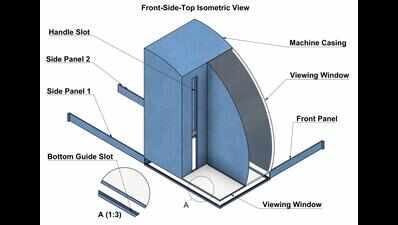
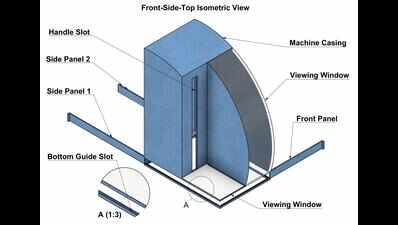
Pune: Researchers at MIT World Peace University (MIT-WPU) have created a new technology that could cut industrial noise by up to 20 decibels while significantly improving workplace safety.The innovation, developed by mechanical engineering team members Rohit Ghadge, Mahesh Kulkarni, and PhD scholar Yash Chavande, contains sparks, dust, and flying metal particles produced during the cutting operations. Currently in the prototype stage, the technology has already secured a published patent application.The technology is designed for abrasive saw machines, which are widely used in manufacturing units, fabrication workshops, construction sites, automobile plants, railway maintenance facilities and shipyards. “These machines often produce noise levels between 95 and 110 dB(A), making them among the loudest pieces of equipment used in industrial workplaces,” Ghadge said.The researchers have developed a compact protective enclosure that can be fitted onto both existing and new abrasive cutting machines. Unlike conventional safety guards, the enclosure surrounds the cutting area and includes transparent viewing windows and adjustable sliding panels.This allows operators to monitor the cutting process safely while protecting them from sparks, dust and flying debris.According to Kulkarni, the enclosure has been specially designed to control noise at its source. “Its structure combines a rectangular rear section with a curved front profile that helps redirect and contain sound waves produced during cutting operations,” he said.To enhance sound reduction, the team tested hybrid acoustic materials made from E-glass fibre, basalt fibre and perforated aluminium layers. Laboratory tests showed sound absorption levels as high as 0.98 and sound transmission loss of up to 30 dB(A) in frequency ranges commonly associated with industrial machinery.Based on these findings, researchers expect the enclosure to reduce actual machine noise by around 10 to 20 dB(A) during real-world operations. Even such reductions can significantly improve worker comfort and reduce long-term exposure to harmful noise.Kulkarni said, “The aim was to develop a practical solution that improves workplace safety without requiring expensive infrastructure changes. We feel that the technology could help industries create cleaner, safer and healthier work environments while supporting worker welfare as India’s manufacturing sector continues to grow.”