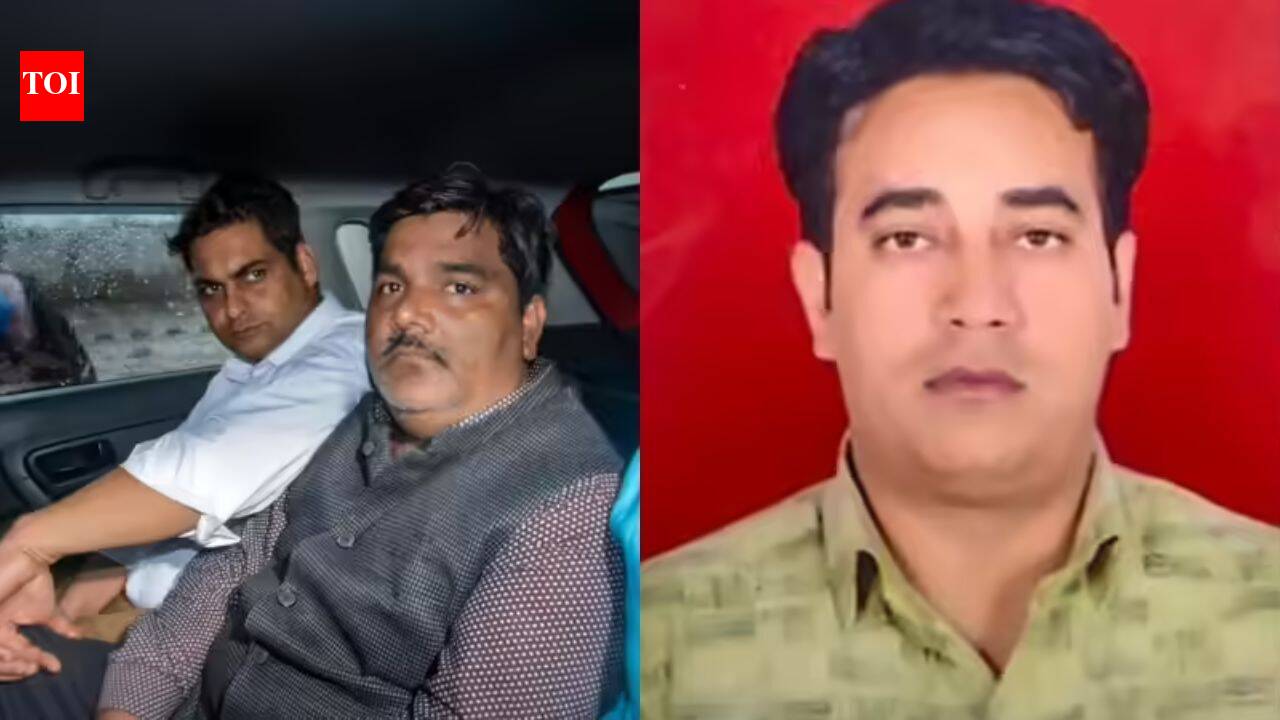
NEW DELHI: Former MCD councillor Tahir Hussain has moved the Delhi high court challenging his conviction and life sentence in the 2020 IB staffer Ankit Sharma murder case.His appeal is likely to be listed for hearing next week, according to news agency ANI.Ankit Sharma was killed in the Dayalpur area during the North East Delhi riots in 2020. His mutilated body was later recovered from a drain.On July 13, a Karkardooma court convicted Hussain and four others in the case. On July 31, the court sentenced all five convicts to life imprisonment.Hussain has now challenged the trial court’s verdict before the Delhi high court.Additional Sessions Judge (ASJ) on Tuesday sentenced former MCD councillor Tahir Hussain and four others — Nazim, Kasim, Javed and Anas — to life imprisonment for the murder of Intelligence Bureau staffer Ankit Sharma during the 2020 northeast Delhi riots.The court also imposed a fine of Rs 5 lakh on Tahir Hussain and Rs 25,000 each on the remaining convicts.According to news agency ANI, apart from the murder conviction, the five convicts were sentenced to seven years’ imprisonment for the offence of kidnapping and were also fined. They were further convicted and sentenced for offences including rioting and unlawful assembly.After the sentencing, Tahir Hussain, while leaving the courtroom, told the media that he was not satisfied with the judgment and that the matter would be challenged before the High Court.The court had reserved its order on sentencing on July 27 after hearing submissions from the Delhi Police and counsel representing the convicts. On July 13, the court had convicted Tahir Hussain and the four co-accused in the case.During the sentencing hearing, the prosecution sought the death penalty for all five convicts, arguing that the murder was a heinous and anti-social crime that fell within the “rarest of rare” category.Special Public Prosecutor (SPP) Madhukar Pandey sought capital punishment and submitted before the court that the convicts acted with extreme brutality.“They should be kept behind bars and should be given the death sentence,” the SPP had submitted.The prosecution argued that the killing was deliberate and cold-blooded, alleging that a heavy cutting weapon had been used in the attack. It further contended that the incident could not be viewed in isolation from the larger context of the northeast Delhi riots, in which 53 people lost their lives.The SPP also referred to the injuries suffered by Ankit Sharma and submitted that 51 injuries were found on his body, seven of which were sufficient to cause death. The prosecution argued that the deceased had not provoked the attackers.“They committed the offence without caring for the punishment. They deserve a death sentence,” SPP had submitted.The prosecution further argued that Supreme Court precedents relating to the award of capital punishment were applicable to the present case.Opposing the plea for the death penalty, Advocate Rajiv Mohan, appearing for Tahir Hussain, urged the court to take a lenient view and argued that the death sentence could not be awarded in every murder case. He submitted that both aggravating and mitigating circumstances must be considered before imposing punishment.The counsel argued that Tahir Hussain had been convicted on the basis of vicarious liability arising out of unlawful assembly and that the prosecution had failed to establish any conspiracy during the trial.“In this case, the police cited conspiracy, and in another case the police have alleged larger conspiracy, adding that the Accused person charges for actually inflicting injuries has been acquitted,” Advocate Rajiv Mohan had argued.He further submitted that the specific role attributed to an accused was an important factor while determining the sentence and contended that the police personnel present at the spot were unable to prevent the rioting.According to the defence, liability for the incident could not be solely placed on Tahir Hussain and his conviction was based primarily on his presence at the location.There is no preparation, no Conspiracy; the deceased was taken by the crowd, and brutality was done. This case is not at par with the cases which provided a death sentence, the counsel argued.The defence also submitted that Tahir Hussain’s conduct during incarceration had remained satisfactory and should be taken into account during sentencing.The counsel maintained that no specific role had been attributed to Tahir Hussain and therefore the case did not fall within the category of the “rarest of rare” cases warranting the death penalty.Advocate Tara Narula, also appearing for Tahir Hussain, submitted that he has three children, while his wife is a homemaker and his father is elderly.The defence further stated that Hussain was an MCD councillor at the time of the incident and that part of the family’s property remains sealed. It was submitted that the family was residing in the rear portion of the property and had no source of income other than a monthly rental income of Rs 83,000.Counsel Abdul Gaffar Khan, appearing for convicts Kasim and Nazim, argued that the incident occurred amid widespread rioting involving members of both communities. He submitted that Ankit Sharma was accompanied by two to three persons and was carrying a stick at the time. The defence sought to argue provocation; however, the court rejected the contention.