India’s immediate neighbours have witnessed a unique political phenomenon where the movements popularly called as ‘students’ or ‘Gen Z’ movement, led by youth have overthrown the ruling political establishments. These young citizens, appear to be the vanguards of democratic ethos and torchbearers of disenchantment by overthrowing the government. Though, these movements appear alike in Sri Lanka, Bangladesh and Nepal, the protest ecology is not monolithic, their motivations and political logistics differ significantly.
Recently, India has also seen a handful of young individuals who have attempted to destabilise the government in furtherance of political narratives and parochial interests. Hence, it is necessary to understand the structural factors which rendered such protests successful in neighbourhood whereas why such attempts by handful of individuals remained ineffective in India. The precursors and outcomes in each of these cases are significantly varied and hence it becomes vital to examine them under separate lens. It is equally important to inquire whether such movements are spontaneous or designed, planned and executed carefully by internal and/or external actors.
One can broadly identify three structural factors that engender youth unrest of any kind. The first is what Jürgen Habermas calls a “legitimation crisis”. It signifies a condition wherein the state loses its moral and institutional authority to govern. This occurs when democratic institutions are hollowed out, electoral processes are manipulated, and civil liberties are systematically curtailed. Bangladesh under Sheikh Hasina could be cited as a textbook example of a legitimation crisis. The Hasina administration blatantly muzzled the free press by Digital Security Act 2018, suppressed any expression of political disenchantment, repressed political opposition and subordinated democratic institutions to the executive will. Most opposition parties boycotted the 2014 and 2024 elections. The elections remained non-competitive. This is a case of democratic backsliding and authoritarianism. All of these factors together with corruption and nepotism manufactured a legitimation crisis, which led students taking to the streets in unprecedented numbers and the eventual overthrow of the Hasina administration in 2024.
The second factor is what may be termed a “delivery deficit”. It signifies the state’s abject failure to provide essential public goods to the people at large. Bangladesh was not the case of failure of delivery as the country recorded consistent economic growth since 2010, with rising per capita income. On the other-side in Sri Lanka, the sudden and disgraceful ouster of President Gotabaya Rajapaksa in 2022 demonstrates this perfectly. The food, fuel and fertiliser crisis, coupled with the hard-hit tourism industry due to COVID-19, stripped the government of any residual legitimacy. On the issue of corruption and nepotism, 2021 Pandora Papers revealed the family’s offshore financial arrangements. It entails diversion of public resources for private gains. Thus, the administrative and governance failure precipitated the downfall of a democratically elected government in Sri Lanka. Similarly, in Nepal, ever since 2006, when Nepal made the fateful transition from monarchy to republican, each successive democratic government has failed to deliver the expectations of citizens i.e. health, education, employment etc. Reports suggest that more than 1,500 adults leave the country every day in search of work, which clearly reflects failure of delivery. Finally, shutdown of 26 social media platforms has generated deep disillusionment among the Nepalese, especially the youth, who channelised their frustration with poor governance into Gen Z mobilisation and regime change.
The third and perhaps most contextually sensitive precondition is the “breach of the social contract between the state and its citizens”. Since it is context-sensitive, this phenomenon works differently across states and societies because the terms of the contract differ in each case. Where civil society is highly politicised and basic consensus among different political stakeholders is lacking, the scope for intervention and manipulation – whether by deep state actors or by foreign vested interests – expands considerably. These are evident in case of Sri Lanka, Bangladesh and Nepal. However, Pakistan’s case in this regard is counterintuitive. The civil society in Pakistan is always in cahoots with the military establishment. As a result, it serves to insulate the military establishment with the external supports from any popular revolt even when there exists a legitimation crisis and a wide delivery deficit.
While neighbourhood has experienced such regime-change operations, India exhibits relative immunity to this kind of narrative induced sporadic protests. In fact, India doesn’t provide any such ground of bafflement. Democracy is a habit that needs to be nurtured, a wakefulness that needs to be learnt and education that needs to be passed on to the next generation. Fortunately, India has succeeded in not just protecting but also inculcating these democratic ethos and values, hence, there exist a general sense of trust among the youth, emanating from robust electoral processes and governance mechanisms. Unlike the capital centric politics of Bangladesh, Nepal, or Sri Lanka, India’s political landscape is genuinely polycentric. Mumbai, Kolkata and Chennai are not merely economic hubs — they are equally important centres of political gravity. It has been constitutionally ensured that power in India is shared between the centre and the states. Hence, disenchantment or discontent with the establishment, if there is any, is not directed at any one common opponent. This federal, democratic and political arrangement has saved India from experiencing any legitimation crisis. Similarly, on the developmental front, India’s record over the past decade has been exemplary. The Direct Benefit Transfer (DBT) mechanism has singled out the rent-seeking intermediaries that earlier siphoned off public funds intended for targeted beneficiaries. The Pradhan Mantri Mudra Yojana has institutionalised access to formal credit, which has benefited millions of those who earlier depended on extortionary informal credit sources. India has built digital public infrastructure at an unprecedented scale, near-universal financial inclusion through mechanisms like Jan-Dhan, Aadhar, Mobile (JAM) trinity, and large-scale creation of physical infrastructure, including national highways, high-speed rail tracks and maritime shipping routes, which have collectively narrowed down the delivery deficit. As a result, India navigated through major recent crises like COVID-19, the Ukraine-Russia war, US-Iran war, skilfully and without suffering the kind of supply-chain (by creating alternative supply sources) or economic collapse that devastated other economies.
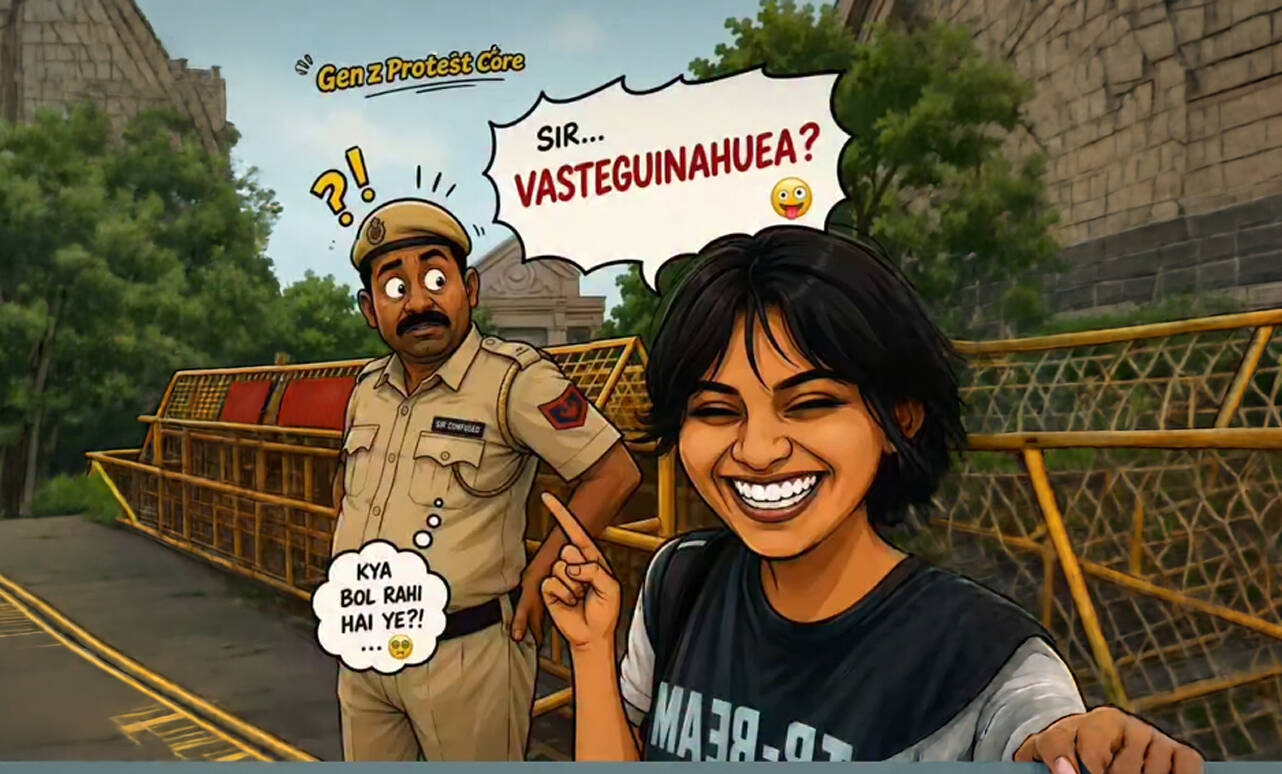
The recent protest centred on examination irregularities must be situated within this broader analytical framework. They represent a specific governance grievance, not a systemic crisis of legitimation. The government’s response has been timely, measured, and one that adheres to the democratic ethos. It has immediately ordered a high-level inquiry, suspended and arrested implicated persons, and conducted a fresh and fair examination. It reflects the strength and responsiveness of India’s institutional arrangements. The Cockroach Janta Party (CJP) and handful of protesters are trying to politicise the whole issue of examination irregularities to score political brownie points. They have nothing to offer as a viable alternative and concrete suggestions for reforms. Promoting a robust academic governance and fair system are the morality of all.
Implementation of National education Policy 2020 within a window of feedback system and bringing educational administrative reform through Viksit Bharat Shiksha Adhisthan (VBSA) Bill-2025 are the examples of government serious attempt to bring a robust academic governance model and implement the non-western domain of knowledge System which is all inclusive.
The opposition must look beyond their parochial political interest and partner with the government to develop robust academic governance to address genuine grievances of the students and the next generation. The protest movement focuses only on the failure of the state but overlooks the complexity of private actors within the same ecosystem. Converting technical and administrative lapses into a narrative is politically irresponsible, and morally reprehensible. India is a polity in which young citizens feel sufficiently empowered to articulate grievances freely and publicly, confident that democratic institutions will respond effectively.
At last, the West is already pursuing a “contain India strategy” which identifies India as a long-term geopolitical challenge. Deputy Secretary of State Christopher Landau’s remark, made at the Raisina Dialogue in March 2026, hints at this strategy, where he said: “We are not going to make the same mistakes with India that we made with China”. Hence, the preferred instrument of destabilisation is not military confrontation but internal entropy — fostering conditions of domestic chaos that arrest India’s developmental trajectory and diminish its geopolitical agency. They have already been successful in case of neighbours including Pakistan.
Therefore, with India’s long-standing democratic credentials and widespread trust in its development model, the country’s young and aspirational citizens are likely to exercise independent judgment rather than be swayed by divisive provocations. India’s democratic maturity and informed electorate remain among its greatest strengths.
Disclaimer
Views expressed above are the author’s own.