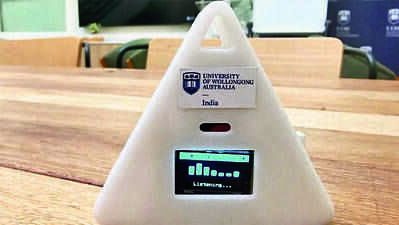
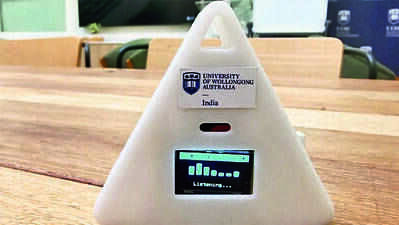
Ahmedabad: A mosquito’s disease payload depends on its species, which is laborious to identify, but a University of Wollongong team has created buzz-scanning tech that promises to detect species using only wingbeat sounds.Prof Kiran Trivedi and his student, Harsh Shroff, of the university’s GIFT City campus developed the device. University officials said the device is inexpensive and is powered by AI.“The device analyses wingbeats and checks them against distinct acoustic signatures of various mosquito species,” Trivedi said. “The model was trained using publicly available mosquito sound recordings. The model achieved an accuracy of 88.3% in identifying species.”Built on a compact platform with an integrated microphone and display, the device provides a portable alternative for monitoring, Trivedi said.Conventionally, entomologists collect mosquito larvae to identify the species. And species information reveals disease risk. Doctors say Aedes aegypti is the primary carrier of dengue, yellow fever, and zika; Anopheles carries malaria parasites; while Culex is the vector for encephalitis and filariasis.The device can identify these three types, researchers said. The device was showcased recently at the United Nations AI for Good Global Summit in Geneva. Prof Trivedi said the highlight of the device is its rapid identification without internet connectivity or laboratory infrastructure.“A network of these devices can monitor mosquito activity and provide real-time insights into emerging disease hotspots,” he added.Blurb: Aug 20 is World Mosquito Day, which marks the discovery that female Anopheles mosquitoes transmit malaria parasites. Events on the day highlight the dangers of vector-borne diseases and the ways to fight them