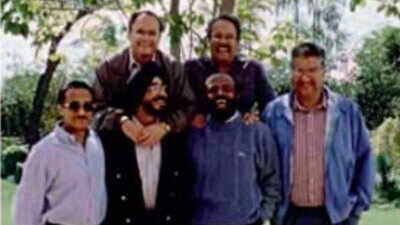
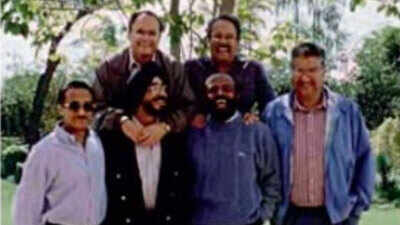
In 1976, starting a technology company in India was nothing like launching a startup today.There were no startup accelerators, no venture-capital ecosystem and no easy access to bank funding for young engineers with an ambitious idea. Computers themselves were still unfamiliar to most Indians, while the machines that did exist were large, expensive and largely confined to specialised institutions.Yet six young engineers decided to take a risk.Shiv Nadar, Ajai Chowdhry, Arjun Malhotra, Yogesh Vaidya, Subhash Arora and D.S. Puri left their jobs because they believed that the microprocessor would transform computing. Together, they managed to raise just Rs 1.87 lakh — through savings, borrowing and, in one case, even selling a car.Their first workplace was a modest barsati in Delhi’s Golf Links.They called their venture Microcomp.What followed would eventually become the story of Hindustan Computers Limited, better known today as HCL.But for students, aspiring engineers and young entrepreneurs, the most interesting part of this story is not simply how a technology company was born. It is how six engineers turned limited resources, regulatory hurdles and technical challenges into an opportunity to build indigenous computing technology.
Six engineers, Rs 1.87 lakh and one big idea
The founders had something that was difficult to find in India in the 1970s: a strong conviction about where technology was headed.They believed the microprocessor could change the world.The problem was that believing in an idea and building a company around it were two very different things.India’s technology environment was heavily regulated. Manufacturing computers required licences, and the founders did not initially possess one. Their solution was to work with UP Electronics Corporation, which had the required manufacturing licence.That partnership eventually led to the creation of Hindustan Computers Limited.The company was not born in a sophisticated technology park. Its early days were spent in a small Delhi barsati, with the founders trying to build a business around a technology that was still unfamiliar to much of the country.And then came an even bigger gamble.They began selling a computer before the final machine had actually been built.The sales teams carried brochures and a mock-up of the proposed computer and travelled across India trying to convince potential customers to invest in an idea that did not yet exist as a finished product.It sounds almost unimaginable today.But the strategy worked.Among the early customers were IIT Kharagpur and IIT Madras. Their interest helped demonstrate that an Indian company could build and sell indigenous computing technology.For students, there is a lesson hidden here: innovation does not always begin with abundant resources. Sometimes it begins with recognising an opportunity before everyone else does.
When computers occupied entire rooms
To understand why HCL’s early work mattered, it is important to understand what computing looked like in India at the time.During the 1970s, IBM 1401 computers were among the machines being used in India. They were huge systems that required dedicated data centres and air conditioning.According to an account by a member of the HCL 8C development team, companies could spend around Rs 5 lakh a year leasing an IBM 1401.HCL’s answer was dramatically different.The HCL 8C, introduced in 1978, could be purchased for around Rs 3 lakh. It was compact enough to sit on an office desk and did not require air conditioning.The machine was based on the Rockwell PPS-8 microprocessor and was designed to meet the computing requirements of medium-sized companies.More importantly, much of the system was developed by Indian engineers from scratch.The team designed the motherboard and input-output boards, while the operating system, device drivers, BASIC interpreter and Sort/Merge package were developed for the machine.It was a remarkable engineering challenge because the developers were working at a time when many of today’s basic software-development conveniences simply did not exist.
There was no mentor, no modern IDE and barely any debugging infrastructure
The story of how the HCL 8C was developed perhaps provides the strongest educational lesson of all.The engineers did not have a modern development environment where they could write code, compile it and immediately test the result.They had to work extremely close to the hardware.Initially, the development system consisted essentially of the Rockwell PPS-8 processor and memory. Programs had to be loaded into memory using rows of toggle switches, byte by byte.Imagine debugging software under those conditions.A power fluctuation could wipe the program from memory.The engineers would then have to load it again.The development team eventually found a better approach using PROM chips. But even that did not solve the fundamental problem: the hardware itself was still being developed.So one of the engineers created a Rockwell PPS-8 simulator on an IBM 360 at the Delhi University Computer Centre.This was an ingenious solution.Instead of waiting for the physical HCL hardware to become available, software development could proceed separately on the IBM 360.The engineer went a step further and created a cross-assembler, allowing programmers to write code using assembly-language commands rather than directly working with strings of zeroes and ones.For today’s computer science students, concepts such as simulators, assemblers and development environments are part of everyday programming. In the 1970s, creating these tools was itself an engineering challenge.
When debugging meant carrying boxes of punched cards
The development process became even more demanding because of the computing infrastructure available at the time.Programs were submitted to IBM 360 systems using 80-column punched cards.Each card represented a line of code.The engineers would prepare boxes of punched cards and carry them to the Delhi University Computer Centre. They would submit their jobs to a batch queue and wait for the results.Sometimes the programme failed because of a single punching error.Then they had to submit it again.The team could sometimes get only two runs a day.That meant a programming error that might take seconds to identify today could consume hours.Eventually, the engineers discovered that the IBM 360 at the Physical Research Laboratory in Ahmedabad was less busy.The team travelled from Delhi to Ahmedabad, sometimes staying for a month to develop software, before returning to Delhi to test it on their system.The account recalls journeys in third-class railway compartments, carrying large boxes of punched cards, along with software debugging sessions that stretched to 36 hours.For engineering students accustomed to laptops, cloud computing and instant compilation, it is difficult to imagine the patience required.But that patience helped produce the HCL 8C.
The engineering behind India’s early indigenous computer
The HCL 8C was not simply a computer assembled from imported components.The development team built much of the system themselves.The motherboard and I/O boards were designed and assembled using discrete components. The operating system, device drivers, BASIC interpreter and Sort/Merge software were written specifically for the machine.There were exceptions: the microprocessor and memory chips were imported.But the rest of the development represented a significant indigenous engineering effort.The software was written in machine code, helping the HCL 8C achieve high efficiency.Once the hardware and software teams completed their work, the result was a compact system that could compete effectively with much larger machines.The HCL 8C began selling rapidly.Its success also created a new problem.Customers wanted software improvements.Because the original software was stored in ROM, updating it was difficult. The team turned to EPROM technology, which allowed customers to replace older chips with new versions of the software.The old EPROMs could then be erased using ultraviolet light and reused.That detail may sound technical, but it captures something fundamental about engineering: innovation rarely ends when the first product is completed. Real innovation begins when users start asking for the next version.
What students can learn from the HCL story
The HCL story is more than a chapter in India’s technology history. It offers several lessons for students preparing for careers in engineering, computer science, entrepreneurship and research.
1. Start with curiosity, not perfect resources
The founders did not have everything required to build a technology company.They had an idea, technical knowledge and the willingness to experiment.Students often wait for the perfect laptop, the perfect course, the perfect mentor or the perfect opportunity before beginning a project.The HCL story shows why that mindset can be limiting.Resources matter, but curiosity and persistence can determine what you do with the resources available to you.
2. Learn beyond the textbook
The engineers developing the HCL 8C had no ready-made roadmap.They had to understand hardware, machine language, software, simulation and system design while building the product itself.That kind of interdisciplinary learning is increasingly important today.A student interested in robotics, for example, may need programming, electronics, mechanical design and mathematics. Someone building an AI product may need computer science as well as an understanding of the problem the technology is meant to solve.The strongest projects often happen at the intersection of disciplines.
3. Failure can become an engineering tool
The HCL engineers repeatedly encountered failures.A programme could disappear from memory. A punched card could contain an error. Hardware development could hold up software development.Instead of treating each obstacle as a reason to stop, they created tools and processes to overcome them.The PPS-8 simulator and cross-assembler are examples of turning a problem into an opportunity for innovation.
4. Build for a real problem
The HCL 8C was not technology for technology’s sake.The goal was to make computing more accessible and practical for Indian businesses.The machine was smaller, more affordable to own and did not require the infrastructure associated with larger systems such as the IBM 1401.That is an important principle for students working on projects today: the best innovation often begins by asking, “What problem am I trying to solve?”
5. Your first workplace does not determine your future
The founders began in a barsati.The development team worked with limited computing infrastructure.Yet the technology they built eventually contributed to the emergence of a major Indian technology enterprise.For a student sitting in a classroom today, the message is simple: the size of your current environment does not necessarily determine the size of the problem you can attempt to solve.Disclaimer: This article is based on the historical accounts and inputs provided for the HCL founders and HCL 8C development; some historical details may vary across contemporary accounts.