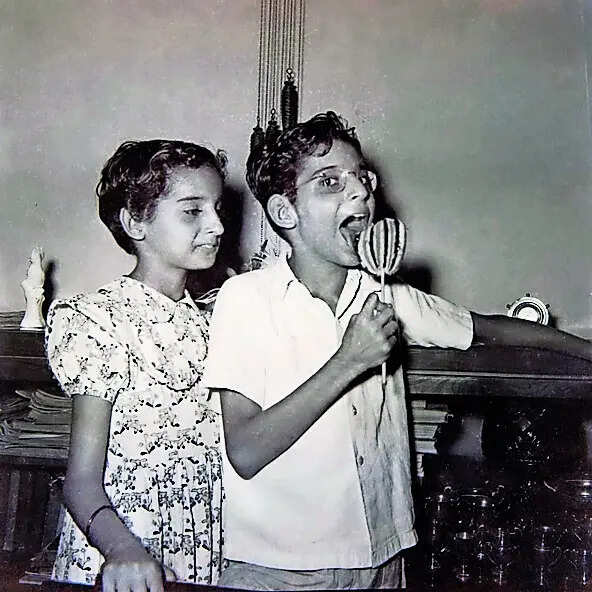
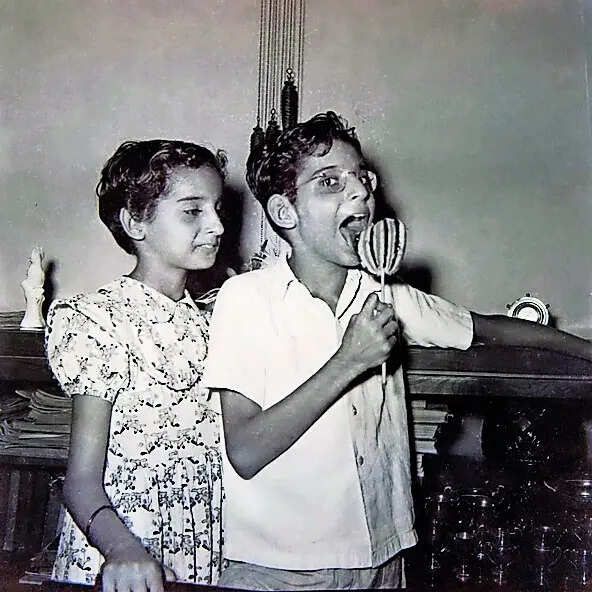
MUMBAI: In 1935, Khurshed Maneckji Bharucha – the first Indian chief cashier of Tata Steel in Jamshedpur – borrowed Rs 3.5 lakh from a friend who owned an island near Bombay. Soon, on an open ground at Bistupur junction, arose a four-storey building with partition walls made of ‘surkhi’, a burnt clay and limestone mix. Intended to house the wave of Parsi workers arriving from Bombay, Surat, Karachi and even Birmingham and Munich after Tata Steel’s founding in 1907, the building later accommodated Regal Cinema, the city’s first single-screen theatre, on its ground floor.Today, after decades of migration, interfaith marriages and dwindling numbers, only around 200 Parsis remain in Jamshedpur. Yet fragments of that thriving community survive in a box of photographs, letters and notes preserved by Bharucha’s son-in-law, Keki Gazder – a tall, camera-loving mechanical engineer whose archive has transformed Cymroza Art Gallery in Cumballa Hill into a 1950s Parsi attic.Sparseeing – a title coined to mean “seeing things as though they were disappearing” – presents more than 70 images from the Gazder-Bharucha family archive. Even though many lack names and dates, they offer a rare peephole into Parsi domestic life and the evolution of Jamshedpur around India’s first steel plant. “Though the Gazder-Bharuchas were but one family among many in the city, they became its inveterate archivists,” notes a descriptor at the exhibition, which runs until June 20.While the Bharucha Mansion was presided over by its tea-cup-toting matriarch Goolbanu Bharucha, the first woman to drive a car in Jamshedpur, the show’s central figure is Keki, the introverted chief electrical officer at Tata Engineering and Locomotive Company, who grew up a fly on the wall, documenting everything around him.His postings at industrial centres across Brussels, Belgium and Berlin filled a red hardbound diary, while postcards from relatives in Birmingham and letters from family members working in Tata’s locomotive division charted lives connected by industry. The idea of the show sprang from a box. Documentary photographer Abhishek Basu and researcher Joyona Medhi were at Regal Cafe – run by Keki’s grandson Varun Gazder in the same Bistupur building – when they encountered a cache of photographs, negatives, postcards, glass slides, cabinet cards and theatre advertisements once projected at Regal Talkies. The collection, Medhi recalls, arrived in “a sad little shoebox filled with cobwebs.”Rather than impose a chronology, the curators embraced the archive’s gaps. Through flipbooks, accordion books, lightboxes and fragments of fiction, they built a partly fictional, unfinished narrative from incomplete records. “Sometimes, fiction is the best way to get close to the truth,” as Medhi puts it. The project won the Alkazi Grant in 2022. The archive preserves intimate moments: children climbing playground ladders, factory workers, women posed in studios with pearl necklaces and lace sarees embroidered with Iranian motifs. One image is believed to show Keki’s aunt Perim — who apparently fussed over her appearance en route to Thankeys, a rundown photo studio run by a second-generation Chinese immigrant named Mr Frank. “It was perhaps the one sent before her marriage to Adi Hodiwala of Tata Trusts,” said Medhi.Further ahead, a handwritten ledger lists Keki’s millwright staff – foremen, chargemen, ‘khalasis’ or dockyard workers from Kerala, labourers and a clerk-cum-typist. Yet it was photography that became Keki’s true obsession. A member of an amateur photography club, he frequently contributed images to TELCO publications and spent long hours in the family attic observing and recording everyday life.One recurring question that the exhibition asks is simple: what was Keki thinking when he took these photographs? Among the images is a self-portrait made decades before the selfie era, showing him naked, gazing skyward in a dramatic lunge. Other photographs capture bodybuilders carrying spears in a theatrical performance staged during wrestler Dara Singh’s visit to Jamshedpur. “He was heavily influenced by bodybuilding culture,” says Basu.Several photographs raise more questions than they answer. One shows a woman in a polka-dotted saree speaking into a microphone. Another depicts a female operator dwarfed by an enormous switchboard. The identities of both women remain unknown. “Keki had witnessed the arrival of Jamshedpur’s first telephone exchange,” says Cymroza founder Pheroza Godrej. “He consciously switched to a wider angle to capture the disproportion.“The archive also opens unexpected windows into the history of the city itself. References in Keki’s journals lead to Otto Konigsberger, the German emigre architect who prepared Jamshedpur’s development plan for Tata & Sons. “He was also among the founding contributors to MARG magazine,” notes Rahaab Allana of the Alkazi Foundation for the Arts. Today, Bistupur’s Regal Cinema is shuttered. But its seats, lights, fans, trophies and memories live on at the cafe Varun Gazder runs in the same building. The mansion remains. So does the box.