
AHMEDABAD: An analysis of 731 suicide and accidental death cases from city police shows that Ahmedabad recorded at least 98 suicide cases involving individuals aged 46 and above between January 2025 and August 2026, revealing a pattern of middle-aged and late-life mental health crises across the city.Of the 98 cases identified in this bracket, 73 victims were middle-aged adults between 46 and 60 years old, while 25 were senior citizens aged 60 and above.The overall dataset reflects a predominantly young demographic, with an average age of 32.7 years. However, the steady toll among older age brackets points to unique vulnerability factors that often go unnoticed in public health discussions.Police narratives cited financial pressures, chronic illness, domestic and interpersonal strain, loneliness, family disputes and unexplained circumstances among the factors associated with suicide.While suicides among youth often correlate with acute stress, suicides among seniors reflect chronic isolation and unaddressed physical suffering.
Why eastern Ahmedabad is hurting
The dense urban expanse stretching from Odhav to Vatva forms Ahmedabad’s manufacturing engine. Police data indicates that this swathe has a high concentration of suicide cases.Data and ground-level observations highlight several systemic pressures driving high distress rates in the eastern industrial corridor. Worker colonies, economic shocks and financial insecurity can translate into personal crises.The area also faces a shortage of accessible mental health clinics, while industrial hubs experience high levels of population density and migrant labour.
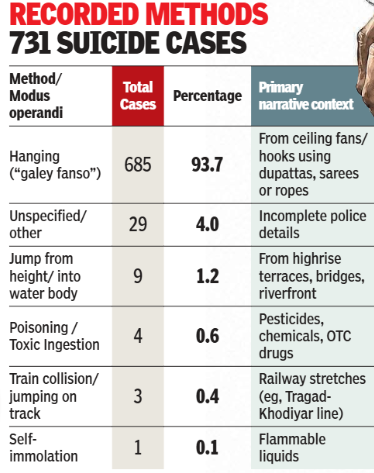
Suicide cases recorded methods
Police records included incomplete police documentation and other unspecified circumstances.Seniors’ despair: Chronic illness, agony, family supportPolice records show that victims often kill themselves with little apparent warning.Police documentation frequently records financial problems, chronic illness, family pressures and other vulnerabilities among older victims.For middle-aged victims aged 46-60 years, financial obligations and declining health frequently emerged as contributing factors.For those above 60, prolonged degenerative diseases, loss of independence and shrinking family support networks emerged as core drivers of suicide.Medical experts note that severe physical pain, chronic illness, economic instability, family support and dense living conditions can make residents particularly vulnerable to psychological distress.
Stress points
High migrant population, low-income housing, informal settlements, irregular wages, inadequate living space and financial pressures emerged as recurring stress factors.High-density Odhav topped the list across police station jurisdictions with 59 cases, followed by Narol with 55, Ramol with 49 and Amraiwadi with 48.Together, these four contiguous industrial and blue-collar residential zones logged 205 cases, representing more than 25% of all recorded cases in the dataset.Other eastern hubs reported high totals, including Nikol with 39 cases, Vatva with 31 and Khokhra with 21. In the north and western belts, Chandkheda and Sola reported 27 cases each, while Sabarmati logged 26 cases.The heavy clustering in Odhav, Narol, Vatva and Amraiwadi underscores the intense social and economic vulnerabilities within Ahmedabad’s industrial belt.These areas have high population density, low-income housing and a dense concentration of migrant factory workers and daily-wage labourers.Experts say economic instability, family support and dense living conditions can contribute to psychological distress among residents in these industrial areas.Intervention by 112 Jan Rakshak personnel has prevented a man from attempting suicide on railway tracks near Kalupur railway station. Police escorted him off the tracks and counselled him.