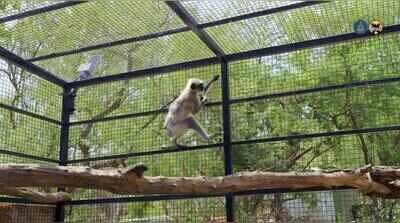
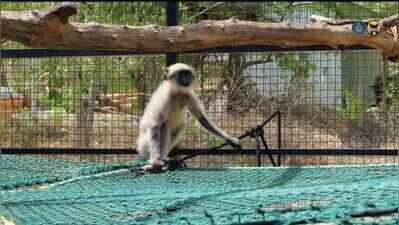
Pune: The forest department recently released a grey langur into its habitat, marking an end to months of rehabilitation after the primate’s burnt tail was amputated after electrocution.In March, the langur was found wedged atop a tin partition after the shock, too frightened and injured to be approached safely. The rescue team used a dart for a low-stress capture and brought him to RESQ Charitable Trust in Manjri. Veterinarians found third-degree burns and extensive damage to the tail, which could not be saved. The next challenge was to determine whether he could safely navigate the trees without one. After weeks of outdoor rehabilitation, the langur relearned his movements and cleared every mobility milestone. When he was released, he climbed straight up a tree.A langur’s tail is an important aid to balance. The long tail acts as a counterweight, helping the animal steady its body and control its movement, as it leaps between branches or moves along narrow supports atop canopies. Losing it can make life in the trees difficult, even if it does not make survival impossible.“It is not unheard of — langurs living without tails. They can survive in the wild. In urban and suburban areas, they can suffer serious injuries, including from encounters with electrical infrastructure, and some may require amputation eventually. They learn to cope with the loss and make up for it. If you give wildlife a second chance and the opportunity to recover, they can make the most of it,” said Nachiket Utpat of RESQ CT.The danger is relevant in Pune, where hills and forest patches remain interspersed with dense residential and commercial development. Langurs are found in several of these green pockets, which serve as habitat and movement areas for wildlife, even though the city has grown around it.The natural movement of langurs makes electrical infrastructure especially hazardous. “Langurs move from one tree canopy to another, jumping between branches. In urban and suburban areas, which are human-dominated landscapes, power lines come in between and can be a deadly obstacle to their movement,” said Utpat.As construction encroaches on their habitat, langurs are increasingly forced to navigate a landscape where natural corridors are interrupted by dangerous power lines. Last year, there were three cases of langurs affected by electrocution reported from Pune district. A sub-adult with severe injuries was found and an infant brought in after its mother died from electrocution.