For centuries, Europe knew how to fight the cold.Its homes were built to trap warmth. Thick walls, insulated roofs, double-glazed windows and tightly sealed buildings helped people survive long winters. Entire energy systems were designed around one question: how to keep people warm when temperatures fell below freezing.Now that old design logic is being tested by a new climate reality.As deadly heatwaves become more frequent across Europe, the continent is discovering that buildings meant to hold heat in winter can become dangerous heat traps in summer. The latest heatwave has exposed a vulnerability decades in the making: Europe was built for heating, but it is now struggling with cooling.The warning signs are no longer limited to weather charts. Roads have buckled, train services have been disrupted, schools have shut classrooms, power grids have come under strain and hospitals have reported a surge in heat-related cases. In several countries, temperatures have crossed 40°C, pushing cities and public health systems beyond what they were designed to handle.
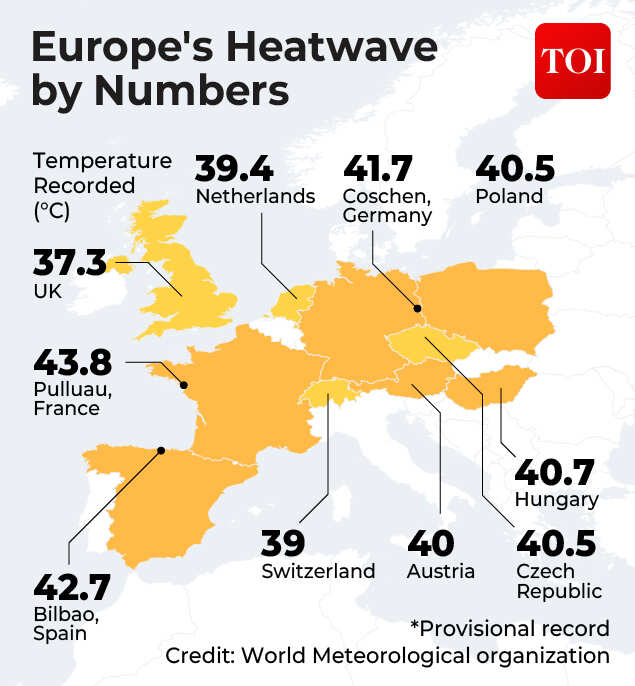
Europe’s heatwave has shattered temperature records across the continent, with several countries recording unprecedented June highs. France touched 43.8°C, Germany 41.7°C, Spain 42.7°C, while Hungary, Poland, Austria, Switzerland, the Netherlands, Denmark and the UK also set new records. The extreme heat prompted widespread red alerts, unusually warm nights and heightened health and wildfire risks, highlighting the growing intensity of heatwaves across Europe.The heat has done far more than rewrite records.In France, nearly 1,000 excess deaths were recorded during the peak of last week’s heatwave, according to Santé publique France, with authorities warning that the toll could rise further.World Health Organization Director-General Tedros Adhanom Ghebreyesus described Europe as “the fastest-warming continent on Earth,” heating at twice the global average. In a post on X, he said 150 million people were living under extreme heat, with schools shut, grids under pressure and hundreds dead.His warning captured what climate scientists have been saying for years: Europe is no longer dealing with isolated heatwaves. It is adapting to a different climate.
Why Europe is warming so quickly
According to the World Meteorological Organization and the Copernicus Climate Change Service, Europe is warming at roughly twice the global average, making it the fastest-warming continent on Earth.As average temperatures rise, heatwaves are becoming more frequent, lasting longer and reaching intensities once considered rare. Scientists say Europe’s rapid warming is linked to a mix of factors, including changes in atmospheric circulation, shrinking snow cover, drying soils and the rapid warming of the Arctic, which influences weather patterns across the continent.
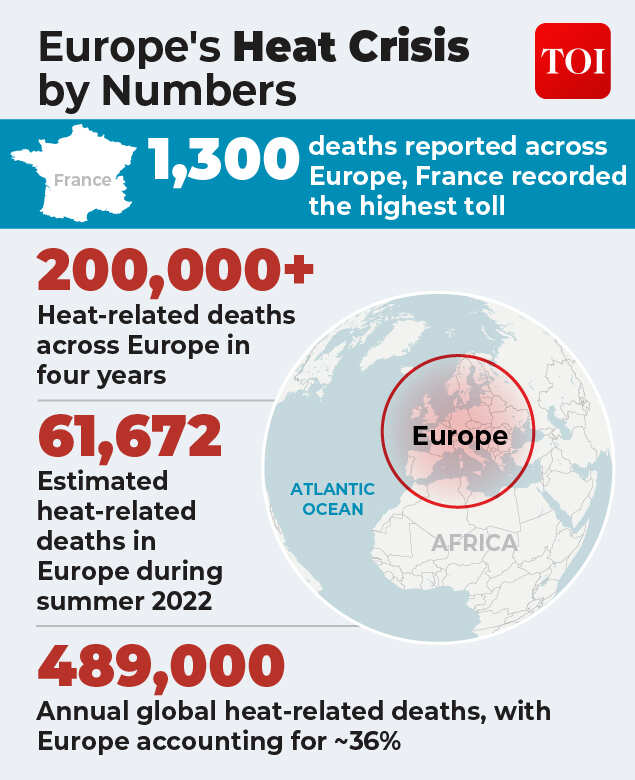
The heat has done far more than rewrite weather records
Soumya Dutta, trustee of MAUSAM, says the current European heatwaves are the result of both long-term climate change and immediate atmospheric conditions.“There are two main reasons. First, the baseline temperature has already increased because of global heating. Over the last hundred years, the global average temperature has gone up by about 1.3°C. Any additional rise is now happening on top of this higher baseline,” he says.This higher baseline means that when heat-trapping weather systems settle over Europe, temperatures can quickly climb to dangerous levels.Meteorologists have identified an “Omega Block” as one of the atmospheric patterns sustaining the latest heatwave. In this pattern, a stubborn high-pressure system becomes trapped between two low-pressure systems, resembling the Greek letter Ω. It disrupts the normal flow of the jet stream, prevents weather systems from moving on and allows heat to build over the same region for days or even weeks.
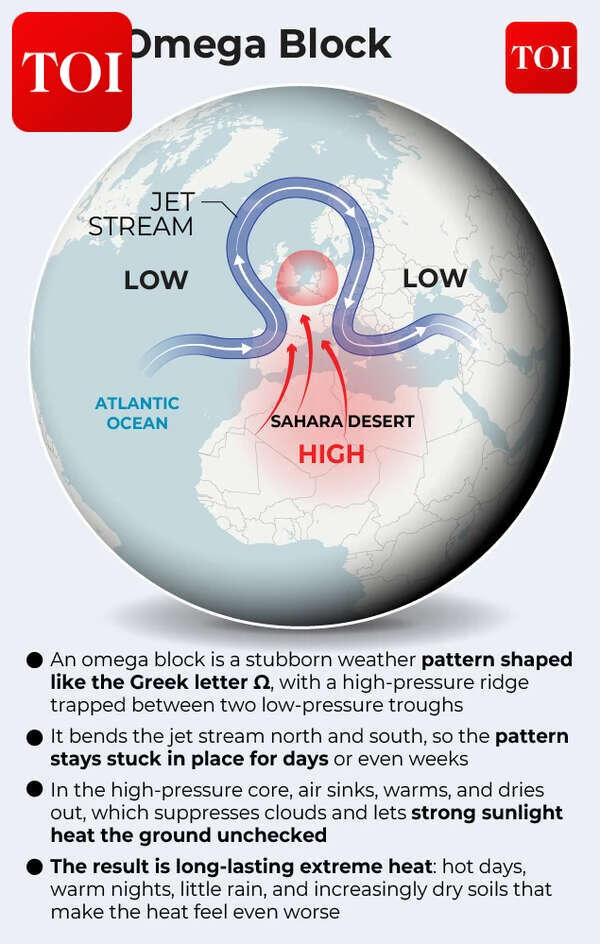
Omega block plays a major role
Heat is Europe’s silent killer
Unlike floods, storms or earthquakes, heat often leaves little visible destruction.There are no collapsed buildings or flooded streets. Yet public health experts increasingly describe extreme heat as Europe’s deadliest weather hazard.WHO Europe estimates that more than 2,00,000 people have died from heat-related causes across Europe over the past four years, adding that nearly all of those deaths were preventable with better preparedness, early-warning systems and public health measures.Globally, WHO estimates around 4,89,000 heat-related deaths every year, with Europe accounting for nearly 36% of that burden despite representing only a fraction of the world’s population.“Heatwaves are often called silent killers because, unlike floods or cyclones, they leave behind little visible destruction,” Dutta says. “There is no dramatic external feature except its impact on living things. Older people, very young people and those doing manual physical work are more likely to fall sick or die, but there is no obvious infrastructure damage that people can immediately see.”During the summer of 2022, more than 61,000 people died from heat-related causes across Europe, making it one of the deadliest climate disasters in the continent’s recent history.
Why people die in heatwaves
Extreme heat is often associated with dehydration and heatstroke. Doctors say the reality is more complex.Prolonged exposure to high temperatures increases the risk of heart attacks, strokes, kidney injury, respiratory illness and pregnancy complications. Heat forces the cardiovascular system to work harder. Blood vessels dilate, the heart pumps faster and the body loses fluids rapidly through sweating.For elderly people, children, outdoor workers and those with underlying health conditions, that additional strain can prove fatal.Dutta says air temperature alone does not determine how dangerous a heatwave is.“It is not only the temperature. It is the temperature and the relative humidity together which determine thermal discomfort and thermal illness,” he says.
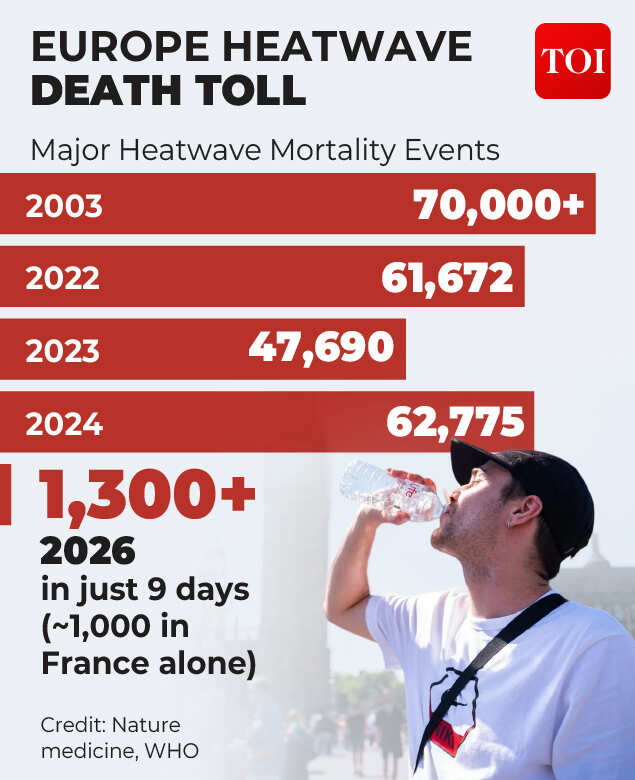
The most fatal heatwaves in Europe in the recent past
High humidity limits the body’s ability to cool itself through sweating. “Even at 38°C, if the relative humidity is 90%, you can die. But at 42°C or 43°C with around 40% humidity, people may be able to cope,” he says.The risk rises further for people doing physical labour, because the body is producing its own heat even as it is exposed to high outdoor temperatures.Europe’s buildings are turning into heat trapsPerhaps the biggest danger is not daytime heat, but what happens after sunset.Historically, cooler nights allowed the human body to recover after hot afternoons. Increasingly, that relief is disappearing.Buildings absorb solar radiation through the day and release it slowly at night, a process scientists call heat storage. When outdoor temperatures remain high after sunset, homes do not cool naturally. The body remains under stress for longer, increasing health risks.This is particularly dangerous for older adults. WHO has said heat-related mortality among people over 65 increased by around 85% between 2000-2004 and 2017-2021.The problem is worse in dense urban neighbourhoods with fewer trees, more concrete and limited green spaces. These areas often record temperatures several degrees higher than surrounding rural areas because of the urban heat island effect.In some cities, that difference can exceed 10°C during extreme heat.That is where Europe’s old design strength becomes a new weakness.For generations, architects designed homes to keep precious warmth inside. Thick masonry walls, compact apartments, insulated roofs, double-glazed windows and airtight construction became the norm because Europe spent far more time preparing for sub-zero winters than scorching summers.That design philosophy is now colliding with a hotter climate.“Any city that builds up too much concrete and steel absorbs much more heat and keeps radiating it till late at night. That phenomenon is global,” Dutta says.But he adds that the effect is not uniform across Europe. Some smaller cities cool down faster at night because they are less densely built, showing how urban design can influence the severity of heat stress.According to the European Environment Agency, climate change is exposing a dangerous mismatch between Europe’s built environment and today’s weather extremes. Many homes, hospitals, schools and care facilities were never designed to withstand prolonged periods of temperatures above 40°C.
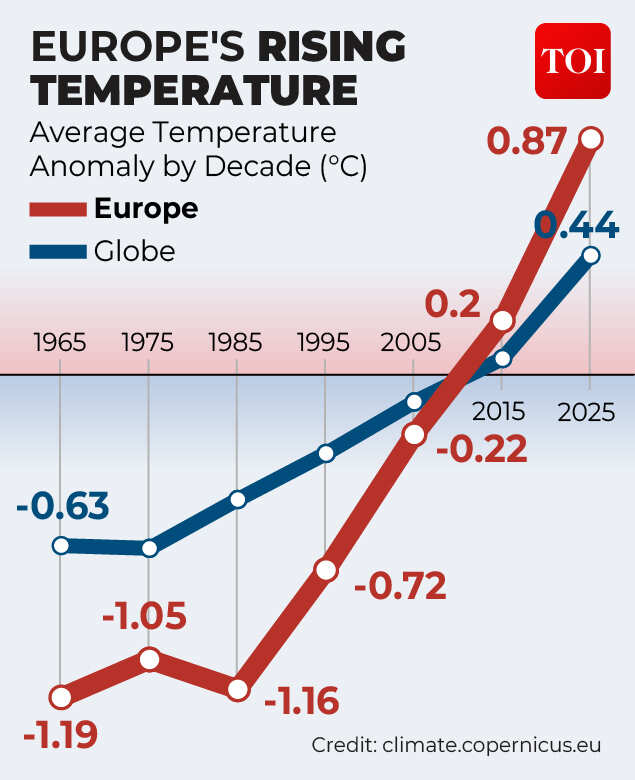
Why is Europe called the fastest-warming continent on Earth
The air-conditioning gap
Unlike many Asian and Middle Eastern cities, where air conditioning became common decades ago, large parts of Europe still rely on passive cooling and natural ventilation.About 20% of European homes have air conditioning, compared with around 90% in the United States, according to the International Energy Agency. Adoption varies widely. It is far higher in southern Europe, including Italy, but remains low in countries such as Britain.This creates a difficult policy question. Air conditioning can save lives during extreme heat, but if powered by fossil fuels or used inefficiently, it can increase electricity demand and worsen emissions.That is why urban planners argue that Europe’s future heat strategy cannot rely only on machines. Cities will also need shade, ventilation, water bodies, reflective roofs, greener streets and better building design.
Infrastructure is beginning to fail
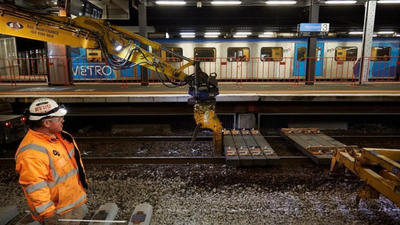
The effects of extreme heat now extend far beyond hospitals.Road surfaces soften. Railway tracks buckle. Construction work slows. Schools shut classrooms. Outdoor sporting events are cancelled. Electricity demand rises as cooling needs increase.At the same time, power generation itself can come under pressure.Several European nuclear plants have had to cut electricity generation because of reduced access to cooling water for reactors. In France, output fell by 4.1 gigawatts on June 24, equivalent to 7% of total midday power demand, according to data from utility EDF.This is the new infrastructure challenge facing Europe: systems designed around moderate summers are being pushed into conditions they were not built to handle.
The race to cool a continent
For decades, climate adaptation in Europe meant preparing for floods, storms and freezing winters. Today, scientists say the conversation has shifted.The challenge is no longer only about surviving cold seasons. It is about redesigning entire cities to withstand relentless heat.The European Environment Agency says adaptation can no longer be treated as a distant environmental ambition. It has become an urgent public health necessity.
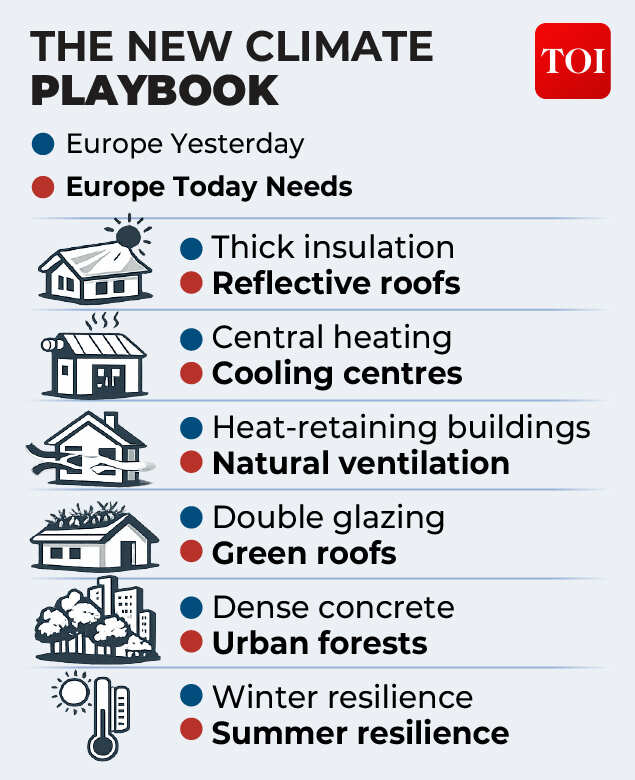
Several measures are already being adopted or discussed across European cities: expanding urban forests, planting tree-lined streets, installing green roofs and walls, using reflective “cool roofs”, laying lighter-coloured pavements, creating shaded pedestrian corridors, restoring wetlands and designing buildings with better cross-ventilation.The cities that cope best with future heatwaves may not be those with the most air conditioners. They may be the ones that stay cooler by design.Cooling centres are also becoming an important part of emergency planning. Cities including Paris, Athens, Madrid and Barcelona have expanded public cooling shelters during heat emergencies, giving residents, especially older adults and people without home cooling, a safer place to go during dangerous temperature spikes.Authorities have also begun mapping vulnerable neighbourhoods, checking on elderly residents living alone and issuing early heat-health warnings.WHO Europe says such interventions can save lives.
Europe’s new climate test
The nearly 1,000 excess deaths recorded during France’s latest heatwave are more than a public health statistic. They are a warning that Europe’s climate is changing faster than many of its cities, buildings and infrastructure systems can adapt.For centuries, Europe’s great climate challenge was keeping people warm.Now, in a hotter world, the same warmth can become a threat.A continent built to conserve heat must now learn how to release it. Its next test is not just surviving another hot summer, but redesigning homes, cities and public systems for a future where extreme heat is no longer the exception.