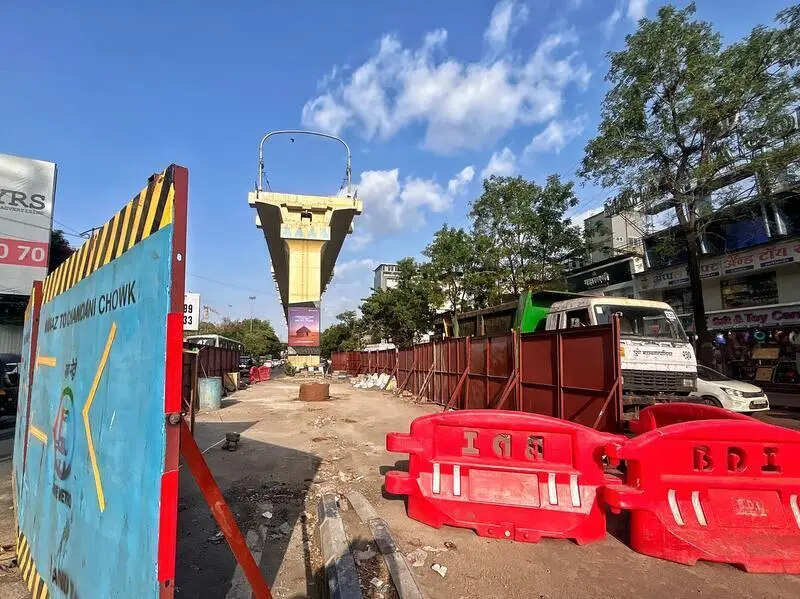
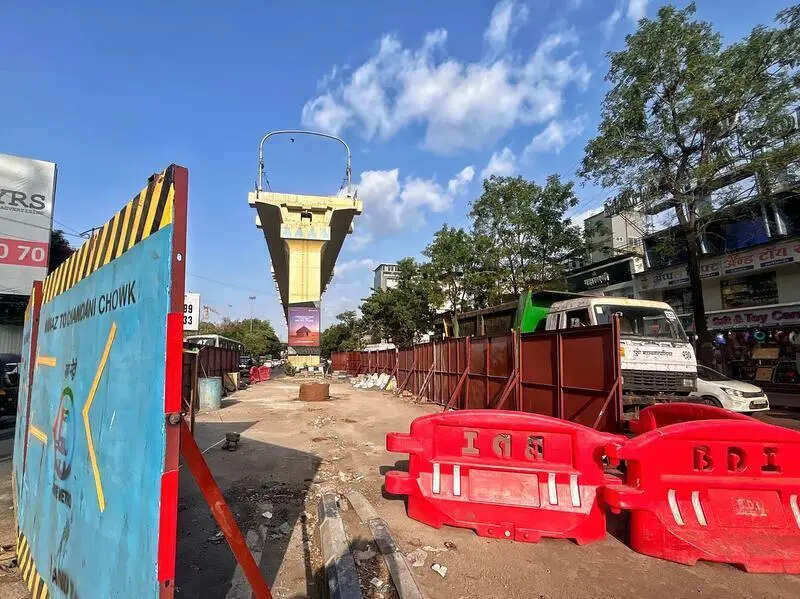
Pune: When the Union Cabinet cleared Pune Metro Phase 2 in June last year, the Vanaz–Chandni Chowk extension was billed as the missing piece that would finally bring rapid transit to one of the city’s most congested junctions — where Paud Road meets the Mumbai–Pune–Bengaluru highway.But the alignment now taking shape on the ground tells a different story. Residents of adjacent areas, including Bavdhan and Paud Road, already have a litany of doubts: Who benefits from infrastructure if citizens’ needs are not the central focus? Why are authorities not learning from previous mistakes? And why aren’t projects a solution to existing civic issues, but rather add to residents’ woes? Not really Chandni Chowk Work is already under way on the Vanaz–Chandni Chowk extension of the existing Aqua Line 2, with two Metro stations to be added — Kothrud Depot station and Chandni Chowk station near Lohia Jain IT Park. Those getting down at the latter will be greeted by a 500m-long elevated walkway, connecting Metro users on foot to a spot near Irani Cafe at Chandni Chowk, as well as to a foot over bridge (FOB) being built close by. Commenting on this, town planning expert Prathamesh Sawant told TOI, “Based on reports, the extension will terminate not exactly at Chandni Chowk, but roughly a km short of it at Lohia Jain IT Park. For a project of this scale, the gap is difficult to excuse. The Vanaz–Chandni Chowk line is already one of the shortest additions in Phase 2, just over a km in length. To fall short of its own namesake destination within so modest a distance points to a basic failure of foresight, not an unfortunate technical surprise.” “While the official reason for the lack of extension is the elevated gradient, this is no unknowable variable that emerged mid-construction — it is determined by topography itself, which is data available from day one. That this was not accounted for when the Phase 1 viaduct was designed suggests either that the western extension was never seriously contemplated at that stage, or it was envisioned but the information never travelled between teams responsible for each phase,” said Sawant. He suggested, “Instead of the elevated walkway, a more grounded use of the same funds would be widening and properly designing footpaths between Lohia Jain IT Park and Chandni Chowk — continuous, well lit, and obstruction-free. This would cost less, service a wider range of users and reflect how people already move there, rather than asking them to adapt to a structure compensating for a planning shortfall. Does Pune Metro have a holistic vision for its western corridor, or is the network being extended sanction-by sanction-haphazardly, with each phase designed in isolation from what comes next?” Calling it a matter of concern, Sawant cautioned, “India’s cities offer a consistent warning on this front. Mumbai has poured close to a thousand crore rupees into its skywalk network since 2008, with several structures now underused, neglected, or demolished, including the once-flagship Bandra skywalk. Bengaluru’s experience is similar, with BBMP’s Iblur Junction skywalk left largely unused, and others plagued by broken lifts and poor accessibility. The pattern is consistent enough to warrant real scrutiny before Pune repeats the same.” Others agreed. Former head of College of Engineering Pune Technological University’s (CoEPTU) town planning department, Dr Pratap Raval, said the Metro alignment need to be evaluated from the perspective of long-term urban mobility and integration with surrounding neighbourhoods. “Bavdhan and Bhugaon are rapidly growing residential areas with significant travel demand. During the planning of any Metro corridor, it is important to ensure that major residential, commercial, and institutional areas are effectively connected through stations and efficient first- and last-mile access. If constraints like difficult terrain or steep gradients influence alignment, these should be carefully assessed during planning and design stages so that engineering or alignment alternatives can be explored,” Raval said. He reiterated that high-quality first- and last-mile connectivity is an essential support. “While Metro projects encourage public transport, walking, and cycling, this requires continuous footpaths, safe pedestrian crossings, dedicated cycling infrastructure, and seamless integration with feeder services. Depending on local conditions, park-and-ride facilities may also be considered at select stations to improve accessibility. Successful Metro systems depend not only on the rail corridor but also on coordinated planning among transport, urban development, and civic agencies. Better inter-agency coordination from the planning stage through implementation helps optimise public investment and reduces the need for future costly modifications,” he reasoned. Bavdhan left behind Contrary to what experts suggest, residents of Bavdhan — next door to the new line — said nothing has changed for them with this much-touted Metro extension, although those living along Paud Road and near right and left Bhusari Colony will benefit from it. “While it’s good that the station has come a bit closer now, nothing else changes in our public transport experience. The lack of share autos, feeder buses and parking persists. How do authorities expect ridership to rise if they don’t give us proper means to access the Metro?” asked Manish Deo, core-member of the Bavdhan Citizens’ Forum (BCF). In Nov last year, BCF conducted a survey among Bavdhan residents and submitted their demands to Maha Metro — better connectivity topped the list. “Unfortunately, such projects are primarily profit-driven. Citizens are not at the centre of the planning process,” said Dushyant Bhatia, another BCF core-member, adding, “It will not be possible for Metro tracks to be elevated above the current height of Chandni Chowk flyovers. But Maha Metro and National Highways Authority of India (NHAI) officials should have considered this much earlier. It is wasted potential. Having a station closer, yet accessible only with great difficulty, is not going to bring in ridership from Bavdhan.” According to Bhatia, “We asked authorities for some basic facilities to make it easier for hundreds of Bavdhan residents to use the Metro, but nothing has happened yet. Unless there is first- and last-mile connectivity, the purpose of building Metro lines — and curbing pollution by reducing private vehicle use — is defeated.” Both Raval and Sawant also proposed that authorities focus on increasing connectivity from various parts of Bavdhan and Bhugaon to the Metro line, either by hiring small feeder buses or liaisoning with PMPML and various autorickshaw unions. Flyover forms flashpoint Besides these plans, authorities had also proposed a closely located flyover on Paud Road, ending just after Kothrud Depot. However, residents said this bridge would only add to traffic chaos on the stretch. Kothrud resident Prashant Kanojia said, “The flyover only avoids Kothrud Depot traffic signal, and does not much else. There is already a lot of traffic on this route and the flyover will create a bottleneck where it starts and ends. When planning, authorities need to also consider how much the area will grow. Without this, we are simply building and demolishing infra structure at the slightest hint of inconvenience.” For the last several weeks, Kanojia — founder of the Kothrud Citizens’ Forum — has with other residents and forum members been meeting officials to present a list of suggestions and demands regarding the Metro extension and flyover project. Their main ask is to prepare a new plan based on needs of people living in and around Paud Road. They have proposed another location for the flyover based on the old development plan (DP) to avoid a bottleneck. On June 30, a meeting was held with KCF members, Union minister of state Murlidhar Mohol, Pune Municipal Corporation (PMC) commissioner Naval Kishore Ram, Maha Metro managing director Shravan Hardikar, other officials from the Metro planning department, PMC city engineer Aniruddha Pawaskar, PMC chief engineer (projects) Dinkar Gojare and other civic body officials. “Traffic jams on Paud Road are not new. Authorities should have been aware of how a small flyover like this could affect commuters. There are a lot of commercial buildings on the route, so many people often haphazardly park to access shops. This also causes bottlenecks, which the flyover will add to. A parking facility in and around both proposed stations need to be thought about in the planning stage, too,” Kanojia said. “As far as access from Chandni Chowk and Bavdhan goes, 500m is a lot to walk, especially for senior citizens. It will not help with ridership. We have met with all authorities involved and they have assured us that they will revisit the plan and make amends based on the suggestions we gave them,” he added. ExpertSpeak ‘Coordinated approach crucial’ Pune’s Metro governance already involves several overlapping bodies: Maha Metro, PMRDA, PMC, and PWD, each with its own mandate and timeline. A coordinated planning process should have flagged this mismatch years before construction reached this point. Back then, correcting it would have meant a redrawn diagram rather than a km-long compromise baked into concrete and steel. That it surfaces only now, as the project nears execution, suggests that the western corridor was planned in segments rather than as a single coherent line, with each phase handed off with insufficient regard for what would need to follow. For a city investing thousands of crores of rupees into its Metro network, this is not a small administrative lapse. It is the kind of gap that erodes public confidence in whether these projects are planned holistically at all, or simply approved and built in whatever pieces happen to be ready — Prathamesh Sawant | Town planner & architect OfficialSpeak ‘PMC must provide parking where needed’ We can’t build over a certain height at Chandni Chowk and so, the planned Metro station is at Lohia Jain IT Park. These plans are made in consultation with PMC and as per the detailed project report (DPR) of the area. Providing parking is not within our purview. It is the responsibility of PMC to provide space and services to facilitate that. What we can do is encourage PMPML and autorickshaw unions to provide first- and last-mile connectivity. Our plans are in line with the city’s comprehensive mobility plan (CMP). In fact, we know of cases where commuters come to Nal Stop Metro station in a share-auto from Warje — Chandrashekhar Tambavekar | Additional general manager (administration & public relations), Maha Metro ‘31 spaces across 13 stations identified’ A basic parking policy is not a part of Metro’s planning as their focus is on channels of non-motorised transport. However, we have for the last month been working on identifying reserved parking spaces within 300-500m from Metro stations for two- and three-wheelers. We have identified 31 spaces across 13 stations as of now, and the process is ongoing. We will start developing these into designated parking spaces for Metro users soon — Dinkar Gojare | Chief engineer, projects department, PMC