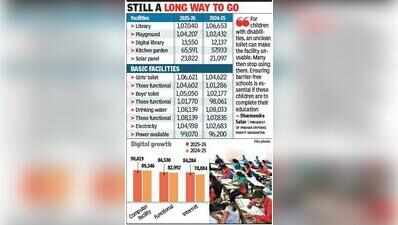
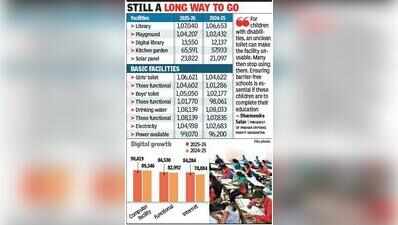
Pune: Maharashtra’s classrooms are still grappling with some of the most basic facilities despite hosting country’s second-largest school enrolments at 2.16 crore students. Fresh UDISE Plus 2025-26 data shows that more than 9,900 schools across the state continue to lack functional toilets for girls and boys, exposing a stark gap between infrastructure claimed on paper and facilities that actually work on the ground.According to the data, while over one lakh schools are officially connected to the electricity grid, only 99,070 have functional power supply, casting a shadow over the National Education Policy 2020’s push for digital learning. Educators said the problem was not the absence of infrastructure but its slow deterioration through neglect.Education experts said the difference between infrastructure being “available” and being “functional” was often caused by broken equipment, delayed maintenance, unpaid electricity bills, poor internet connectivity in remote areas, obsolete computers and inadequate technical support. “This is a common problem. Even a school shown as having 100% drinking water facilities may not actually provide water throughout the year. During data collection, photographs of tanks or taps are uploaded, but nobody checks whether water is regularly available or whether facilities are maintained. The same applies to toilets, computers and internet services, especially in remote areas,” Mahendra Ganpule, spokesperson for the Maharashtra School Principals’ Federation, said.He said schools often lose power because of unpaid electricity bills.While Maharashtra recorded notable progress in sanitation facilities and accessibility measures for Children With Special Needs (CWSN) between 2024-25 and 2025-26, disability rights advocates said significant gaps remained. Nearly 32,228 or 29.8% of the total schools, still do not have dedicated toilets for CWSN. Although only 3,845 schools lack ramp access, 16,341 schools have ramps without handrails, limiting safe access for many students.Dharmendra Satav, president of Prahar Divyang Kranti Sanghatna, said the issue was not a lack of policy but poor implementation. “The dropout rate among CWSN students is already high, and inaccessible schools only make matters worse. Even where dedicated toilets exist, they are often poorly maintained. For children with locomotor or visual impairments, an unclean toilet can make the facility unusable. As a result, many stop using school toilets altogether. Ensuring barrier-free schools is essential if these children are to complete their education, pursue higher studies and gain employment opportunities,” he said.Satav also pointed to broader systemic failures, saying even the state disability commissionerate’s office was yet to become fully barrier-free. “If government institutions themselves do not meet accessibility standards, it becomes difficult to expect compliance elsewhere,” he said.The figures underscore a persistent challenge for Maharashtra: moving beyond infrastructure on paper to ensuring schools are equipped with facilities that function consistently throughout the year, particularly in remote and underserved regions.