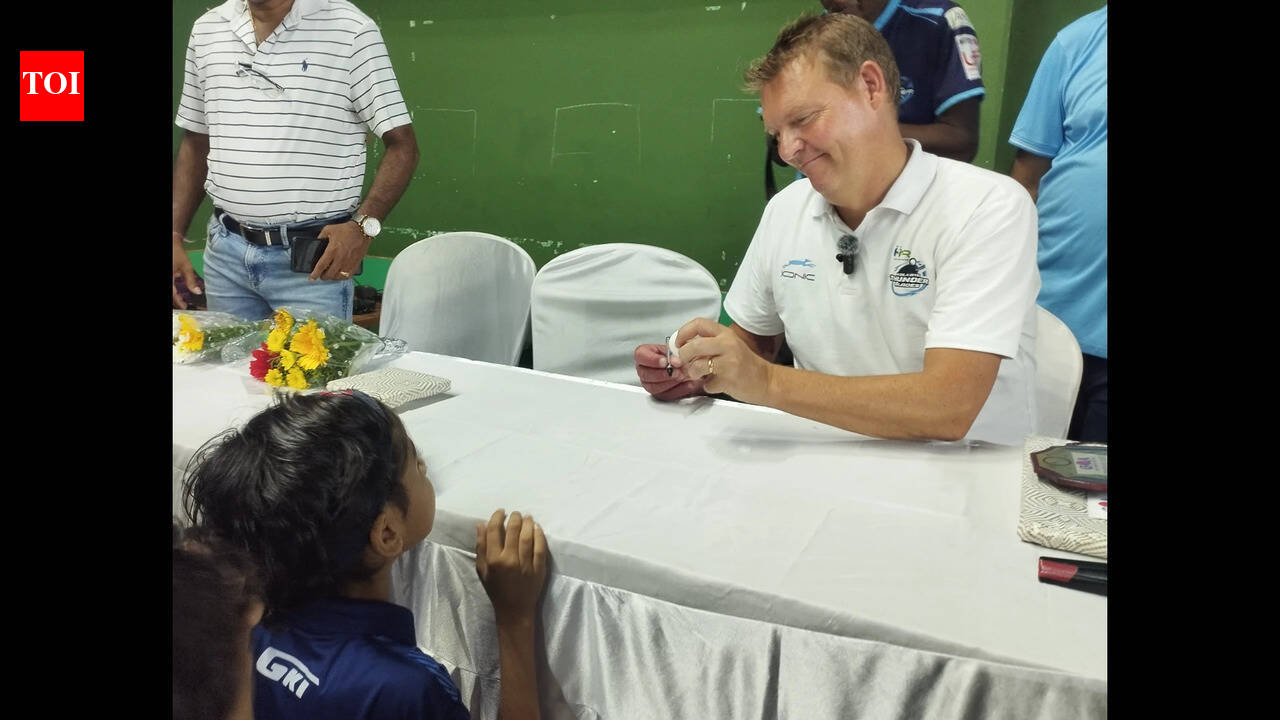
Margao: Around 30 young paddlers had a day to remember as they met five-time world table tennis champion Peter Karlsson at an event hosted by Kolkata Thunder Blades in association with GTTA at Fatorda on Wednesday.Interacting with young paddlers and their parents, Karlsson, 57, emphasised on the importance of being positive.“We can have extremely big support with positivity,” said the former world No 11. “When you become nervous during a match, self-talk. It is fine to be nervous and still play well, but you must train harder.”Karlsson is a five-time world champion; four times in team event, and once, in doubles. He is also a six-time European champion. The former star believes India has the potential and will challenge China’s undisputed might in the future.“I came to India in 2007. Sport in India has progressed. Table tennis has benefitted from an active sports society, with plenty of academies. We can see the progress. For India, the best is yet to come. The next step is harder. With UTT, govt and private academies are doing a fantastic job, there is hope. India must turn good junior players into excellent seniors. India can be in the top five in the world. It is a challenge,” said Karlsson.China has long dominated table tennis. There is no escaping China’s influence in the world, but Karlsson believes India can measure up to the challenge.” China has a longer history. They have more top-quality trainers. India will get there. With the number of players India has, it needs to work intelligently and turn it to their advantage,” said the former European champion.A brand ambassador with Kolkata Thunder Blades, Karlsson has watched the talent here during the Ultimate Table Tennis (UTT) and is familiar with what they can achieve.“I was fortunate when I was young. Sweden had the best team, with a lot of champions, and that helped me. I became a world champ too. If you are in a good environment, ready to learn and reflect, you will learn a lot from your coach and teammates.“India players need to compete regularly. The academies should train and compete too (against each other). There has to be an exchange programmes,” said Karlsson.