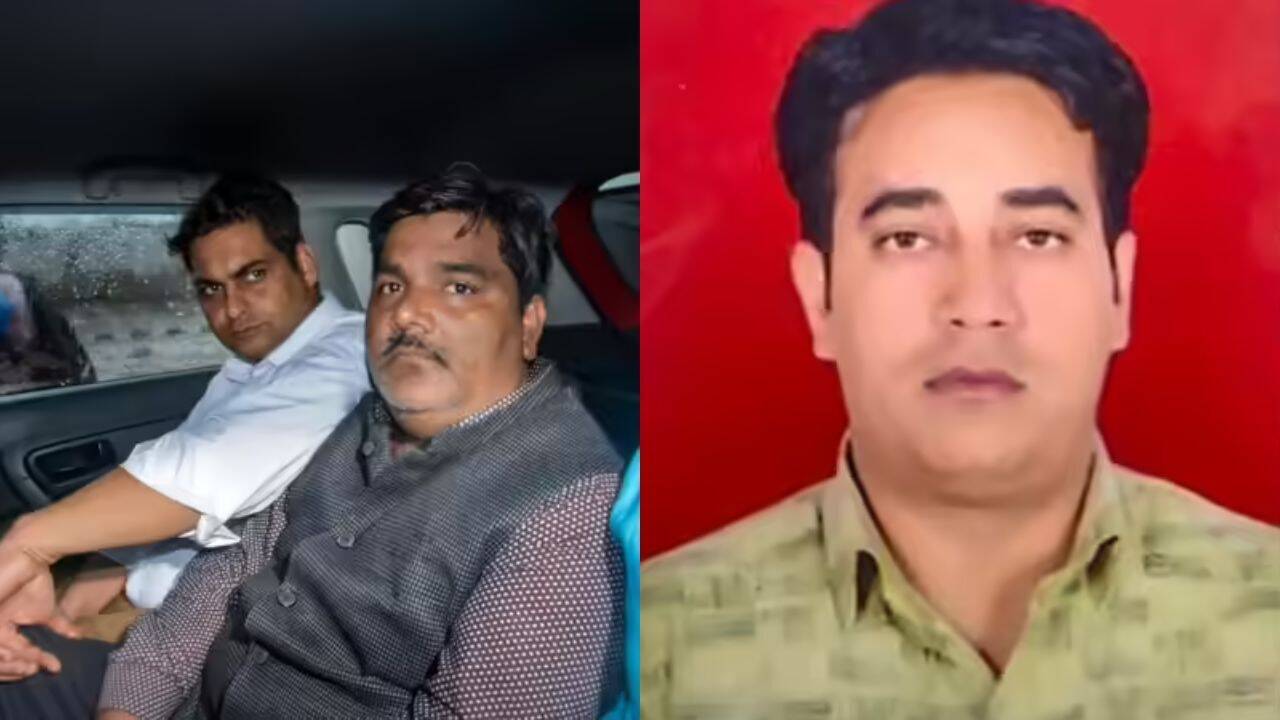
NEW DELHI: In its order convicting former AAP councillor Tahir Hussain and four others, the special riots court has underlined the “brutality” with which Intelligence Bureau (IB) officer Ankit Sharma was “surrounded and dragged by a murderously armed mob towards Chand Bagh Pulia” before being killed “in a savage and relentless assault” on Feb 25, 2020.Additional sessions judge Parveen Kumar Singh observed that an “unlawful assembly” had gathered “with animus against Hindus”.“As has already been found that this assembly was heavily armed with deadly weapons, it had a considerable strength of hundreds of people and had a shared object of arson, vandalism, rioting, looting and causing damage to property and person of the members of the rival community,” the court noted, while holding Hussain and the four others guilty.However, the court also flagged several shortcomings in police investigation, noting that police witnesses made “considerable improvements” in their statements, rendering them “unreliable”.Referring to three of the accused, Sameer, Nazim and Kasim — it acquitted Sameer — the court pointed to the “serendipitous” discovery of witnesses as they turned up every time police took the three to the crime spot.“When it comes to believing that by virtue of coincidence these witnesses would be near the scene of crime on the same days and at the exact same time when the investigating officer (IO) would bring the three accused for spot identification, I find it too serendipitous,” the judge noted.He also criticised the failure of the IO to pursue a lead where DNA from blood found on a knife and clothes recovered from Nazeem and one Haseen alias Mullaji — he was acquitted — wasn’t that of the IB officer, but of a second possible victim.Calling it a clear connection between Nazeem and Haseen, the judge indicated police had not done enough to rule out “the possibility of another crime.”In its over 300 page order, the court also referred to Sharma’s post-mortem report to note that the “number of injuries is reflective of the manner and the brutality inflicted upon the deceased,” adding that to “any layman”, they clearly indicated murder.Sharma was killed between 4 pm and 5.30 pm on the main Karawal Nagar Road near Chand Bagh Pulia. The court observed that his body was thrown into a drain beneath the bridge.Although the court was forced to acquit all the accused on the charge of criminal conspiracy due to failure of the prosecution to table conclusive evidence, the judge said, “the fact that CCTV cameras around the area had either been damaged or had been covered or turned away points towards pre-planning, and thus the fact, that a conspiracy might have been afoot”.It noted, “However, no evidence had been led by the State to prove when, where and how this conspiracy was hatched and who all were the conspirators… therefore, there is no evidence against accused Tahir Hussain and for that matter, against any of the accused which can lead to their conviction under Section 120B of IPC”.On the issue of common liability, the court reaffirmed the principle of shared criminal responsibility, observing that “Section 149 of IPC fastens a vicarious criminal liability on every member of an unlawful assembly for any offence which is committed in prosecution of the common object of such an assembly”.It rejected the defence’s argument that the complaint of Ravinder Sharma, the deceased’s father, had been altered merely to introduce Hussain’s name “to satisfy public sentiment”.Noting that Ravinder had accompanied police to Hussain’s residence while searching for his missing son, the judge said this “clearly establishes that even before the recovery of the dead body, suspicion had already arisen regarding the involvement of Hussain”.In his earlier judgments in connection with the 2020 riots, ASJ Singh had on several occasions castigated the investigation carried out by police, resulting in the court acquitting a number of accused.In an unrelated case regarding terror funding, the judge had convicted Kashmiri separatist Yasin Malik.