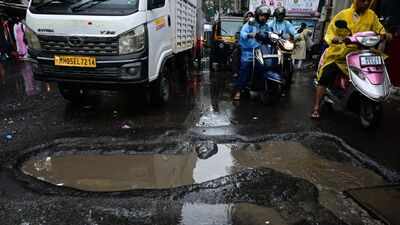
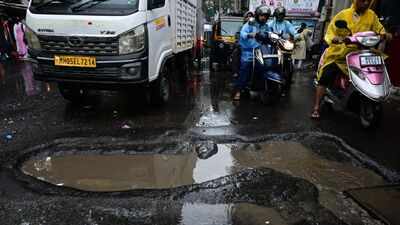
Year after year Indian cities spend hundreds of crores on filling up potholes that reappear with the next bout of heavy rain.Roads are tarred before the monsoon, only to crack, cave in and develop potholes in weeks. Emergency tenders are floated, traffic crawls, commuters and vehicle owners lose productive hours and pay dearly for damaged tyres, suspensions and wheel alignments.
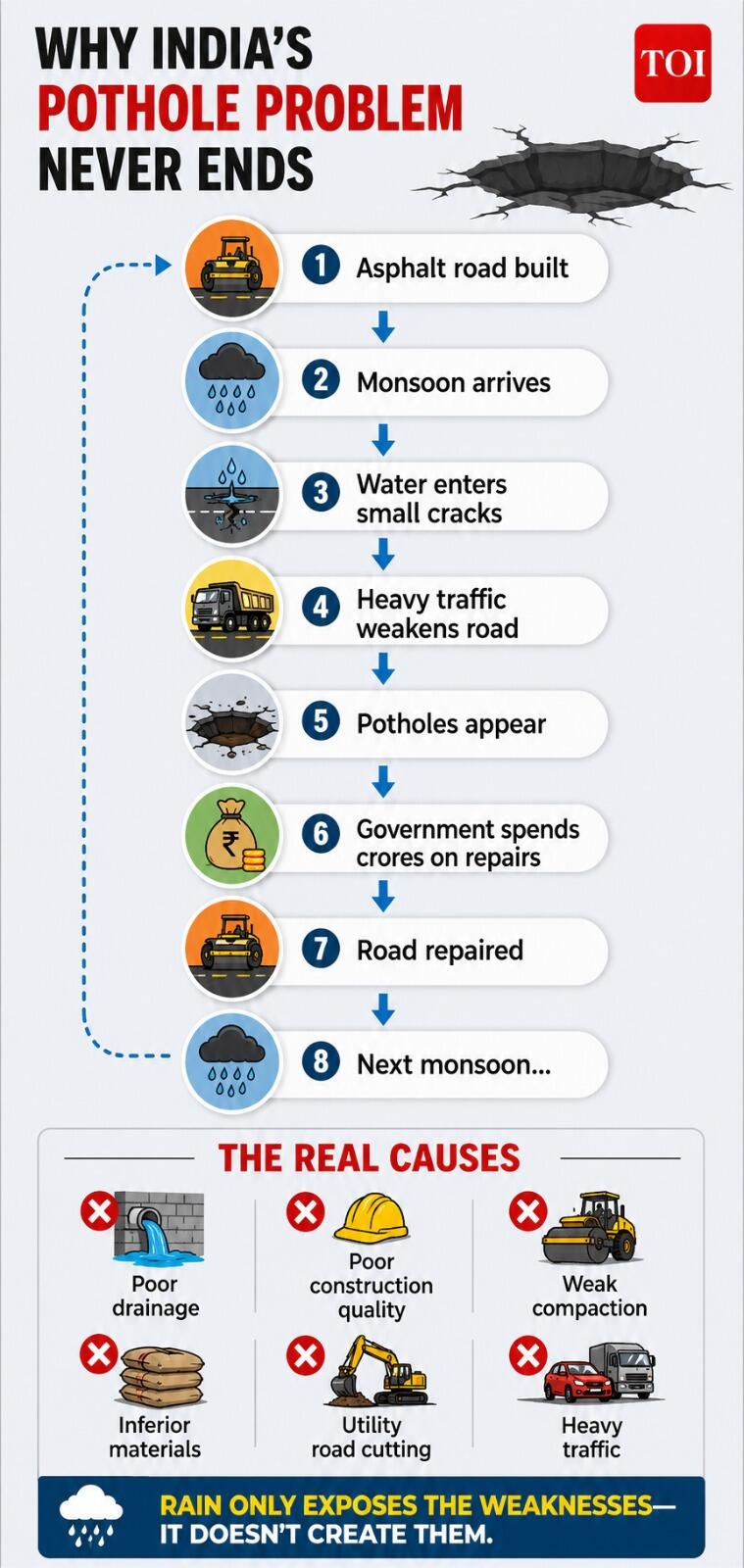
Why India’s pothole problem never ends
This cycle repeats itself year after year with pothole repairs becoming a persistent burden on taxpayers.The rain itself is not the real enemy, say the engineers. The potholes are primarily caused by bad road design, poor drainage, shoddy construction, repeated digging up for utilities and India’s overwhelming dependence on asphalt roads that don’t last long under heavy traffic and monsoon conditions. Experts increasingly believe the country needs to stop fixing roads each year and start building roads that last for decades.Mumbai gets a sneak peek of what permanent roads might look likeMumbai has become the biggest testing ground for cement concrete (CC) roads in India. Before 2022, almost 1,200 km of its approximately 2,050 km road network had been concretised. Another 677 km is being upgraded under the Rs 17,000 crore mega-concretisation project of the Brihanmumbai Municipal Corporation (BMC). The Maharashtra government aims to have almost 95% of Mumbai’s roads concreted by 2027.The best reason for concrete roads is money. BMC’s expenditure on pothole repairs has decreased gradually as more roads have been concretised. Annual expenditure decreased from Rs 202 crore in 2023-24 to Rs 156 crore in 2024-25 and about Rs 89 crore in 2025-26. The actual expenditure has been reduced even further, said chief minister Devendra Fadnavis. The numbers might be different, but the trend is clear: more concrete roads mean less money spent on maintenance and fewer potholes.
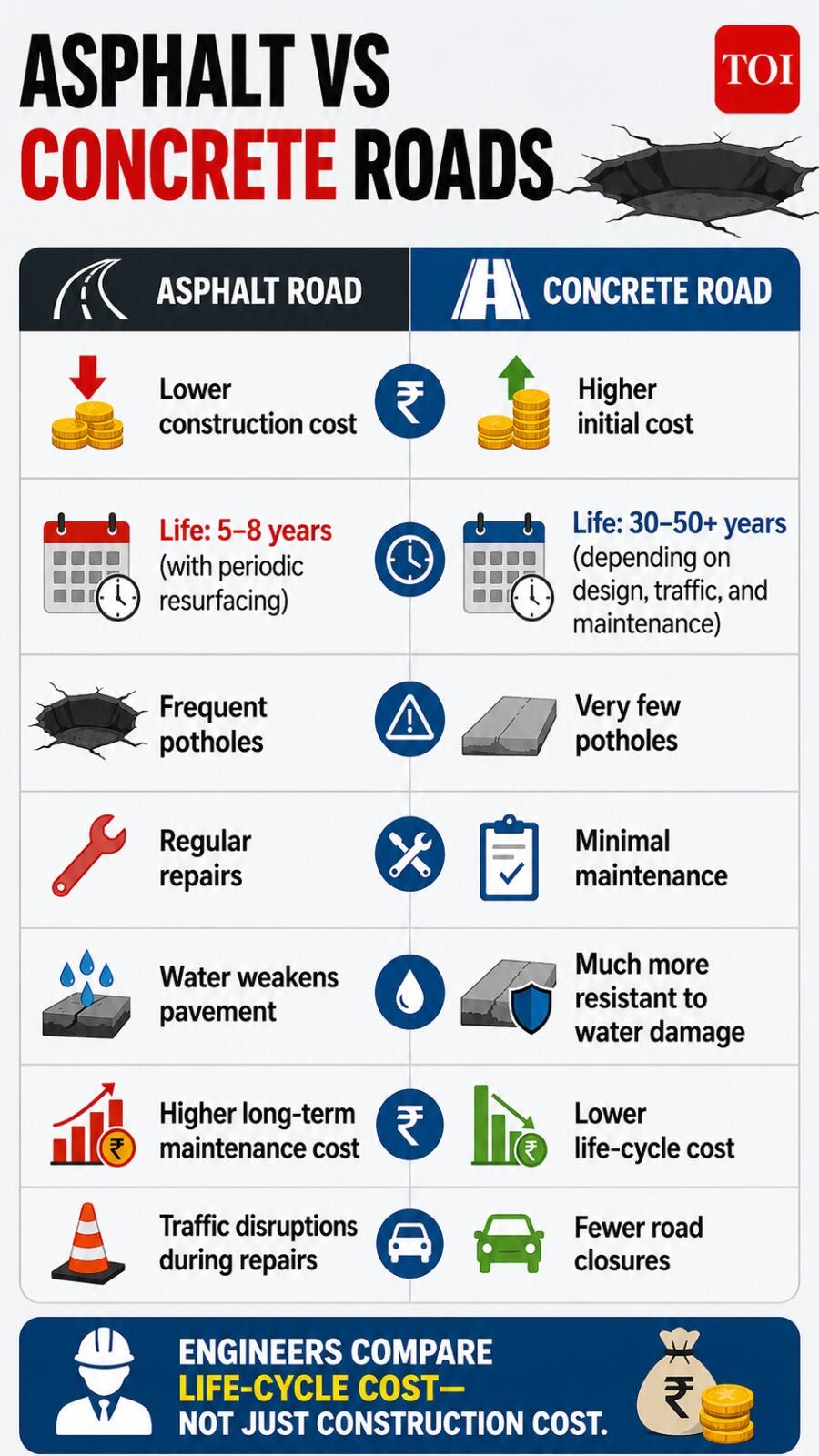
Asphalt vs concrete roads
Why concrete roads last longerIt’s engineering that counts. Asphalt roads are made with bitumen which softens under high temperatures and is weakened when water gets into surface cracks. Eventually, those weak spots turn into potholes as constant traffic from heavy vehicles pounds them.Concrete roads are another thing. They are rigid pavements that allow the surface to continuously deform instead spreading the vehicle loads on large slabs. Concrete expands and contracts with temperature change and small cracks can appear. These are not potholes and are controlled with expansion joints. Well designed and constructed concrete roads can give 50 years service or more with relatively little maintenance. Experts say potholes are man-made, not rain-made. Normally, poor workmanship, poor compaction, poor drainage, inferior materials and repeated digging are the causes of road failures.More expensive upfront, but much lower total costConcrete roads are generally two to two and a half times more expensive to build than asphalt. Typically, critics end the comparison there. Engineers say the comparison should be for the whole life of the road.
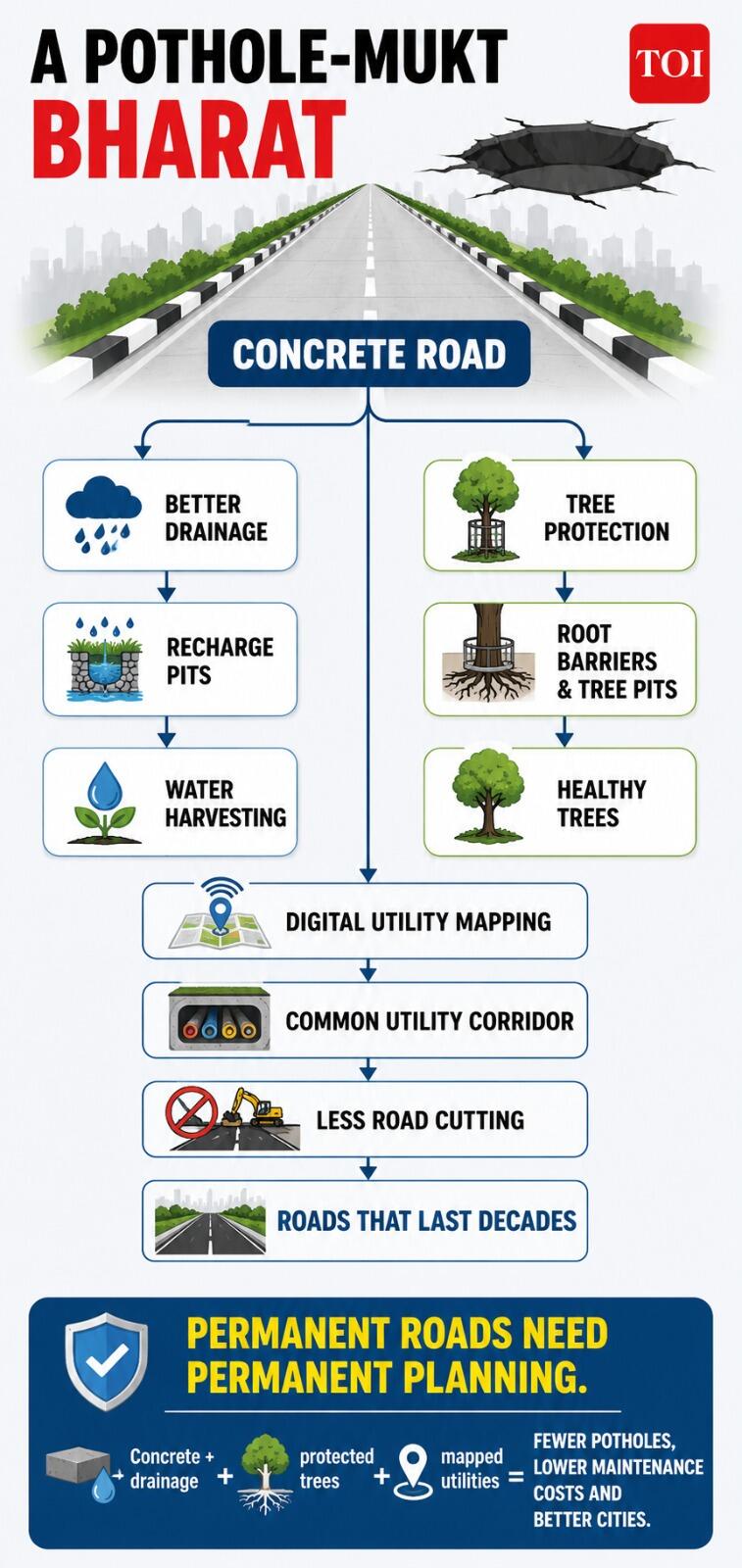
Asphalt will need to be resurfaced and repaired many times over its life span. Concrete is more expensive initially but much less to maintain for decades. Concrete roads are more economical in the long run, many experts say, when you factor in recurring repair bills, traffic disruptions, vehicle damage, fuel wastage and productivity losses.The hidden economic costs of potholes are huge. Slow traffic means more fuel consumption, loss of productive hours for businesses, delays in emergency services and an increase in road accidents, especially for two-wheelers during the monsoons. These costs are rarely included in government budgets, but they are ultimately paid by citizens.The facts are also worth noting – as are the environmental concernsConcrete roads are also environmentally friendly. Fewer rebuild cycles mean less movement of construction machinery and materials. They last longer. They also reduce reliance on bitumen, a petroleum product. Their lighter surface reflects more sunlight and can improve night-time visibility. A few engineering studies suggest that using concrete as a road surface could reduce rolling resistance and improve fuel efficiency, particularly for heavy commercial vehicles.Don’t blame the concrete roads when a tree fallsAnother criticism that is often heard after every monsoon is that concrete roads are responsible whenever roadside trees collapse. The problem is much more complicated, experts say. The fact that the road next to them is concrete does not mean that the trees fall for that reason. Trees fall because of aging, fungal decay, damaged roots, bad soil, waterlogging, repeated trenching for underground utilities or strong winds.Modern road engineering permits concrete roads and trees to coexist by incorporating well-designed tree pits, structural soils, root barriers and permeable spaces around tree bases. Urban planners say it’s poor planning, not concrete, that is usually to blame for unstable trees. It is far more important to do better audits of tree health and protect root zones during construction than to give up durable roads.Roads should also gather rainwaterExperts say that cities spending thousands of crores on permanent roads should also improve urban water management at the same time. Recharge pits, infiltration trenches, bioswales and scientifically designed drainage systems should be standard features of major road projects. These actions can help reduce flooding and recharge groundwater.Road building should be viewed as part of a broader urban infrastructure strategy, not as an individual engineering project.The biggest challenge is below the roadThe biggest obstacle to concrete roads is, ironically, the underground infrastructure. Indian cities often have to dig up roads to repair water pipelines, sewer lines, electricity cables, gas pipelines and telecom networks. Asphalt roads can be restored without much difficulty. Concrete highways cannot.Urban planners say the long-term solution is to create. Common Utility Corridors that carry multiple underground services together so maintenance can be done without cutting open roads over and over. Governments should also do all underground utility work before road concretisation, digitally map all utilities using GIS technology and increasingly adopt no-dig methods such as Horizontal Directional Drilling. Heavy penalties for unnecessary road cutting would do much to protect costly public infrastructure.The road before usMumbai is not the only one. Nagpur has long been showing off durable concrete roads. Pune, Surat, Indore and Hyderabad are now increasingly using concrete on busy corridors where long term performance is more important than higher construction costs. Countries such as Germany Japan and the United States also rely heavily on concrete pavements for high traffic roads requiring decades of service.Concrete roads aren’t the cure-all. They are more expensive up front, require better planning and raise legitimate environmental concerns. But India’s annual war with potholes shows that endless patching up of failing asphalt roads is neither economical nor sustainable. With concrete roads along with scientific drainage, stormwater harvesting, protected trees, digitally mapped utilities and common utility corridors, India could finally inch closer to the long-envisioned goal of a pothole-mukt Bharat.
What do you think is the main cause of potholes in Indian cities?
3k+ users shared opinion today
5k+ users already voted today
3k+ users shared opinion today
The question for India is no longer whether it can afford to build more concrete roads. Increasingly, it may be whether the country can afford not to.