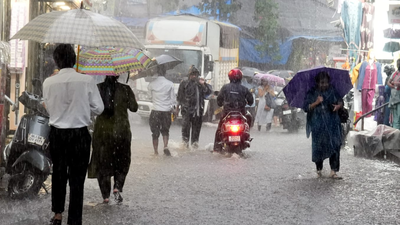
MUMBAI: June ended with Mumbai recording significantly less rainfall than its long-period average, even as the India Meteorological Department (IMD) issued a forecast for heavy to very heavy showers in the first week of July. The IMD’s Colaba observatory recorded 441.1 mm of rainfall between June 1 and 30 (81% of its normal June rainfall of 542.3 mm.) The Santacruz observatory recorded 416.4 mm, or 77% of its June normal of 537.1 mm.For south Mumbai, this was the lowest June rainfall in the last three years. Colaba had recorded 592 mm in June 2025 and 507 mm in June 2024. In the suburbs, Santacruz also received considerably less rain than the 592 mm recorded in June last year. The below-normal June rainfall doesn’t come as a surprise as the month saw a delayed start to the monsoon on June 23 which was the second most late arrival ever. It was only after the onset that, the rain deficit for the season began narrowing. In fact Mumbai was drenched by extremely heavy overnight rainfall in the first 24 hours of monsoon onset, as in the 24-hour period ending 8.30 am between June 23-24 IMD Colaba recorded 247.8 mm of rainfall and 224.8 mm at Santacruz observatory. The second significant shower came between June 28-29 when the IMD’s Santacruz observatory recorded 104 mm of rain in the 24 hours ending 8.30 am, the Colaba observatory in south Mumbai logged just 30.4 mm. The first major spell of monsoon showers turned tragic, when an 11-year-old student was killed after a roadside peepal tree fell on a school bus in Chembur in the afternoon. The incident occurred around 2.58pm near a building on Road No. 11. Fire Brigade and other agencies rushed to the spot and evacuated all 12 students, including two children who were trapped inside the bus.Five injured students were taken to a nearby hospital, where four were reported to be stable. However, 11-year-old Vihan Srivastava, who suffered serious injuries, was declared dead around 4.30pm. The bus was carrying students of Universal High School. The School Bus Owners’ Association raised concerns over civic preparedness and preventive maintenance, saying the incident raised questions over authorities responsible for public safety.Meanwhile IMD has issued an orange alert for Mumbai, Thane and Palghar from July 1 to 4, forecasting heavy to very heavy rainfall at isolated places. Raigad has been placed under a red alert for July 2, indicating the likelihood of extremely heavy rainfall in isolated areas.”A low-pressure area is likely to form over the northwest Bay of Bengal around July 3, which is expected to trigger an active monsoon phase over central India during the week,” said the IMD.On Tuesday rainfall was recorded throughout the day with the IMD Colaba and Santacruz observatory recording 25.4 mm and 14.1 mm in the nine hours ending 5.30 pm.“The unusual rainfall pattern in June reflected the prevailing synoptic conditions during the month. The combination of weak monsoon westerlies and a persistent East–West shear zone prevented deep moisture penetration. Instead of sustained orographic rainfall, precipitation occurred mainly through localized, stationary thunderstorm cells, resulting in highly uneven rainfall distribution and leaving much of the ghat and interior belt significantly drier than normal,” said weather observer Abhijit ModakThe rainfall deficit has also reflected in the catchment areas of the seven lakes supplying Mumbai, where inflows have remained poor. As of Tuesday, the combined water stock stood at just 97666 million litres or 6.75% of total capacity as compared to 5.82 lakh million litres or 40% on the same date last year.