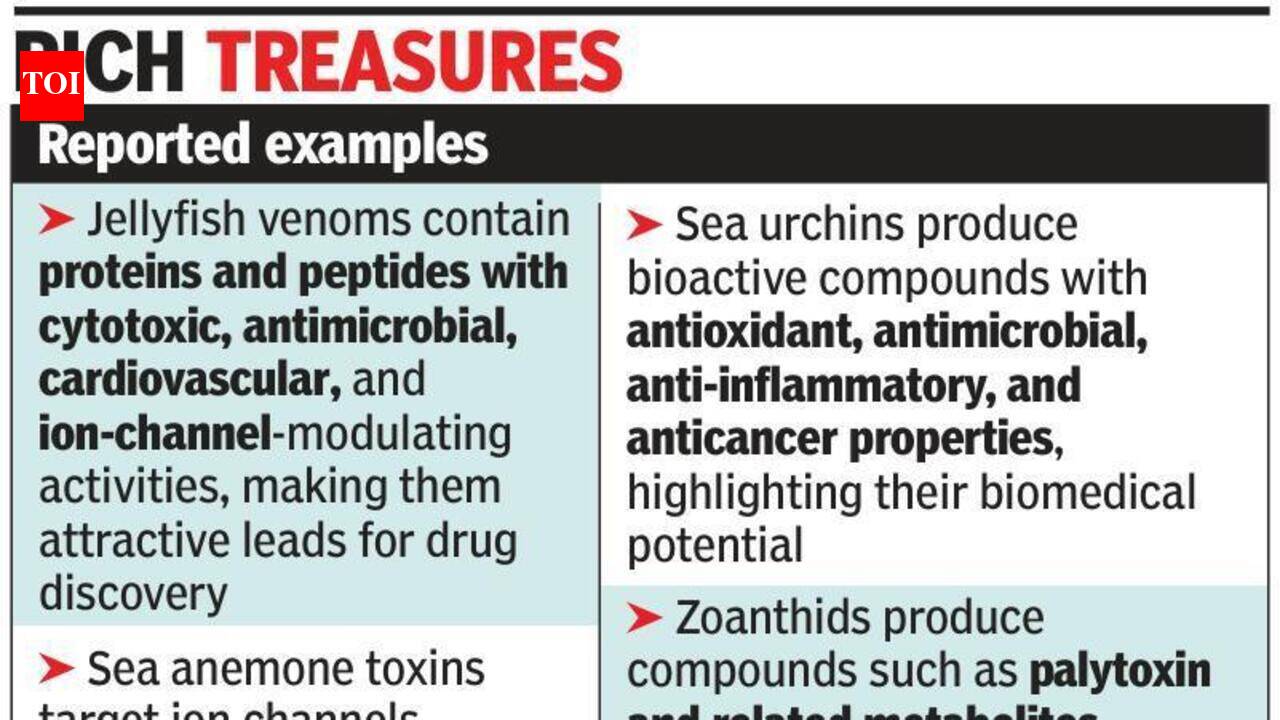
Panaji: Scientists at CSIR-National Institute of Oceanography (NIO), Dona Paula, Goa are studying some of the ocean’s most unusual marine animals that produce venom to find compounds that could help make new medicines for pain relief, fighting infections, and treating nerve-related diseases.This project began along the coast of Goa with support from the Council of Scientific and Industrial Research in 2024. Now, because it has been successful, scientists are expanding their work to study the selected intertidal rocky shores of the west coast of India in Veraval, Mumbai, Kunkeshwar, and Kumta.The researchers are carefully exploring beaches and underwater areas to find cone snails, jellyfish, sea anemones, zoanthids, and sea urchins, using advanced tools which help identify species by studying their genetic code.“DNA barcoding helps scientists accurately identify and classify species based on their genetic makeup, while LC-MS/MS analyses the chemical compounds and metabolites they produce. Combining these techniques allows researchers to link specific bioactive molecules to particular species, aiding biodiversity assessment and the discovery of new natural products,” said chief scientist Narsinh Thakur.They also study how these animals produce venom and what chemicals are inside it.Some compounds found in venomous marine organisms have already inspired medicines or are being studied for future drug development. For example, the cone snail venom peptide ziconotide has been developed into an FDA-approved drug for the treatment of severe chronic pain. Researchers are also investigating toxins from jellyfish, sea anemones, zoanthids, and sea urchins for their potential use in developing new treatments for cancer, inflammation, cardiovascular diseases, neurological disorders, and antibiotic-resistant infections. “These studies highlight the enormous pharmaceutical potential of marine venoms,” said Thakur.What makes this research exciting is that the venom from these marine animals may also help researchers better understand how the brain, nerves, and other body systems work, making marine venoms an important resource for future medical discoveries.“The work done in Goa is also helping scientists around the world. The information collected is being shared in global scientific databases, making India an important place for marine research. The biodiversity information collected during this research, including records of marine species and their DNA barcodes, is shared through global biodiversity databases. This helps scientists worldwide identify species, monitor marine biodiversity, and better understand the distribution and conservation status of marine organisms. By contributing this data, India plays an important role in documenting and preserving global marine biodiversity,” said Thakur.The future goals of this marine bioprospecting programme include expanding surveys along India’s coastline to document marine biodiversity, discovering new venomous species, and identifying novel compounds for marine natural product drug discovery. Researchers also aim to understand the ecological roles of these organisms, establish comprehensive biodiversity databases, and promote the conservation and sustainable utilization of India’s marine bioresources for future scientific and societal benefits.