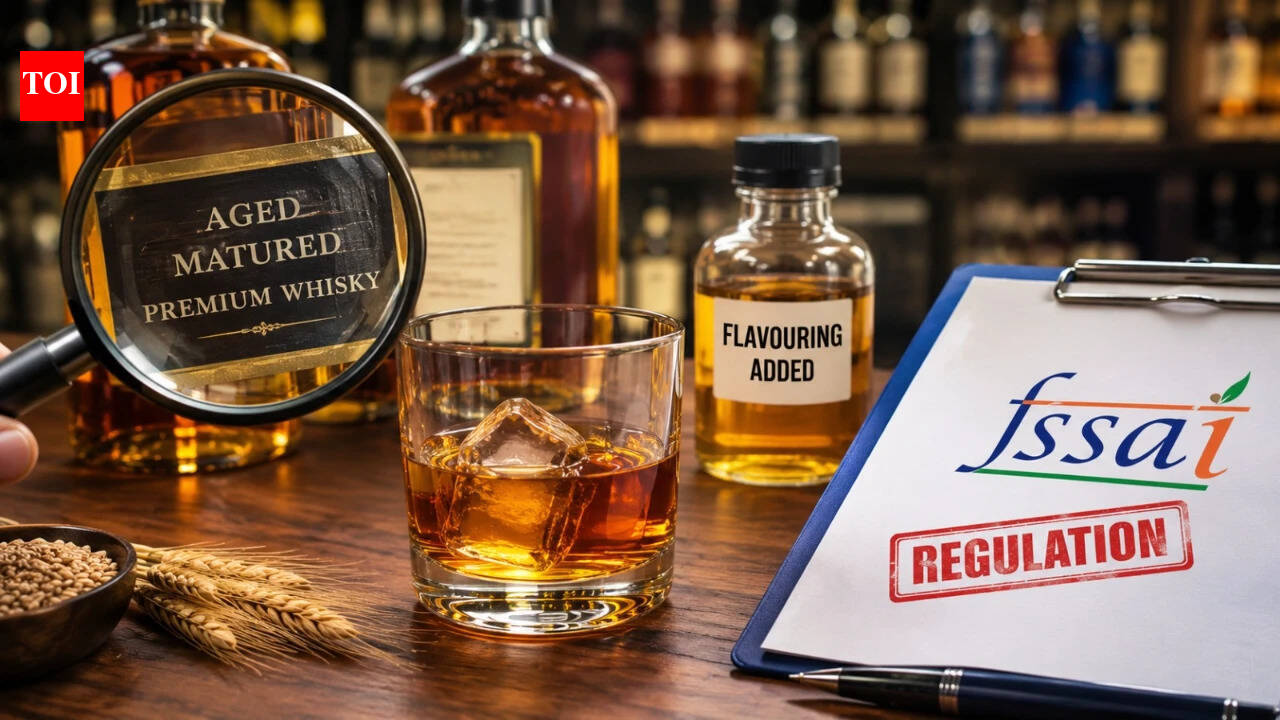

NEW DELHI: Next time you pour yourself a peg of whiskey, there may be one question worth asking before the first sip: is that distinctive taste really coming from the spirit, the wood, and years of maturation, or has some of it been recreated with added flavoring?That question has suddenly become relevant for Indian drinkers after the Food Safety and Standards Authority of India (FSSAI) stepped up scrutiny of alcoholic beverages over alleged violations involving flavor additives and age-related claims.
Problem is not just ‘flavored alcohol’
At the heart of the controversy is a distinction easily lost in the noise.FSSAI does not imply that all flavoring substances are illegal in all alcoholic drinks.It is concerned with the use of flavors to replicate the characteristic profile of a spirit in products where that character is expected to derive from the raw materials and the manufacturing process itself.In layman’s terms, the regulator is raising the issue of adding flavoring to make whiskey taste like whiskey or rum taste like rum, rather than through the processes that are prescribed for those spirits.That’s important because whiskey is not just a colored alcoholic liquid that smells familiar.The regulations governing alcoholic beverages in India specify that categories like whiskey, rum, gin, vodka, and brandy are to acquire their characteristic flavor from their raw materials and the methods of manufacture.The FSSAI has therefore taken exception to what it calls the addition of flavors to mimic the natural characteristics.Notices have been issued to manufacturers by the regulator asking why action should not be taken against them under the Food Safety and Standards Act, 2006.
So is your ‘aged; whiskey actually aged?
This situation is where the problem gets even more interesting for the consumer.Words such as ‘aged’ and ‘matured’ can create a very specific picture in the mind of the drinker: that the liquid in the bottle has been quietly resting in a wooden cask for years.
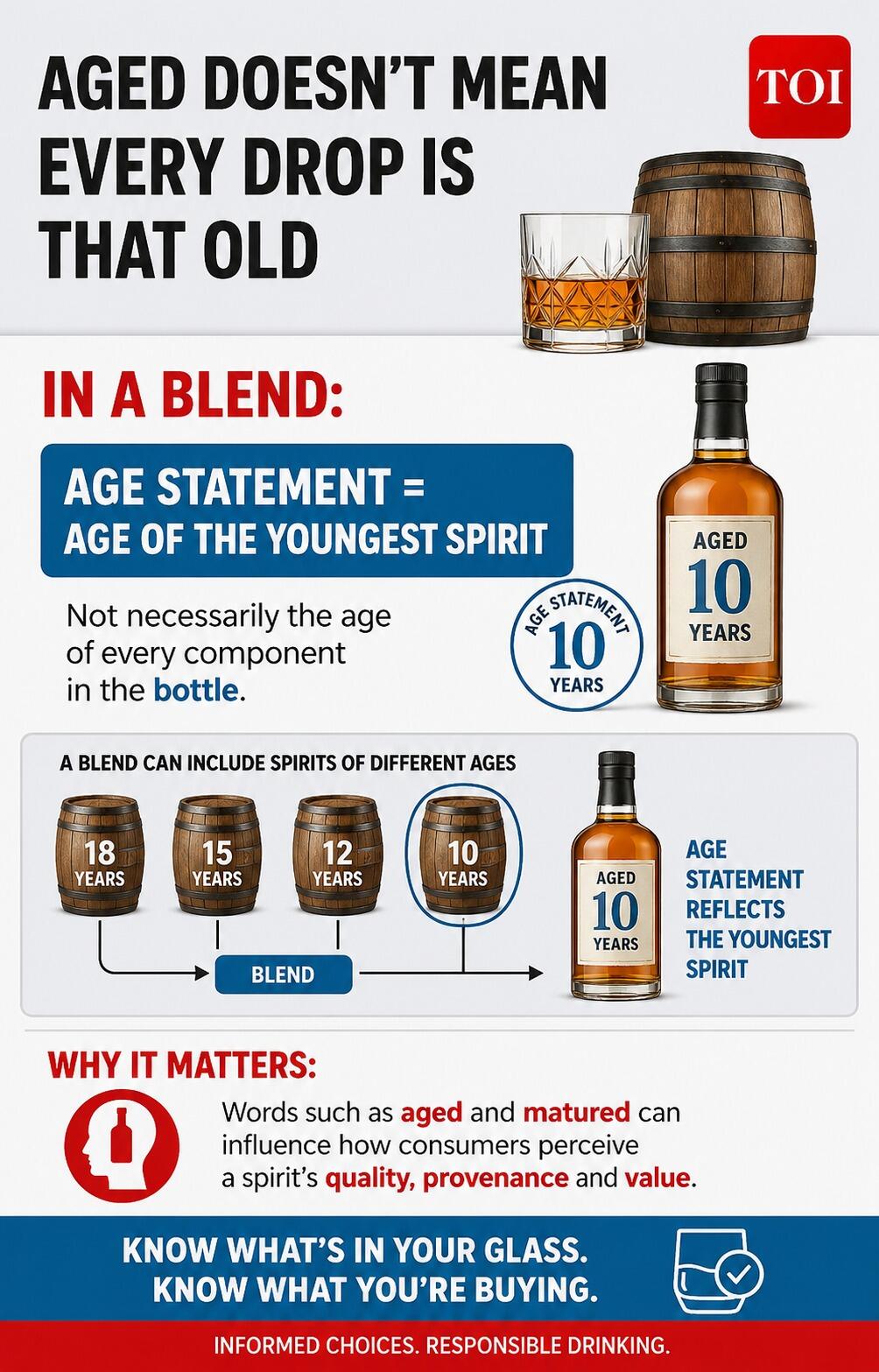
What does an age statement on blended whisky really mean?
But when a spirit is a blend, then the age has a specific regulatory meaning. The listed age is the youngest spirit in the blend, not the age of all components.That difference could be especially relevant in a marketplace where consumers are increasingly trading up, seeking premium-looking bottles, age statements, and words like ‘craftsmanship.’The FSSAI has noticed instances of age-related claims where the required disclosure was not made, which could lead to an impression different from that prescribed under the regulations for consumers.The regulator’s more general message is clear: labels should not create an impression of age, quality, or method of production that the product cannot support.
Why the taste question matters more than you think
Maturation is one of the most costly and time-intensive factors in spirit production.A cask of whiskey takes up storage space, ties up capital, and loses some liquid to evaporation over time.The flavor that develops is also affected by the spirit, the wood, temperature, maturation conditions, and the length of time involved.If a manufacturer can replicate some of those sensory characteristics by adding flavoring, the economics and the consumer proposition can look completely unique.
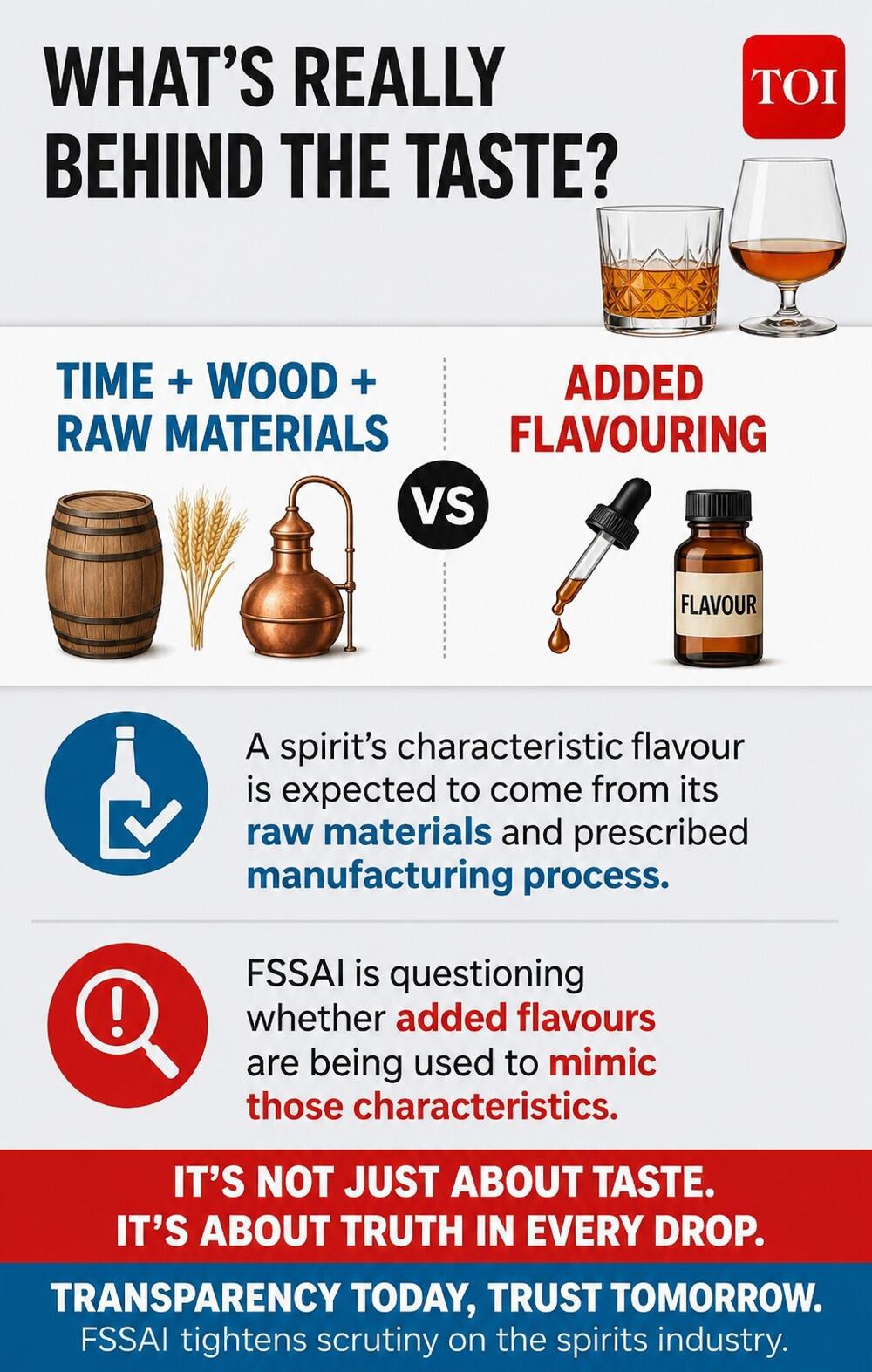
What’s behind the taste? FSSAI scrutinises added flavouring in spirits
This is why regulators distinguish between the natural character of a spirit and a flavor added to mimic it.That difference is becoming increasingly time-intensive.India’s alcohol market expands, and more consumers seek premium spirits.India is one of the markets that continued to grow, even as global beverage-alcohol volumes decreased by 2%.As per reports, by 2032 India will become the world’s second-largest alcohol market. This highlights why issues around composition, labeling, and authenticity are no longer niche industry concerns.
Indian whiskey drinkers are getting choosier
The timing of the crackdown is important.India is already one of the world’s largest whiskey markets, and premiumization is pulling consumers toward more expensive and differentiated offerings.India’s imported spirit volumes experienced steady compound annual growth over recent years, with a further increase expected in the coming years.This means consumers are not just buying alcohol for its strength or any labeling; they are increasingly paying for provenance, maturation, ingredients, craftsmanship, and the story behind the bottle.And that’s where the labeling is more important.If a consumer is willing to pay more for a bottle that seems to promise age, maturation, or a certain method of production, the information on the label is part of the product itself.A false statement is not necessary to create a misleading impression; omission of a qualification may alter the reasonable consumer’s understanding of what is in the bottle.FSSAI’s latest move essentially scrutinizes that principle.
This issue is bigger than a bottle or a category
The regulatory action also indicates FSSAI’s expanding watch on alcoholic beverages.The regulator has carried out inspections, taken samples and taken action involving products alleged to contain artificial or nature-identical flavoring substances in recent weeks.For example, in Tamil Nadu, the state liquor seller halted sale of 11 varieties following FSSAI testing that allegedly detected artificial flavoring substances.Meanwhile, a wider industry investigation has included inspections and sampling of major manufacturing plants, though an inspection doesn’t necessarily mean a product has been found in violation.For the industry, the situation throws up an uncomfortable question of compliance: where exactly should regulators draw the line between legitimate processing aids, permitted flavoring, and flavoring intended to replicate the defining characteristics of the spirit itself?Some manufacturers have questioned parts of the FSSAI’s stand, saying that the rules around flavoring and labeling need to be clarified.That means the current controversy is likely to be resolved not just by enforcement but through consultations, court cases, and possibly clearer regulatory guidance.
What should consumers be looking for?
For drinkers the lesson is not to assume that all whiskey is artificially flavored or that all age statements are misleading.There is no indication that the whole whiskey market is affected.FSSAI’s action serves as a reminder to pay closer attention to labels.
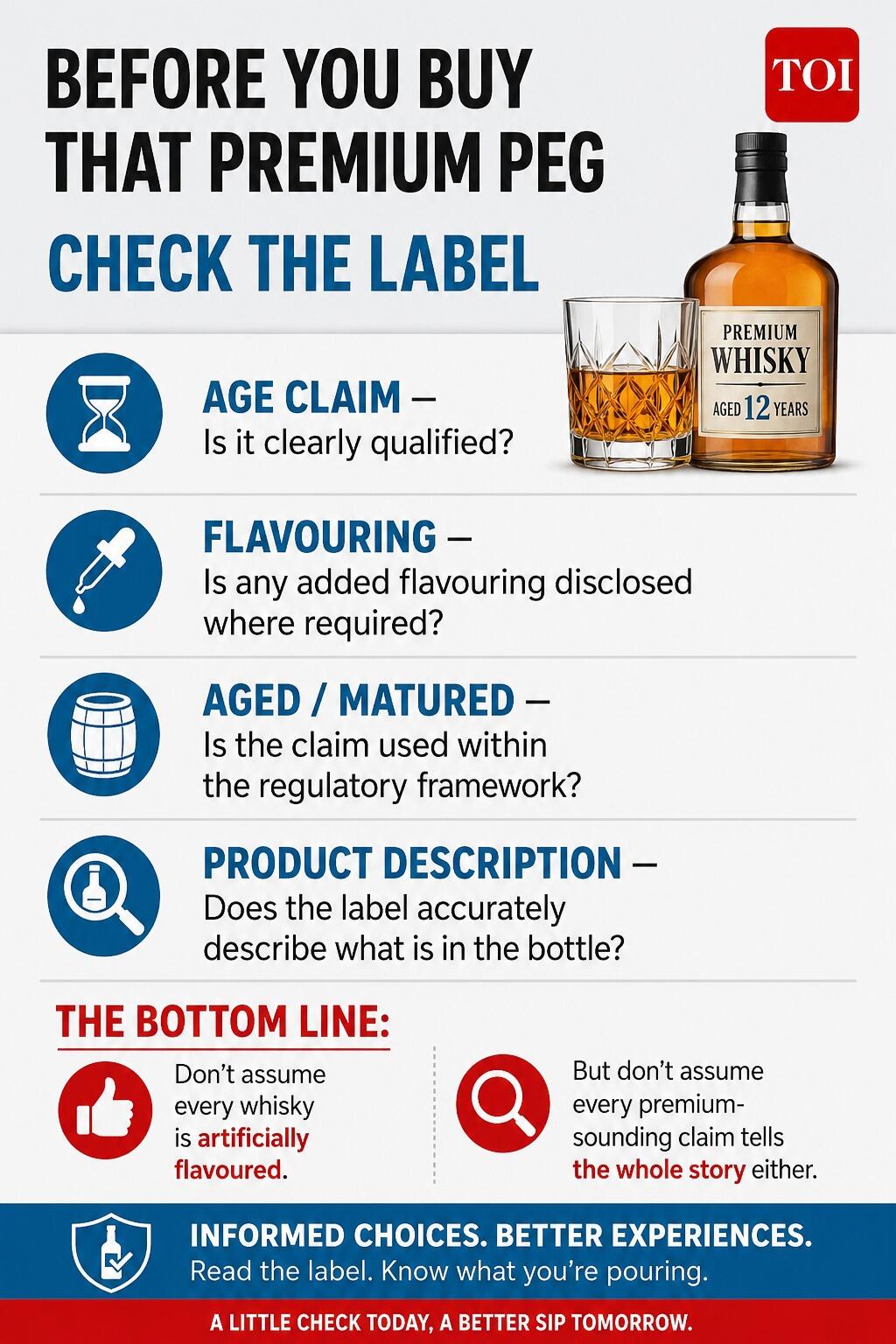
Age, flavouring and ‘matured’: Know what the label really says
Make sure any age claim is clearly qualified, the product identifies any added flavoring where required, and that terms such as ‘matured,’ ‘aged,’ or similar descriptions are being used within the regulatory framework.In the end, perhaps the most significant change will be psychological.For decades, what consumers have largely accepted the contents of their drinks at face value, relying on the label on the bottle, has largely been taken at face value.The FSSAI’s crackdown is bringing the assumption into focus.A whisky’s color, aroma, and smoothness might tell you something about the liquid, but on the sale, they can’t tell you how those traits were achieved.Before taking your next sip, ask yourself the very question FSSAI is now putting forward: is the profile of your drink shaped by time, raw materials, and traditional distillation, or by clever flavor enhancements?