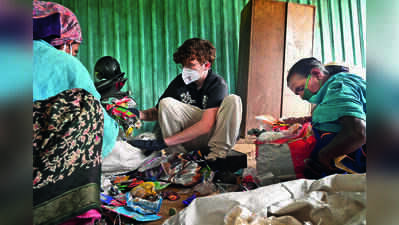
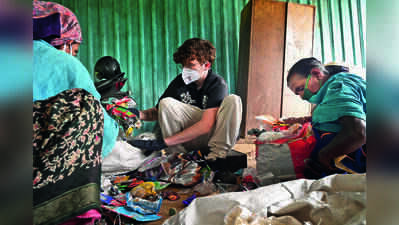
Every morning, in a tin-roofed shed, 21-year-old Samuel Inkster reaches into piles of discarded plastic. The bottles are crusted with betel juice, sticky with spit and sometimes still filled with remnants of gutka. There are half-eaten snacks and soiled food packets, the kind of waste most people would rather not touch. But Inkster puts his hands in without the slightest hesitation. In a tin-roofed sorting shed, he joins a group of women from Rama Pir No Tekro as they work through the pile, emptying, flattening, and sorting each item.“They go through so much. They have lost family members to tuberculosis and face difficult circumstances, yet they keep showing up every day to do this work,” says Inkster, a fourth-year Master of Environmental Science student at the University of Southampton. He has been coming to the shed every morning since June. “Compassion costs nothing.”Inkster came to Ahmedabad on a self-funded, two-and-a-half-month internship with Manav Sadhna, entirely separate from his university course, after connecting with the UK charity Project Chakra. He works out of Paryavaran Mitra’s Ranip centre — one of eight the organisation runs across the city — sorting waste alongside women he cannot speak to in any shared language.“I don’t speak their language, and they don’t speak English, yet I’ve built friendships with nearly all of them through hand signals,” he says. When he was away for a few days, they told him they had missed him.He has made a point of learning their names: Kamla, Priyanka, known as Pinky, Balu, Pragna, and Indira. Balu has been sorting waste for years. “The list is endless,” he says. “These are extremely strong women. They have shown me that family is everything. It comes before everything else.”“Sam has become one of us now,” says Kamla, in her 50s. “He sits with us, sorts waste with us, lifts the heavy bundles when we are tired. He chats with us and even shares meals with us. And when we talk about our lives and struggles, he listens like he understands every word, even though he doesn’t know our language at all.” She pauses, then adds, “Work has made us understand each other well.”
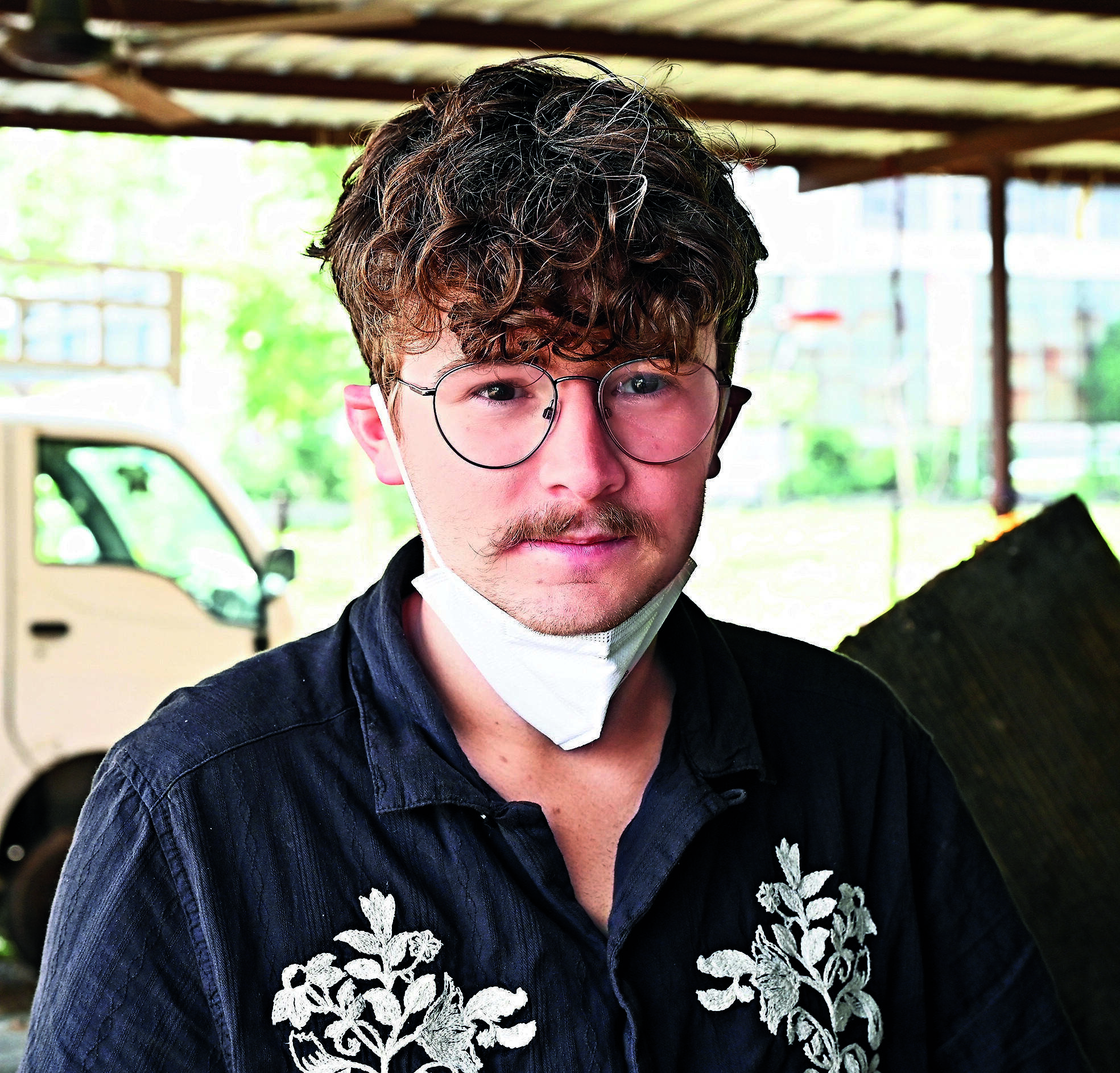
Samuel Inkster, 21, came to the city on a self-funded internship with Manav Sadhna, separate from his university course, after connecting with UK charity Project Chakra
Inkster has also been helping the women sell their premium organic compost to local retailers. Tested and certified by a Gujarat laboratory and free of pesticides, the compost is one of several products the women produce at the centre.Inkster spends hours with the women, listening to their stories, recording their conversations and photographing their work. He is documenting their lives for a Paryavaran Mitra website that is currently being developed.“I came to find out more about Gandhi’s life. It inspires me,” he says. In the city that shaped so much of Gandhi’s life and work, Inkster explains what draws him to his philosophy. “Hands that help are holier than lips that pray,” he says, quoting the Mahatma.Inkster sees Gandhi’s appeal in the way he lived. “Most people with lasting legacies were big talkers or inventors. Gandhi just lived a life of service that showed what a life should look like. It boils down to service with compassion.”Inkster links that simplicity directly to the climate crisis. “He taught us the importance of a simple life free from overconsumption. We think we need a golden watch, but we don’t.” His interest in the environment has roots in his childhood. His grandmother, who still farms in England, taught him the Latin names of plants when he was young. Now, as a student of environmental science, Inkster finds himself at the other end of the consumption cycle, sorting what people throw away. The work has also given him a close-up view of the economics of waste collection.Paryavaran Mitra now works across eight areas of the city, including Bakamandi, Madhupura, Kalyan Nagar and the airport area, with more than 800 women registered in its network. The physical demands are considerable. To collect an average of 20 kilograms of waste, mostly lightweight plastic, a woman may bend to the ground between 1,000 and 1,500 times.Inkster has had his own encounters with discomfort. Once, after getting lost in the Namibian desert, he spent a night sleeping on the floor of a public toilet. “Worst night’s sleep ever, but you make do,” he says with a laugh. In Ranip, he has seen that making do can mean something much more enduring.Punit Agarwal, director of Paryavaran Mitra, says the scale of the work done by the women is huge. “Combined, Ahmedabad’s 40,000 waste collectors pick up an estimated 8 lakh kilograms of waste daily,” Agarwal says. “At an average rate of 10 rupees per kilogram, they collectively earn 80 lakh rupees a day to support their families.”And yet, he says, they are cheated every single day, with middlemen altering weighing scales and denying them fair prices at every step of the supply chain. Paryavaran Mitra cuts out those middlemen, paying the women higher market prices directly. The organisation also funds health checkups and medical treatments, supports women facing domestic violence, and provides financial aid for their children’s education.Sam believes his skills are needed more urgently here than in the UK, where he feels environmental and waste challenges are comparatively “less severe”.It is also a departure from his own family’s line of work. “My stepfather works as a lifeguard rescuing swimmers from drowning, while my mother serves as a health and safety officer inspecting building fire exits,” he says.Much of what the women earn, Sam has come to understand, goes towards taking care of their family members’ health needs. “Some of them have told me about alcohol and addiction issues among men in their families, and everything that comes with it,” he says. “They carry that too, on top of everything else.”These are the perspectives Inkster says he could not have gained in a classroom. He came to Ahmedabad to understand Gandhi’s life of service. He now sees that the real measure of service is in the doing.