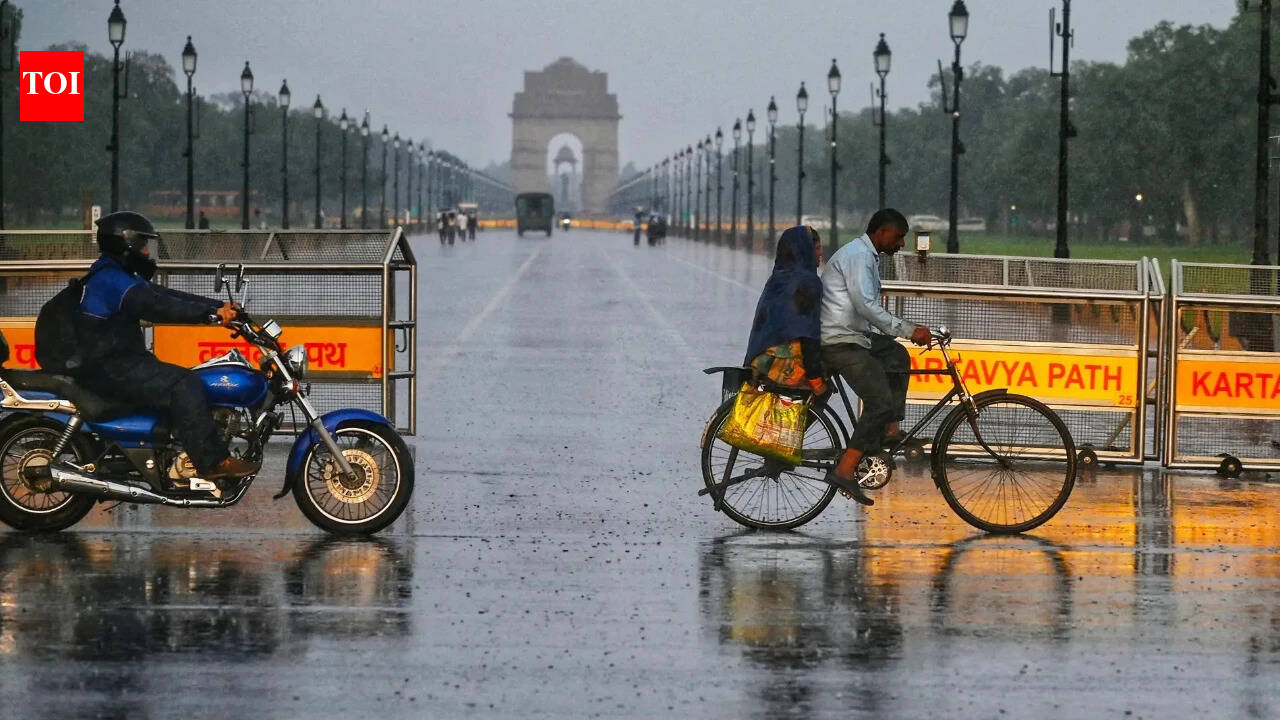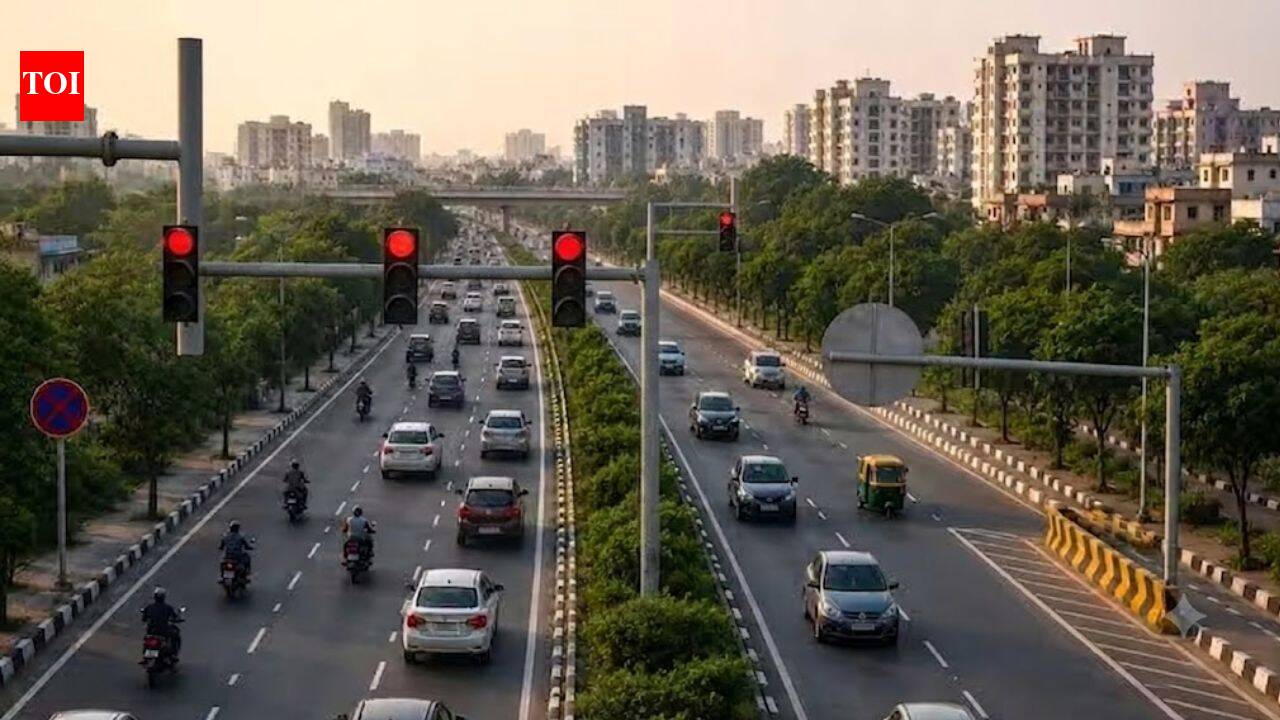
NEW DELHI: Delhi’s traffic signals may soon become less common on some of the busiest streets of the city.Delhi Traffic Police is currently working on making at least seven major roads signal-free and has now decided to shift focus to another 25 roads in Delhi, covering Dwarka Mor and Najafgarh to Mehrauli-Gurgaon Road, Mathura Road and Outer Ring Road among others. These roads will undergo feasibility studies to see if traffic can be managed using U-turns and other engineering solutions in place of regular signal-controlled crossings.
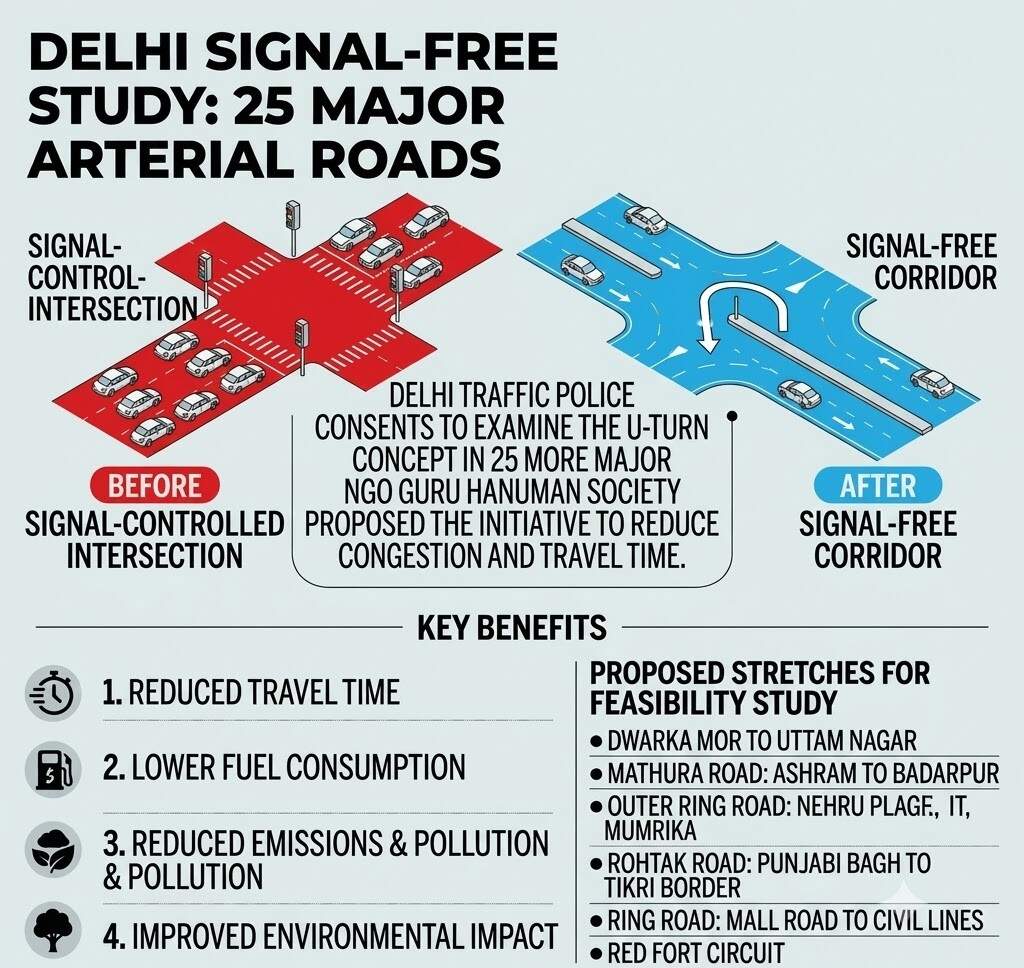
This initiative aims to reduce congestion and travel times across the city.
This initiative is yet another effort to address one of the common urban issues faced by Delhiites: long queues of cars waiting at lights even when the traffic ahead is flowing smoothly.The idea has come from Guru Hanuman Society of India, an NGO headed by its General Secretary Atul Ranjit. Ranjit wrote a letter to Delhi Traffic Police in mid-June proposing a U-turn-based traffic management system that the organisation believes will reduce congestion and travel times as well as fuel consumption and pollution from automobiles.The Traffic Police has now consented to investigate this concept in 25 more segments.However, the proposal shines light on another important question about Delhi’s roadways: can people make the roads quicker without making them more challenging to cross?Changing from seven to more than 25 corridorsThe proposal has arrived at a time when there are several signal-free initiatives already underway in the city.One of the stretches being worked on includes Rajghat and in West Delhi, Najafgarh Road between Rajouri Garden Flyover and Vishal Cinema is also being worked on.Seeing the effectiveness of these initiatives, the NGO has recommended putting the idea into practice at a variety of other significant traffic corridors.Manish Kumar Agarwal, the Special CP (Traffic), said that practical engineering solutions were the main target to be utilised in Delhi’s road infrastructure.“Delhi Traffic Police is dedicated to enhancing traffic mobility by adopting practical engineering solutions in the existing road infrastructure,” said Agarwal. He went on to state that signal-free corridors were a significant component of this plan.The goal here is not just to switch off traffic lights one by one. Instead, authorities will have to study traffic at individual intersections and stretches to determine whether it is possible to change traffic using techniques like U-turns and channelisation without jeopardising road safety.In case the stretch is found suitable, the signal could be replaced with a new pattern of traffic movement.The U-turn theory behind the planAt the centre of the proposal lies a simple idea: instead of letting vehicles stop at a signal to turn right or cross a busy junction, traffic could be guided to a U-turn facility farther down the road.This system has been used on major roads in Indian cities, aiming to cut down on conflicting movements at intersections.A normal signal can make vehicles travelling in different directions stop for many cycles. Even if one direction has little traffic, vehicles may still have to wait for their turn.A well-designed U-turn system, however, can keep the carriageway moving for longer periods.In Delhi, where a few minutes of extra waiting at several signals can add a lot to a daily commute, the potential gains are huge.The NGO says that fewer stops could mean lower fuel consumption, less time on the road and reduced pollution.There could also be an obvious benefit. A vehicle that accelerates, brakes and idles repeatedly at signals uses more fuel than one moving at a steady speed.That is why the proposal is being presented not only as a traffic-management measure but also as an environmental intervention.A long list of roads under considerationThe 25 proposed stretches cover some of the capital’s important arterial roads.In Dwarka, a dozen intersections have been identified for examination.Najafgarh Road has been proposed for two stretches, between Uttam Nagar and Dwarka Mor and between Rajouri Garden Flyover and Moti Nagar.Rohtak Road, one of the western approaches to Delhi, is also on the list, with the proposed stretch running from Punjabi Bagh to the Tikri-Bahadurgarh border.Another major proposal is the Red Fort Circuit. It includes Chhatta Rail Junction, Red Fort, Chandni Chowk, Daryaganj, Delhi Gate, Rajghat, Shanti Van and Hanuman Temple.Patel Road, from Karampura Flyover to Rajiv Chowk, is also being considered.The list reflects the scale of the exercise. Rather than focusing on one part of Delhi, authorities are looking at corridors in the west, south, north, central and southwest parts of the city.South Delhi corridors also in focusSeveral major south Delhi roads are in the spotlight.Maharaja Nahar Singh Marg, from Inderlok Metro Station to Prembari Vehicle Underpass, is being studied.Mehrauli-Gurgaon Road is another corridor being looked at, along with Captain Gaur Marg.Mathura Road, from Ashram to the Badarpur border, is also being considered. This is an important stretch because of the huge number of people travelling between central and southeast Delhi and the nearby NCR region.Badli-Bawana Road is also on the list.The proposed plan includes the Outer Ring Road, covering places like Okhla, Nehru Place, Chirag Delhi Flyover, IIT Flyover, Hauz Khas, Munirka, RK Puram and Rao Tula Ram Flyover.The Ring Road stretch from Mall Road to Civil Lines is another option.UER-I, from NH-44 towards Narela and Bawana, has also been added.
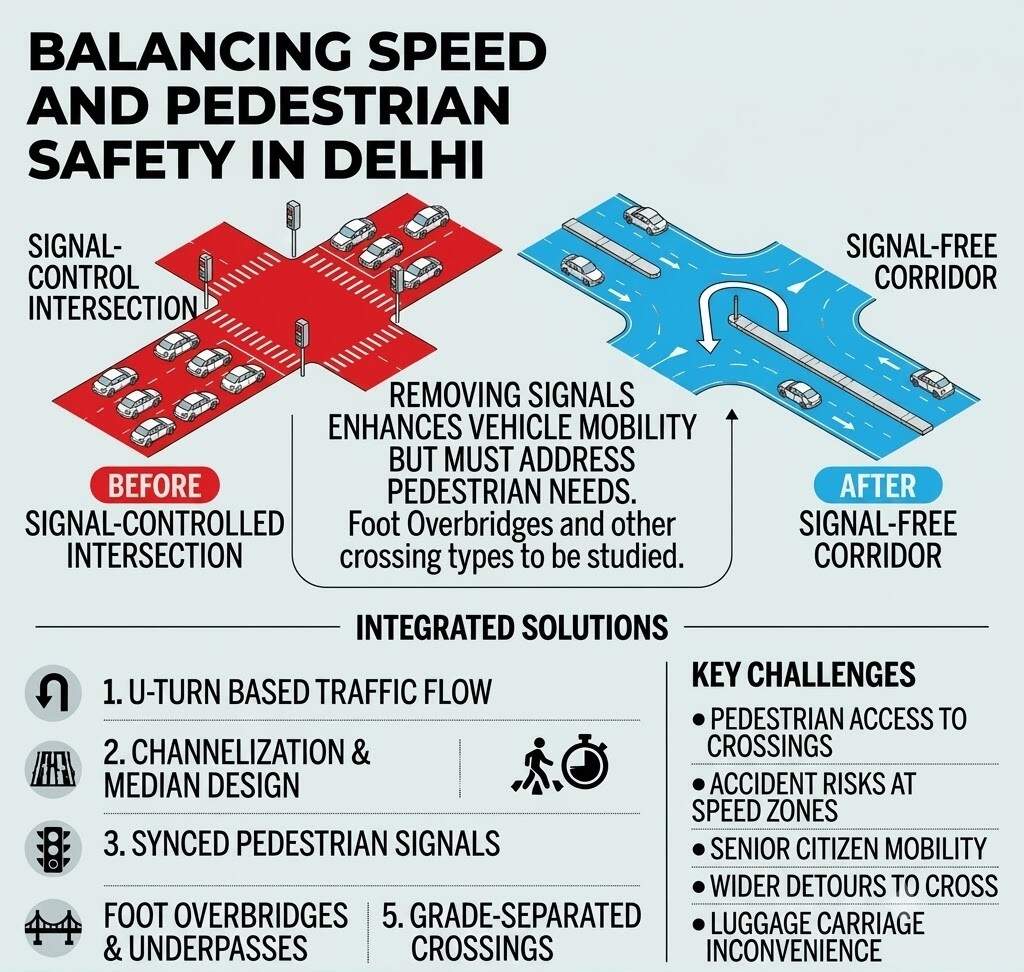
The plan involves implementing U-turns and other engineering solutions to improve traffic flow.
Some of the corridors proposed for study
- Najafgarh Road: Uttam Nagar to Dwarka Mor and Rajouri Garden Flyover to Moti Nagar
- Mathura Road: Ashram to Badarpur border
- Outer Ring Road: Okhla, Nehru Place, Chirag Delhi, IIT, Hauz Khas, Munirka, RK Puram and Rao Tula Ram Flyover
- Ring Road: Mall Road to Civil Lines
- UER-I: NH-44 to Narela and Bawana
Airport roads, Kalindi Kunj and Pankha RoadThe proposal does not stop at the major arterial corridors. It looks beyond those roads.Kalindi Kunj, the stretch of Ring Road under Jhulelal Flyover, the airport area, the Palam area and Pankha Road have also been identified.Mehrauli-Badarpur Road is part of the proposed study. Traffic signals beneath UER-II are also part of the study.The list also includes the Max Hospital Patparganj area. The Model Town traffic signals on Ring Road are on the list. The IIT area is also listed.The NGO has suggested a policy. Roads that have at least three lanes in each direction could be considered for signal-free treatment.If that policy is adopted, it would give the exercise a wider scope than the current list of 25 corridors.Traffic police: Safety will remain the testFor authorities, however, the proposal is not about eliminating signals at any cost.Joint CP (Traffic) Sanjay Tyagi said the objective was to improve traffic flow by reducing stoppages while ensuring safety.“We have enhanced traffic management through deployment of personnel and continuous monitoring,” Tyagi said, adding that work on several signal-free corridors was already under way.The additional 25 stretches will first undergo feasibility studies and the model will be implemented where it is found suitable.That qualification is important.Every road junction cannot be treated the same way. A U-turn system that works well on an arterial road may create new bottlenecks on a narrower or heavily pedestrianised corridor.Traffic volume, carriageway width, turning movements, nearby schools and markets, public transport stops, pedestrian movement and access to neighbourhoods will all influence whether a particular intersection can function without a signal.The pedestrian questionThis is where the signal-free push faces its biggest challenge.For motorists, a traffic signal is often a symbol of delay.For pedestrians, however, it can be one of the few predictable opportunities to cross a busy road.Removing a signal does not automatically remove the need for pedestrians to cross. It can instead shift the crossing point farther away from where people naturally want to cross.That concern has already emerged among Delhi residents.Amit Aggarwal, a resident of Vasant Kunj, said the emphasis should be on synchronising signals rather than simply removing them.“On major roads, foot overbridges are not a convenient alternative for many people,” he said, expressing concern that more signal-free stretches could restrict pedestrian movement and increase accident risks.His worry points to a problem with how Delhi plans its roads. A road might work well for cars. That same road can be hard or even dangerous for people walking.
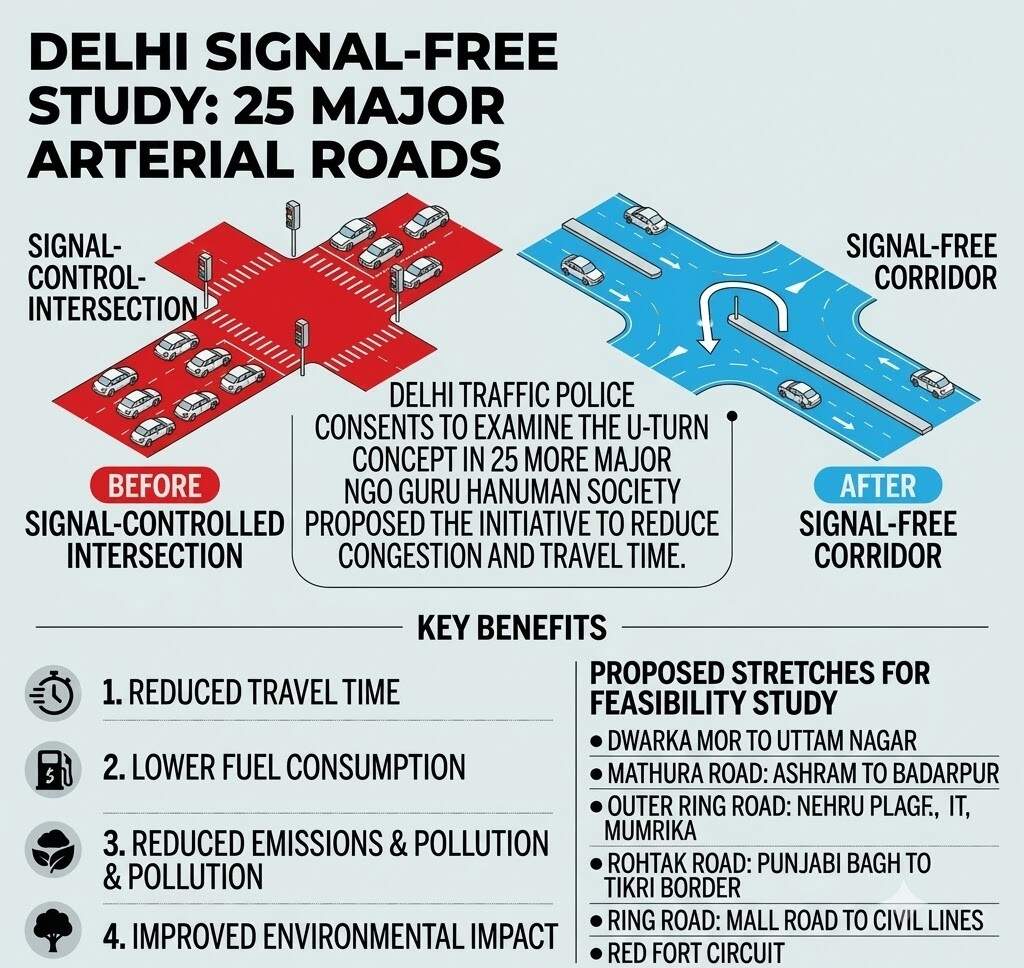
Feasibility studies will determine suitability, prioritizing road safety for all users.
Foot overbridges are not always the answerTraffic engineers often build foot overbridges when they turn a road into a signal-free zone.For people walking, climbing up stairs, crossing a bridge and then walking back down is a very long way to go. This problem is much worse for senior citizens, people with disabilities, parents with small children and commuters who are carrying heavy luggage.When the official crossing is too inconvenient, pedestrians might just take the shortest path and cross the road at ground level.Doing that can ruin the point of trying to keep people safe.A good signal-free corridor needs to look at where people actually want to walk instead of just putting a crossing in a random spot along the road.The real question is not just if cars can keep moving without stopping.The real question is whether everyone can move safely and easily.What Delhi stands to gainIf we design these roads carefully, the benefits could be very big.Fewer stops mean cars do not have to sit idling, which uses fuel. Faster trips could mean vehicles spend less time taking up space on the roads. Better traffic flow could also help buses move better and help emergency vehicles reach people on these corridors.The wins for the environment could be just as important.The plan says that smoother traffic would cut down on pollution and protect trees from the dust and chemicals that come from traffic.Delhi has many reasons for its air pollution, and managing traffic alone will not fix everything. Cutting down on cars idling and starting and stopping constantly can still help lower the emissions from road traffic.For people who travel every day, the biggest win would be time.A trip that stops at ten or fifteen signals feels much longer than a trip where traffic moves without stopping, even if the distance is the same.Expected gains from the signal-free model
- Less congestion and shorter travel time
- Lower fuel consumption and commuting costs
- Reduced vehicular emissions
- Less idling and repeated acceleration
- Lower traffic-related impact on roadside trees and the environment
Signal-free does not mean signal-less everywhereThe term “signal-free corridor” can also be misleading if interpreted as a road where every traffic light simply disappears.In practice, the proposed model is likely to involve redesigning intersections.Vehicles may be prevented from making right turns at junctions and instead directed towards designated U-turns. Median openings may be modified. Lanes may be channelised. Traffic islands may be redesigned. Enforcement may be required to prevent illegal turns and lane changes.The success of such a system depends heavily on discipline.A poorly designed U-turn can merely transfer congestion from one junction to another.A U-turn located close to a major intersection can create weaving movements.If drivers routinely ignore lane markings or make unauthorised turns, the theoretical advantages of the design can quickly disappear.The need for corridor-wide planningAnother challenge will be ensuring that individual junctions are not redesigned in isolation.Traffic does not stop at a junction. It flows from one intersection to the next.If a signal is removed at Point A but vehicles then face a bottleneck at Point B, the overall journey may not improve much.That is why corridor-level planning will be critical.Authorities will need to examine where vehicles originate, where they are headed, where they turn and how traffic interacts with roads.Public transport will also need to be considered. Bus stops located before or after U-turns can create conflicts between buses, turning vehicles and through traffic.Similarly, roadside parking, market activity and informal pedestrian crossings can affect the performance of a well-designed corridor.Delhi’s roads are becoming a testing groundThe push for signal-free corridors shows a bigger change in how Delhi is dealing with traffic jams.For years, the usual way to handle traffic jams has been to make roads wider, build flyovers or add more infrastructure.In a city that is full and has little road space, changing how traffic moves on roads that already exist can sometimes give better results faster.This new plan is an example of that idea.Instead of building a new road, officials are being asked to change how cars use the roads that Delhi already has.That makes the studies about whether it will work very important. They will check if the signal-free idea is really right for each place instead of using it everywhere.The real test starts when the signals are goneTaking away a signal is simple compared to making the system work.The real test will happen during rush hours, when thousands of people are trying to get to offices, schools, train stations, shops and homes all at the same time.It will also happen during rain, when roads are being fixed, when cars break down, when important people are moving and during other situations that usually make Delhi traffic worse.A good corridor will have to keep working in those situations.It will also need to be watched all the time. Traffic patterns change quickly as new places to live, offices, metro stations and shops appear.A place that works well today might need to be changed a year from now.The system will have to work under pressure
- Traffic during rush hours and large commuter volumes
- Rain, road repairs and vehicle breakdowns
- Buses moving and emergency vehicles passing
- Crossings for people walking and local traffic
- Changing traffic patterns as the city grows
A faster Delhi, for whom?The debate over the 25 proposed corridors really comes down to one question.What does Delhi want its roads to do?If the goal is faster movement, then signal-free corridors might be a good tool. If the goal is better mobility for the whole city, we cannot just look at how fast cars go to see if we have succeeded.A person in a car wants fewer stops. A person on a bus wants a journey that’s reliable. A person walking wants an easy way to cross the road. A person on a bike wants a path that does not stop. An ambulance needs a way to get through.All these different needs exist on the road.Delhi Traffic Police has said that the 25 stretches will be studied first. The Delhi Traffic Police will only use this model where it actually works.This gives us a chance to get the balance right.Delhi does not always need signals everywhere. Delhi needs better intersections, smarter ways to manage traffic and safer ways for everyone to move.If these studies can find that balance, the next set of Delhi’s signal-free corridors could do more than just save a few minutes for drivers.The signal-free corridors could show that a city can make traffic move faster without making the streets harder to use for people on foot.That will be the test for the Delhi signal-free experiment.