When Anvi Zanzrukia folds herself into a yoga pose, audiences see only the body that bends with ease. What they do not see is where it began: a sleepless infant struggling with health issues, and a father looking for something that might help.Anvi was born with Down’s syndrome and underwent open-heart surgery at three months of age. By any expectation, her life might have been defined by medical challenges. Instead, at 18, she is among India’s best-known young yoga practitioners, able to complete 101 asanas in five minutes. Anvi’s cognitive development lags behind her age, her family says, but she gets through her day like everybody else — something they credit largely to yoga. Through her performances and outreach, she has helped create yoga awareness among lakhs of people. As a child, Anvi had trouble sleeping because of intestinal issues. She would often lie on her chest and stomach, her legs bent backwards towards her head. Her parents noticed the unusual flexibility. “We thought of trying yoga, hoping that a body so flexible might also heal,” recalls her mother, Avani. For Vijay Zanzrukia, it was never really about medals. “She had intestinal problems, so we started yoga for her health, and it worked,” he says. “It was Avani’s care and effort that made her a champion, even with such limitations.” What followed was years of patient work. Her yoga trainer, Namrata Verma, remembers how difficult the early lessons were.“At first, it was hard. Anvi couldn’t understand what was being asked, so I would train her by holding and moving her through the poses,” Verma says. “Before she began practising yoga, hospital visits were a regular part of her life. Later, they became rare.”The benefits, the family says, extended beyond Anvi. As her health improved, so did the rhythm of the household. Vijay, a principal at a municipal school, and Avani, a school teacher, found they could focus more fully on their own work, freed from the disruption of medical emergencies, even as Anvi continued her physical training.The yoga that began as a response to a health concern gradually became a talent, and then the thing the world knew her by. PM Narendra Modi highlighted her abilities in his radio programme “Mann Ki Baat” and referred to her as the ‘Rubber Girl’, a nickname that followed her into public life.
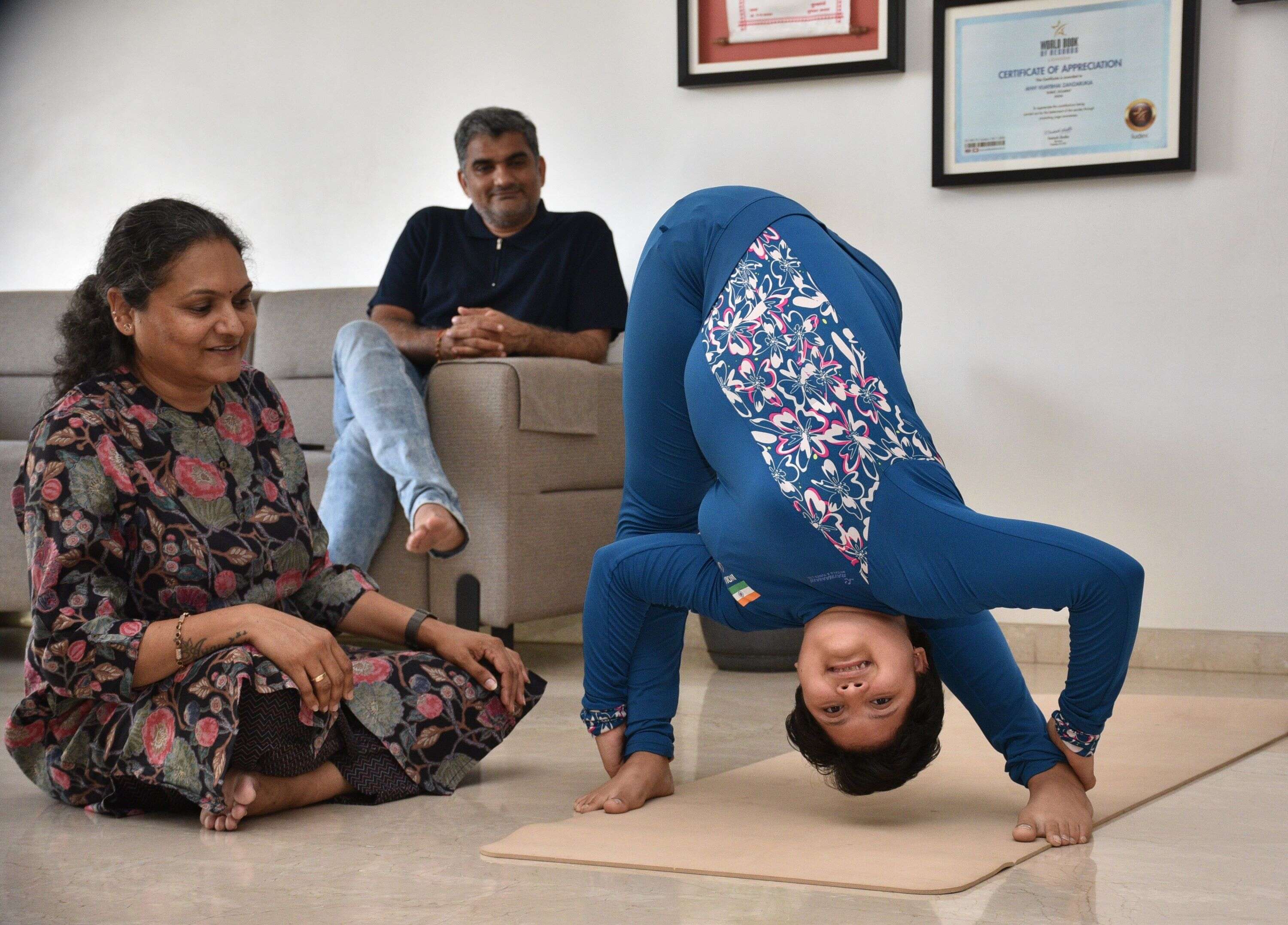
As a child with intestinal problems, the way Anvi slept was unusual. She would often lie on her chest, legs bent backwards toward her head. Her parents noticed the flexibility, tried yoga to ease her discomfort, and watched a talent emerge
She went on to win yoga championships and become a familiar face at events promoting yoga and wellness. Recognition gradually followed. Anvi received an award from the President in 2020 for her yoga prowess, followed by the PM Rashtriya Bal Puraskar in 2022 and the Gujarat Garima Award the same year. “She might be the only person with these many health complications but has such prestigious awards as well,” Vijay says, with evident pride. A chapter on her success is included in a Marathi-language textbook, and she features in about 25 books on success stories.Today, yoga remains central to Anvi’s life, but it is no longer the only ambition. Her parents say she has taken to swimming. After success in national-level events, the family is now preparing for the Special Olympics 2027 and hopes she will earn selection.In good hands: Music that refuses to fall silentOne is a row of porcelain bowls, tuned with water and struck to release a clear, bell-like chime. The other is ancient and solemn, so revered it is called the sound of God. Both the jal tarang and the rudra veena found a home in old Baroda, a princely state whose Gaekwad rulers prized music enough to build one of India’s first schools for it. And in two families of the city, both survive still, handed down from father to son. For the Gaekwads, the music came with the city’s royal past. The tradition goes back to 1904, when Maharaja Sayajirao Gaekwad III invited Pandit Ganpatrao Vasaikar, a celebrated shehnai and jal tarang maestro from Pune, to Baroda. Vasaikar hesitated, and came only after the Maharaja sent a personal emissary to persuade him. He became a court musician, seated beside the ruler at palace durbars, and in time, set up the Shehnai Vadan Pathshala to train others. The art then passed to his nephew, Gangadhar Gaekwad, a court artist and a master of the shehnai, tabla and veena. He has even shared the stage with the legendary shehnai exponent, Ustad Bismillah Khan. But Gangadhar’s greatest legacy was not on a stage. It was his children. “When I was six years old, my father began training me and my brothers in tabla, jal tarang, shehnai and other instruments,” says Dattatray Gaekwad, 77, the eldest of Gangadhar’s four sons.
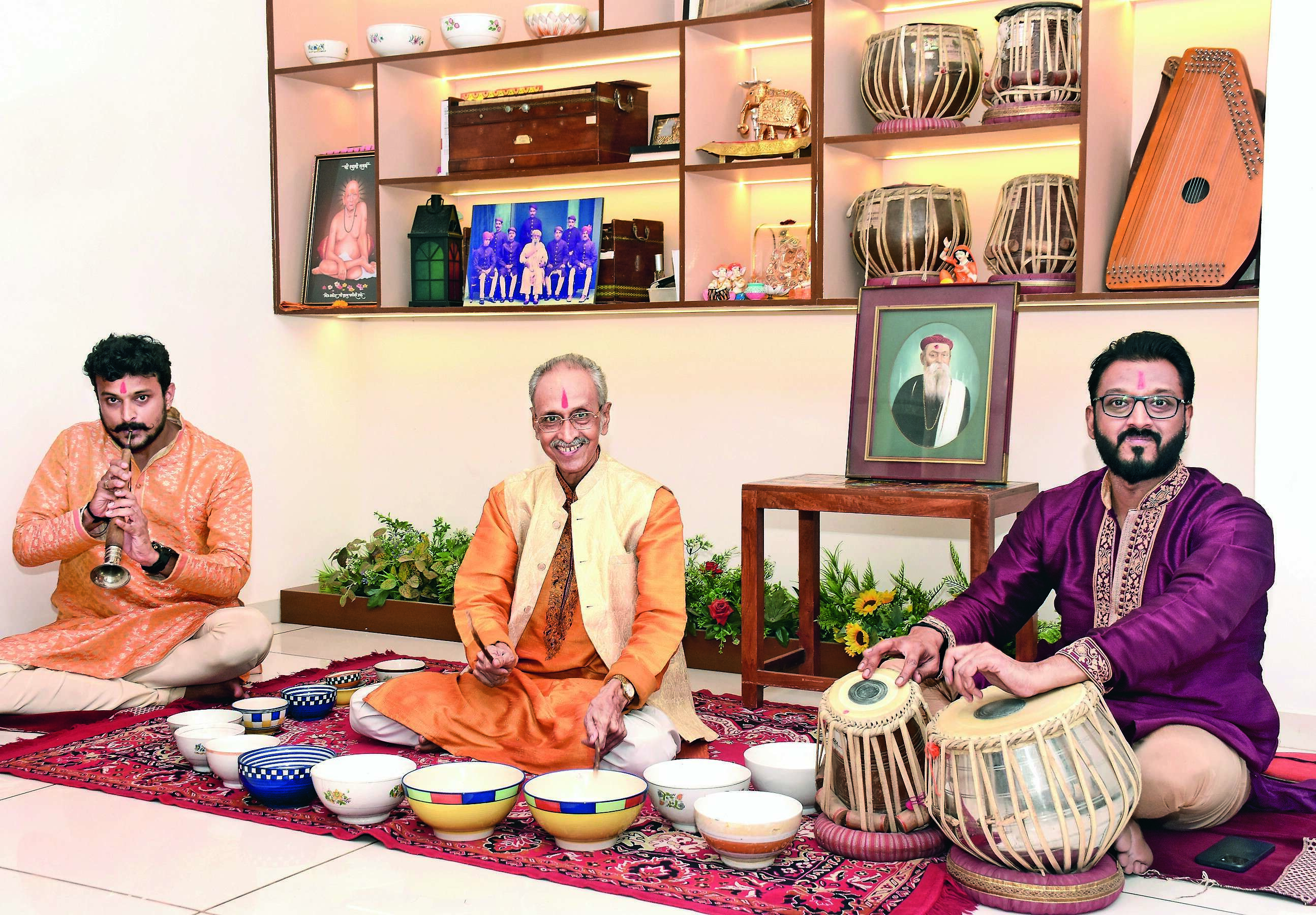
The last ripple of a raga: Dattatray Gaekwad (C) on the jal tarang, with nephew Rushabh (L) and son Aalap, continuing a tradition that traces its origins to the royal court of Baroda in 1904
Dattatray and his brothers, Mukund, Sudhir and Sunil, inherited not only the music but also the duty to keep it alive. They studied, built careers, and never once set the music aside. Dattatray trained formally in tabla and sitar, took jal tarang to stages across the country, and for years the family was a familiar presence at the Band Stand in Sayajibaug. Now it is Dattatray who stands where his father once did. His sons Aalap and Sarang play jal tarang, harmonium and tabla, as does his nephew Shrirag. Aalap balances his passion for music with a career in information technology. “It’s the greatest gift a father can give his children,” he says. For his father, the gift was also a duty he could not put down. “As a father, I felt it was my responsibility to pass on our heritage. Music teaches discipline, values and respect,” Dattatray says. The Mistrys have kept a different art alive for five generations and more than 150 years, not only playing music but also building the instruments themselves. The first of them was Mansukh Raghunath Mistry, the first musician in the family. He learned the rudra veena from M C Bua, a musician in the same Gaekwad court that would later draw Vasaikar to Baroda. His craftsmanship won the family its first gold medal at a Bombay exhibition in 1904. The craft then passed to Bapulal Chhotalal Mistry, whose name the family workshop still bears, and on to Soma Mistry, a radio artist who studied in the first batch of what is today the Faculty of Performing Arts at M S University. Kishor Mistry, 68, carried the craft into a fourth generation, and this month became the first artisan in India chosen for the Sangeet Natak Akademi Award for rudra-veena making.
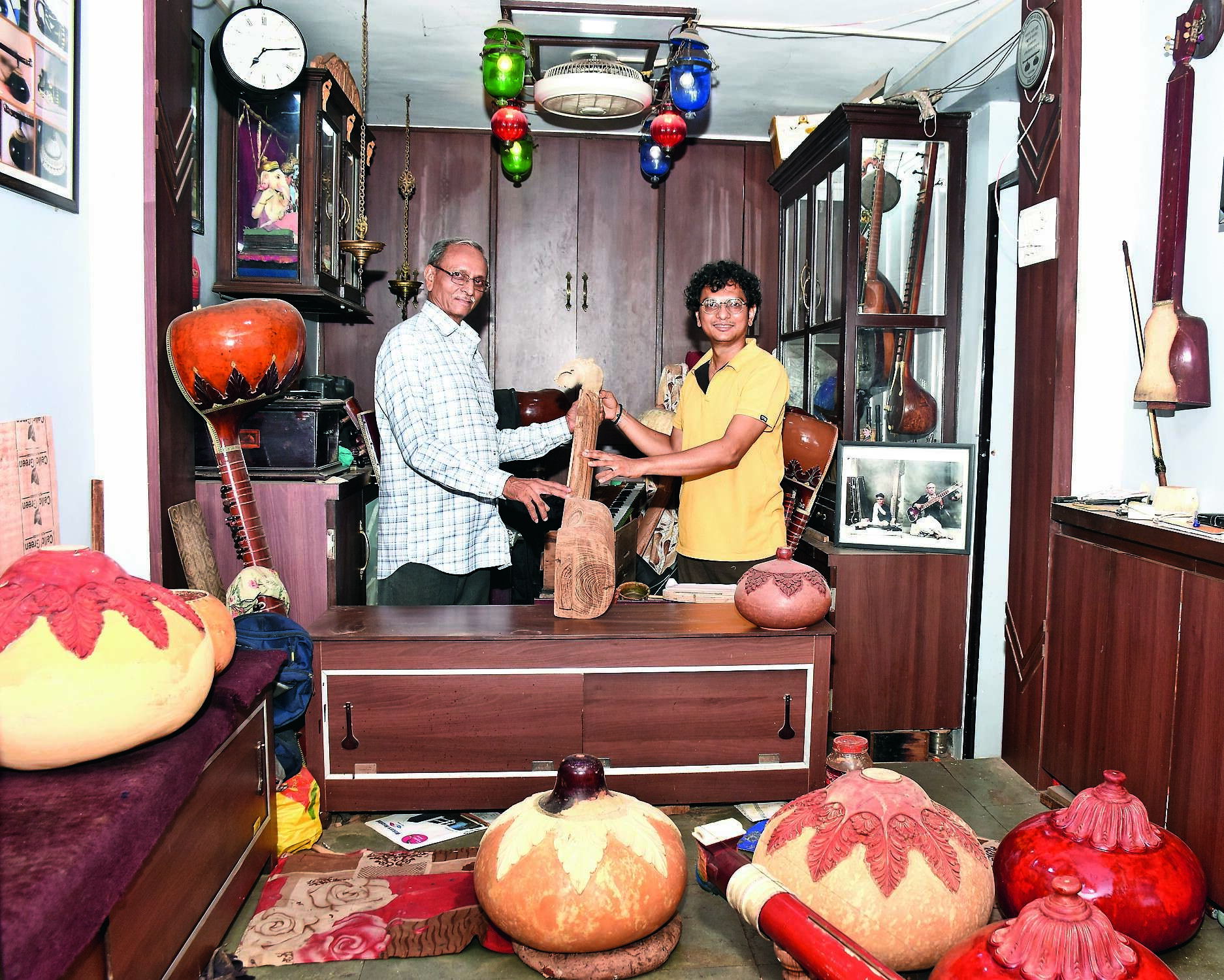
The ‘sound of god’: Kishor Mistry, 68, passed on the craft of rudra veena making to his son Dhaval
Now his son Dhaval, 34, has brought rudra- veena making back to Vadodara after nearly a century, restoring old instruments and crafting many for the Tana Riri Museum in Vadnagar. Where the Gaekwads put instruments into their children’s hands early, the Mistrys hold back until the child reaches for them. “In our family, nobody sits you down and teaches you from day one. First, you have to develop curiosity. You watch, observe and try things on your own. Only when your father sees that hunger to learn does he begin guiding you,” Dhaval says. He learned what that meant in 2014, trying to making a rudra veena himself. The gourd resonators, tumbas, had become almost impossible to find, and his father and uncle would not help him search. “They wanted me to find it myself,” he says. Months later, he traced suitable tumbas to Pandharpur, Maharashtra. “Only when I had found them did they step in to guide me.” However the lesson is passed down, the music outlives the man who taught it. At 94, last Manbhatt still recites storiesIn the old, walled part of Vadodara, there is a lane named after a storyteller. Few who walk it today probably know why. It was named after Manbhatt Chunilal Govindram Pandya. His son, Dharmiklal Pandya, today holds a rare distinction: he is regarded as the only surviving Manbhatt in the country. When he is gone, the art will continue, his family will see to that. What’s uncertain is whether the title itself, earned and held for generations, goes with him. Manbhatt is not simply a performer’s name. It is a tradition more than 350 years old, tracing back to the 17th-century poet Kavi Premanand, combining poetry, music and storytelling into Akhyan — narrative recitals from the Ramayana, the Mahabharata and the Puranas, performed while the artist keeps rhythm by striking a copper pot called a mann. Pandya did not plan to take it up. He wanted to finish his education first. Then his father passed away, and the decision was made for him. “After his death, I accepted the responsibility of carrying forward the legacy of Kavi Premanand and my father, and started performing when I was 25,” he says. He began with the Mahabharata and went on to present over 2,500 recitals in India and abroad. The family still has the small earthen “mann” that Dharmiklal’s sons Pradyumna and Mayank played as children.
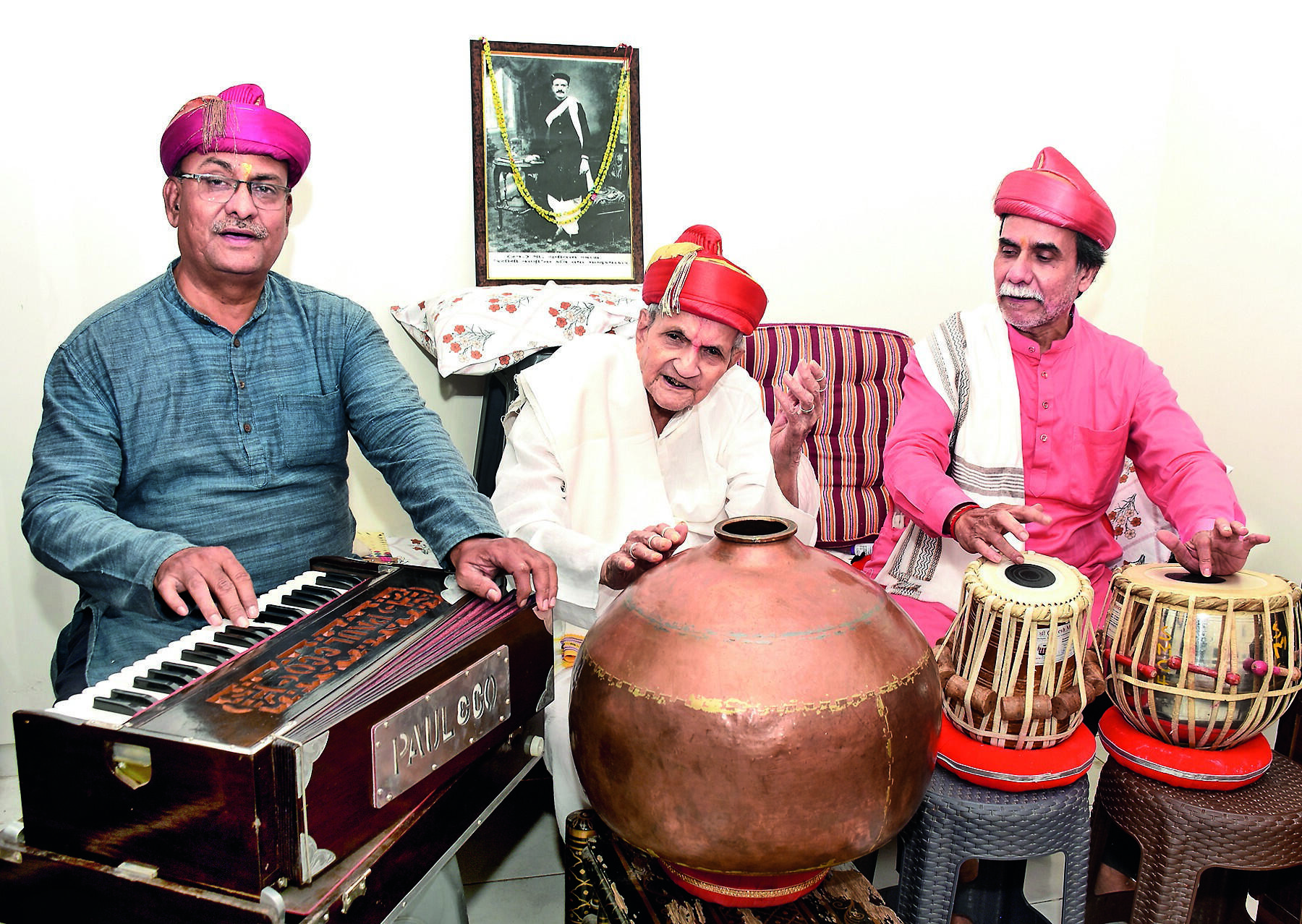
Keeping the tales alive: Dharmiklal Pandya (C) with sons, Mayank (L) and Pradyumna
The brothers, now 65 and 58, took the training in different directions. Pradyumna, a former cooperative bank employee, received a central scholarship and certification as an Akhyankar, while Mayank became an ‘A’ grade Akashvani artist and a music teacher. Both remember exactly how strict the early training was. “My brother and I began by playing manjiras while accompanying our father. Whether at home or travelling by train, practice was compulsory,” Mayank says. It wasn’t only about music either. “He taught us not just music, but also taal, pronunciation, Gujarati literature, Sanskrit and the social context behind every story,” he adds. The family runs a formal seven-year course in the art through its own institution, the Shri Mann Akhyan Kala Shikshan Kendra. The art has now reached a fourth generation. Neh Pandya, 25, Rutvik Pandya, 32, and Yash Pandya, 27, are all MBA graduates with corporate careers, and all three still perform Akhyan. Dharmiklal had taken up the art out of duty, at a moment he hadn’t chosen. He let his sons come to it differently. “Unlike his father, our father never forced us,” Mayank says. “But growing up around the art naturally drew us towards it,” Pradyumna adds.For most of Dharmiklal’s working life, hardly anyone outside Gujarat’s cultural circles had heard of a Manbhatt or knew what an Akhyan was. It took a Padma Shri, not seven decades of performance, to change that. “People now ask what a Manbhatt is and what Akhyan means,” Dharmiklal says. For a man who has dedicated a lifetime to ensuring this art form didn’t disappear, that may be reward enough. But what his father handed down was never just a performance. It was a way of living with story, music and memory, and it is still being practised by his sons and grandsons.