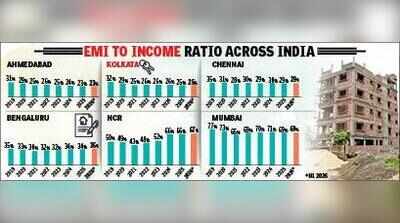
Kolkata: The city emerged as India’s second-most affordable housing market among eight major cities in Jan-June 2026, according to Knight Frank India’s Affordability Index. The city recorded an EMI-to-income ratio of 25%, indicating that an average homebuyer spends one-fourth of household income on home loan EMIs. This is comfortably below the 50% affordability threshold, beyond which banks are generally reluctant to underwrite mortgages.Ahmedabad remained the most affordable major housing market in the country with an EMI-to-income ratio of 23%. Kolkata followed at 25%, Pune at 28% and Chennai at 29%. Bengaluru stood at 35%, while Hyderabad recorded 41%. NCR and Mumbai continued to remain unaffordable, with buyers spending close to 70% of their income on EMIs. NCR’s affordability ratio was 67%, while Mumbai’s was 69%.The index assumes a loan tenure of 20 years and a loan-to-value ratio of up to 80% of the property value. It factors in average home loan rates, city-level average unit sizes and weighted average property prices based on unsold inventory.Kolkata’s affordability remained largely stable over the past four years, with the ratio staying between 25% and 26% since 2021. The city saw a marginal improvement from 26% in 2024 to 25% in 2025 and H1 2026, reflecting a relatively balanced trend in home prices, income growth and borrowing costs.“Over a period of time, prices of houses as well as offices have gone up across the country. Kolkata has not seen the same kind of price surge. As a result, it presents itself as a very attractive place for companies to locate themselves as not only is their cost of operations lower, their employees are also able to access quality housing at much lower prices than in other cities,” said Credai Kolkata president Apurva Salarpuria.Credai Bengal president Sushil Mohta, however, said that when up to 35% of a property’s price goes to the govt before land and construction costs are added, ‘affordable housing’ becomes an urban myth. “We can’t build for the future when the tax burden blocks the foundation,” said Mohta.Knight Frank India said affordability across most Indian residential markets remained supportive in H1 2026, aided by the cumulative impact of 125 basis points of monetary easing. Six of the eight tracked cities stayed within the affordability benchmark, while Mumbai and NCR continued to exceed it.Affordability weakened marginally in Bengaluru and NCR compared to 2025, while other markets remained broadly stable. Lower borrowing costs are expected to continue supporting housing demand in H2 2026, though rising property prices have limited affordability gains in some cities.Knight Frank India chairman and managing director Shishir Baijal said: “Housing affordability remains a key driver of residential demand. The cumulative benefit of lower interest rates continues to support homebuyers across most markets, helping sales remain close to post-pandemic highs. Over the year, affordability gains have moderated mostly due to the rise in property prices. However, healthy employment, stable incomes and supportive financing conditions continue to underpin demand. Going forward, sustained income growth and balanced market fundamentals will be critical to maintaining housing affordability and supporting long-term market growth.”