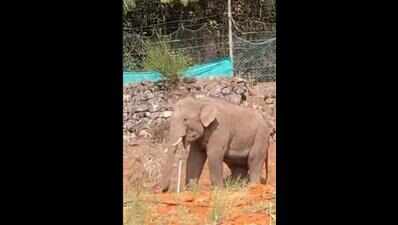
An elephant wandered into a private hospital in Ooty last fortnight. Wildlife experts say that, more than unusual, it is concerning. What was an elephant doing on the upper plateau of the Nilgiris, an area not usually associated with regular elephant movement?The incident was the fourth or fifth such sighting in Ooty and the surrounding parts of the upper plateau in recent months. While elephants enter villages, farms and towns in the foothills and plains, such as the Gudalur–Mudumalai region, they prefer lower elevations where water and food are easier to find.One significant factor is the rapid degradation of their natural habitat, primarily due to invasive species and weeds, says N Lakshminarayanan, elephant expert at the World Wildlife Fund. “Climate change, which leads to fluctuating temperatures, changing water patterns and diminishing water sources, contributes to shifting dynamics in an elephant’s environment.” The rise in global temperatures, he says, is contributing to desertification, which is expanding arid regions and transforming formerly lush grasslands and forests into drier landscapes. “Consequently, the availability of suitable living spaces for elephants is decreasing, compelling them to occupy smaller, more fragmented areas on the plains, while also leading them to seek higher elevations in hilly regions.”Lakshminarayanan adds that the increased frequency and intensity of wildfires, often exacerbated by prolonged drought, further degrade elephant habitats. “These fires destroy vegetation and disrupt ecosystems, potentially resulting in long-term alterations to forest composition, thereby rendering some areas unsuitable for elephant habitation. It is also possible that in some regions, the elephant population is increasing, leading them to explore new areas as they search for space.”It’s not a new phenomenon, says M Mohan Kumar, an elephant expert attached to the NGO Osai. Elephants mapped the hills for British engineers, according to a report by conservationist and naturalist E R C Davidar, who, in 1978, conducted the first study in India on elephant corridors. Davidar had said that British engineers opening up the hills to traffic followed some of the elephant trek routes to lay roads, as they found the animals had done the gradient survey for them.“The study aimed to investigate barriers to elephant movement in the Nilgiri Hills and suggest positive measures to facilitate movement by establishing corridors,” says Mohan. Initially unpublished, the report was released in 2011 and was supported by the Asian Elephant Specialist Group of the International Union for Conservation of Nature’s Species Survival Commission.According to Davidar’s research, elephants followed specific migratory routes from the plains to the plateaus. However, after the arrival of the British, these paths were disrupted as engineers constructed roads along them. Davidar highlights routes such as those from Mettupalayam to Kunjapanai and Mamaram, as well as the Kalhatty Road connecting Masinagudi to Ooty.“This suggests that elephants roamed the hills centuries ago. Elephants are great wanderers. In the Nilgiris, they can move both laterally and vertically. Calves born in high-activity areas, such as Coimbatore, lose their fear of humans. When males leave their herd at puberty, they are less fearful of human-modified areas and often explore new habitats in the hills,” says Mohan.The upper plateau of the Nilgiri mountains, covering roughly 900sqkm at more than 1,500m, previously featured southern montane grasslands and subtropical hill forests (sholas). “Since the 1850s, much of this landscape has been lost to plantations and urban expansion, with only the southwest retaining some original habitat.”But, says Lakshminarayan, while this may be a natural expansion of the ecosystem, we haven’t observed such changes in the past century or so, which raises concerns. “In Arunachal Pradesh, in the northeastern Himalayas, a fortnight ago, WWF camera traps captured images of elephants on a plateau nearly 3,400m high. This elevation is considered the highest recorded for elephants in India and possibly in the world for Asian elephants.”Srinivas R Reddy, head of the Tamil Nadu forest department, says, “Increased crop cultivation near forest areas has led to more conflicts, linked to human activities, but the incident may have also been a stray movement.”