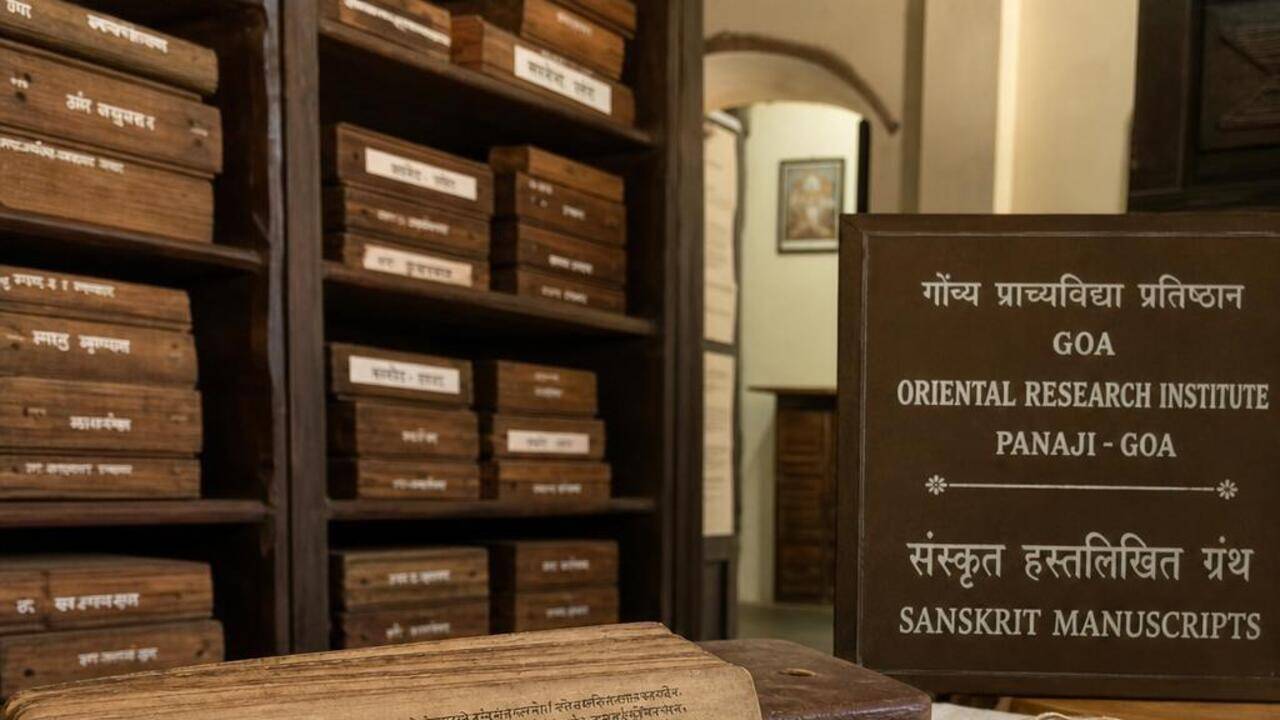
Panaji: Goa’s Sanskrit manuscripts are facing the threat of climate change, said former Goa state museum director Laxman Pitre, who was instrumental in setting up the museum at its previous location at Patto.Speaking at the daylong symposium on history of Sanskrit manuscripts in Goa, Pitre said that rising humidity and moisture pose a serious risk to palm-leaf manuscripts, paper records, paintings, and other historical documents, making conservation efforts increasingly urgent.“The great danger is that this climate is not suitable. It is very damp. Humidity is the main enemy of these documents and paintings. If they are not properly cared for, they get destroyed,” he told TOI.According to Pitre, many surviving Sanskrit manuscripts in Goa are between 200 and 500 years old, with most paper manuscripts dating to the 18th and 19th centuries. He said that older paper-making techniques produced materials that naturally degrade over time, making climate-controlled preservation even more important in a tropical state like Goa.“Manuscripts require deacidification, lamination where appropriate, and careful storage under controlled conditions to slow deterioration. Digitisation and microfilming have also become essential because the original materials have a finite lifespan. Even if the originals deteriorate, at least the information can be saved,” he said.The older documentary tradition, however, stretches back much further through copper plate inscriptions written in Sanskrit. He said the earliest known copper plate from Goa belongs to the Bhoja dynasty and dates to the fourth century CE.“The fact that we find such a well-developed Sanskrit inscription in the fourth century means the tradition did not begin in Goa overnight. There must already have been an established system of learning, administration and trained officials using Sanskrit,” he said.Based on this evidence, Pitre believes Goa’s Sanskrit tradition can be traced back to at least the beginning of the common era, continuing through inscriptions until around the 14th century.“Many families migrated to present-day Karnataka, Kerala, and Maharashtra, taking religious deities with them and leaving behind manuscripts. As a result, manuscripts copied in Goa may still survive in archives and private collections outside the state, although identifying their origin is often difficult because many lack clear references to place,” he said.The surviving Sanskrit manuscripts in Goa largely comprise copies of religious and scholarly texts. Pitre said these include manuscripts of the Vedas, as well as works on Ayurveda and Jyotisha (traditional Indian astronomy and astrology). Many are written on palm leaves, while later copies were produced on paper.“The mantras used during Hindu rituals, including marriage ceremonies and the sixteen samskaras, are preserved accurately in these manuscripts. That is why they continue to be relevant,” he said.Even Sanskrit copper plate inscriptions are some of Goa’s most valuable historical records. These inscriptions, several of which are housed in the Goa State Museum, record royal land grants and contain details including rulers’ genealogies, official titles, names of beneficiaries and dates.“Such information allows historians to reconstruct political administration, social organisation and patterns of land ownership in ancient Goa,” he said.He also referred to a Sanskrit diary written roughly 150 years ago, saying such personal records provide historians with a valuable cross-section of everyday society during that period.