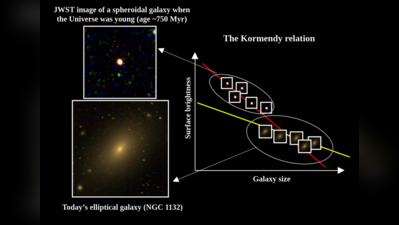
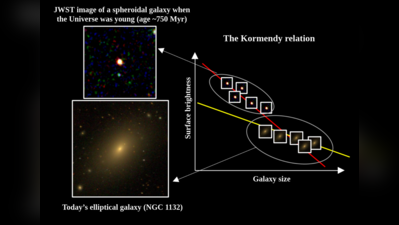
Pune: Some of the earliest galaxies of the universe were well organised less than a billion years after the Big Bang, revealed a study of the Inter University Centre for Astronomy and Astrophysics (IUCAA) astronomers.Based on images captured by Nasa’s James Webb Space Telescope (JWST), the study suggested that galaxies started taking their present shape much earlier than scientists had expected. The researchers studied hundreds of very distant galaxies existing when the universe was only 400 to 900 million years old.The study — The Kormendy Relation in the First Billion Years: Evidence from JWST — by Anshuman Borgohain and Kanak Saha showed the same physical processes that shaped galaxies today were at work in the universe’s earliest years. It was published in The Astrophysical Journal Letters (ApJL) on July 2.The study found that these early rounded or spheroidal galaxies followed the “Kormendy relation”, a well-known rule astronomers used to understand the structure of galaxies. Borgohain, the lead author of the study and a post doctoral fellow at IUCAA, said, “In simple terms, the rule says galaxies with brighter centres are usually more compact. Until now, this relation had been seen mainly in nearby and much older galaxies.”Borgohain said, “The unprecedented capabilities of JWST continue to reveal exciting findings about the earliest galaxies, which challenge our current understanding of how they grew and evolved in an infant universe. Our findings will directly contribute towards setting a new benchmark for understanding the early galaxy assembly.”The researchers said the discovery provided new evidence that galaxies became organised much sooner after the Big Bang than previously believed.Kanak Saha, who supervised the project, said, “For decades, astronomers have used scaling relations such as the Kormendy relation as ‘fossil records’ of galaxy evolution. These relations encode how gravity, star formation, mergers and gas dynamics shape galaxies over cosmic time. Until JWST, astronomers could measure these relations only for relatively nearby galaxies or those seen several billion years after the Big Bang. The first billion years remained largely unexplored because previous telescopes lacked the sensitivity and resolution needed to study such distant systems. JWST has now opened that frontier.”JWST is allowing astronomers to witness the history directly rather than reconstructing it from nearby galaxies alone by observing early galaxies. These observations reveal that the foundations of galaxy architecture were laid astonishingly early, offering an unprecedented glimpse into how galaxies were assembled in the early phase. The findings will help scientists improve future models explaining how galaxies formed and evolved over the past 13 billion years.