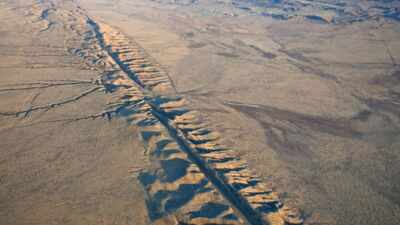
Scientists have discovered hidden movements beneath California’s San Andreas Fault with the help of artificial intelligence, revealing a type of slow fault slip that had largely gone unnoticed till now. The researchers say these silent movements may play a bigger role in earthquake activity than it was previously thought.The study, led by Dr Zahra Zali of the GFZ Helmholtz Centre for Geosciences, found dozens of short-duration slow slip events beneath the Parkfield section of the San Andreas Fault. The findings were published in Nature Communications, sciencex.com reported.Unlike earthquakes, these slow fault movements do not create strong tremors. Instead of that, they release stress over several hours or days, which makes them difficult to detect using traditional earthquake monitoring methods.
What led to discovery
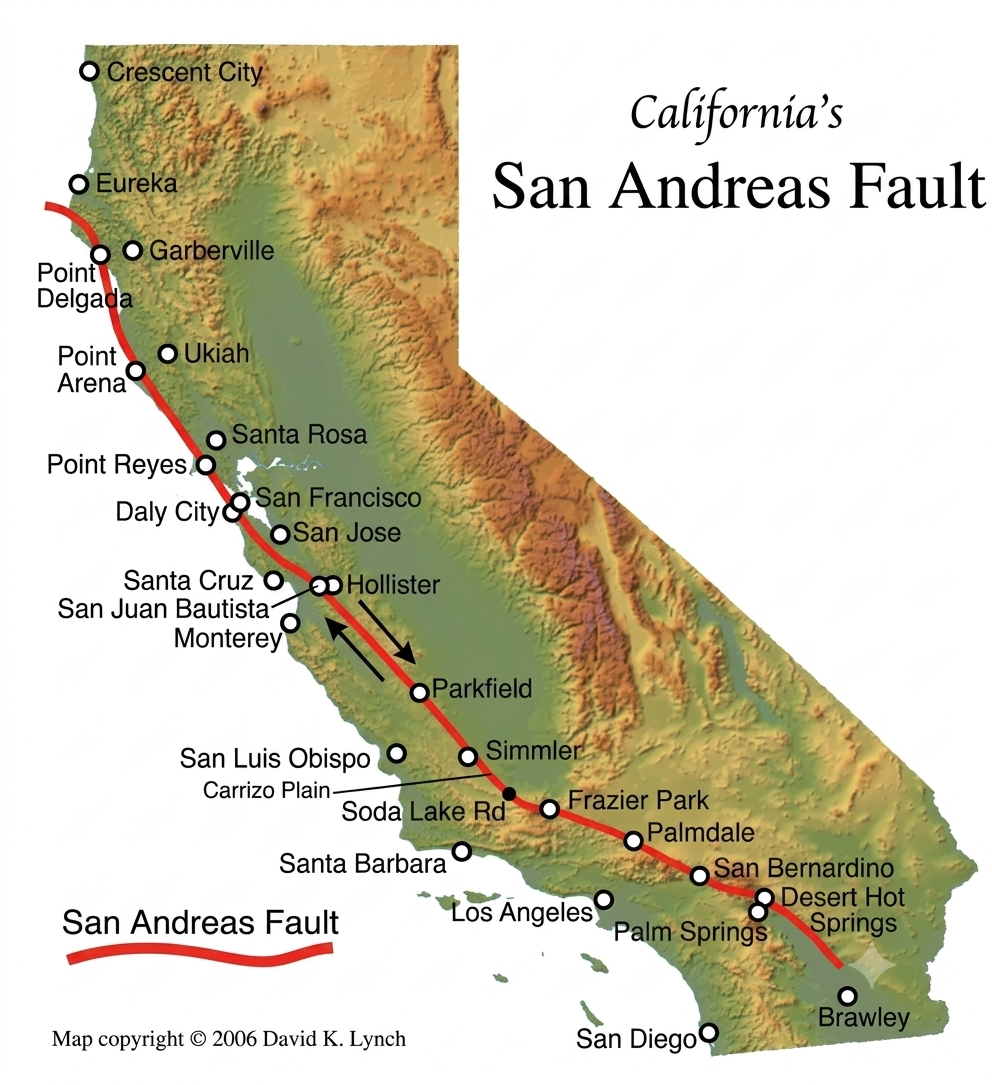
Researchers have long believed that faults do not move only during earthquakes. They also slip quietly without causing noticeable ground shaking. However, because these movements produce very weak signals, scientists have struggled to find out how often they happen, where they occur and whether they affect future earthquakes.Parkfield, located on the San Andreas Fault in California, is one of the world’s most closely monitored fault zones. Scientists have studied it for decades to understand how faults build up and release stress.“Faults can move in ways that do not generate strong seismic waves and therefore escape traditional earthquake detection methods,” lead author Zahra Zali said. “We wanted to know whether important fault slip processes might be hidden within years of continuous deformation measurements.”
.
AI spotted what scientists missed
To search for these hidden movements, the research team analysed continuous data collected by borehole strainmeters. These highly sensitive instruments can detect tiny changes in the Earth’s crust.The challenge was the huge amount of data. Small fault movements can easily be hidden among long-term ground changes, environmental effects and background noise.To solve this problem, the researchers developed a deep-learning system that learnt patterns directly from the data instead of searching for known signals.“These events are difficult to identify by conventional methods because they are small and often hidden within complex background signals,” Zali said. “Artificial intelligence allowed us to recognise their patterns that would otherwise have gone unnoticed.”Using this method, the team created the first catalogue of short-duration slow slip events at Parkfield based on continuous strainmeter observations. Data from nearby creepmeters also supported the findings.The researchers found that these slow slip events occurred at shallow depths and matched the right-lateral movement of the San Andreas Fault.
.
Link with quake activity
The team then compared the timing of the slow slip events with low-frequency earthquakes, a type of weak seismic signal linked to fault movement. They found that low-frequency earthquake activity increased after the slow slip events.According to the researchers, this suggests that even small, silent fault movements can change local stress conditions and influence later seismic activity.“Our results show that these slow fault movements are not isolated phenomena,” said Patricia Martínez-Garzón of the GFZ Helmholtz Centre for Geosciences, who supervised the project. “They appear to be linked to changes in seismic activity, which suggests that slow slip may play an important role in how stress evolves along active faults.”
Can these trigger massive earthquake?
The study does not say that these slow slip events can directly trigger a massive earthquake. Instead, the researchers found that low-frequency earthquake activity increased after the slow slip events, suggesting that the silent movements can change stress conditions along the fault. They say this points to a possible role for slow slip in the earthquake cycle, but more research is needed to understand exactly how these hidden fault movements influence larger earthquakes.
Filling a gap
Scientists have previously studied slow slip events mainly in subduction zones, where one tectonic plate moves beneath another. Similar observations on transform faults such as the San Andreas Fault have been much more limited, especially for short-duration events.The study also found that the relationship between the size of these slow slip events and how long they last is similar to that seen in regular earthquakes. According to the researchers, this supports the idea that fault movement exists on a continuum, ranging from silent deformation to destructive earthquakes.The researchers say the findings show how AI can help scientists detect hidden geological processes in large data sets.They believe similar short-duration slow slip events may also occur on other faults around the world and could be identified through future studies using dense monitoring networks.“Many important fault processes occur without producing damaging earthquakes,” Zali said. “By detecting these hidden signals, we can gain a more complete picture of how faults behave between earthquakes and how stress is transferred through the Earth’s crust.”