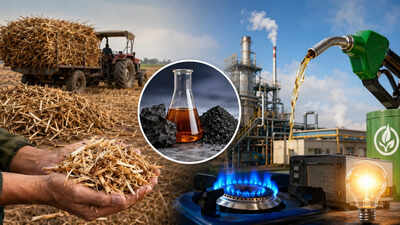
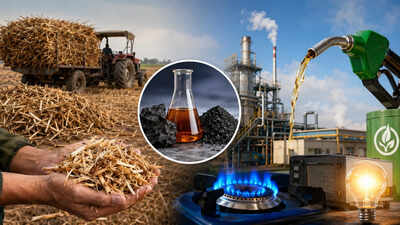
MUMBAI: The recent conflict in West Asia, which rattled global energy markets and renewed concerns over the security of oil supplies through the Strait of Hormuz, has once again highlighted India’s dependence on imported crude.While oil prices have eased after the end of the conflict, the episode has reinforced a larger question: can India insulate itself from future geopolitical shocks?One answer, according to researchers at Mumbai’s Institute of Chemical Technology, may lie not beneath the ground but in the country’s vast quantities of agricultural waste.Leading the effort is Prof. Jyeshtharaj Bhalchandra Joshi, whose team has spent years developing technology that converts crop residue into fuel gas, bio-oil and biochar — potentially addressing energy security, air pollution and farm incomes simultaneously.India produces an estimated 600 million tonnes of agricultural residue every yearA significant portion is burnt in fields, particularly in northern states, contributing to severe winter air pollution.Prof. Joshi argues that instead of treating the residue as waste, it can become a valuable source of clean energy.The technology relies on thermochemical conversion of biomass in an oxygen-controlled environment.As the material is heated, it releases combustible gases and bio-oil while leaving behind biochar, a carbon-rich material that can improve soil quality.Researchers say biochar has shown promising results in field trials.Experiments led by researcher Rohan Oak in the Sangli-Miraj region reportedly recorded soybean yield improvements ranging from 20% to 85%, while later studies indicated even higher gains under suitable conditions.Higher soybean production could also reduce India’s dependence on imported edible oils.The energy potential is equally significant. According to the research team, decentralised biomass processing plants could convert locally available agricultural residue into cooking fuel, electricity and industrial fuel.A processing unit serving a roughly seven-kilometre-by-seven-kilometre agricultural zone could utilise around 50,000 tonnes of annual biomass, enough to supply cooking gas for nearly 5,000 people while generating surplus energy for industry or power generation.To make the technology adaptable across India’s diverse agro-climatic regions, ICT researchers analysed biomass samples collected from across the country.Artificial intelligence was used alongside experimental data to predict conversion efficiencies for different crop residues, allowing plants to be designed for local feedstock.The research has progressed from laboratory-scale experiments to pilot plants. A 10-kg-per-hour unit was first developed and later installed in Jaipur under the guidance of Prof. Abhishek SharmaThis was followed by a 40-kg-per-hour plant, while Pune-based MITCON has commissioned a 200-kg-per-hour facility.The collaborative project also involves Prof. Vaidya, Prof. Manish Yadav of ICT and Prof. Sharma of BITS Goa.Another important breakthrough emerged during refinery trials. Researchers found that bio-oil could be blended with conventional crude oil and processed successfully at lower concentrations.Initial tests reportedly demonstrated satisfactory refining with 5% and 10% bio-oil blends.Challenges encountered at higher blending levels were addressed by introducing waste plastic into the feedstock, improving refining performance while also offering a productive use for plastic waste.The project has attracted support from government agencies. According to the researchers, the Maharashtra government, through the Rajiv Gandhi Science and Technology Commission, has committed financial assistance for scaling up the technology, while additional support is expected from the Centre for a larger demonstration plant in Gadchiroli, where bamboo biomass is abundantly available.Beyond energy security, the researchers see multiple gains: reducing stubble burning, lowering air pollution, improving soil fertility, generating additional income for farmers and cutting India’s import bill for fossil fuels and edible oils.Prof. Joshi is no stranger to indigenous innovation. Working with scientists from the Bhabha Atomic Research Centre, he earlier contributed to the development of lighter and more affordable indigenous bulletproof jackets, reducing dependence on imports.While the biomass technology still requires large-scale commercial deployment and further validation, the recent volatility in global oil markets has lent renewed urgency to such home-grown alternatives.For a country that has previously transformed agriculture, dairy production, telecommunications and space technology through sustained policy support, researchers believe converting farm waste into fuel could become India’s next major self-reliance story.